Ceiling Fan Direction: Which Way Should It Spin in Summer and Winter?
Counterclockwise in summer, clockwise on low in winter. How to check which way your fan spins, how to switch it on any fan, and how much it really helps.
By Cool Ceiling Ideas editorial teamUpdated 7 min read
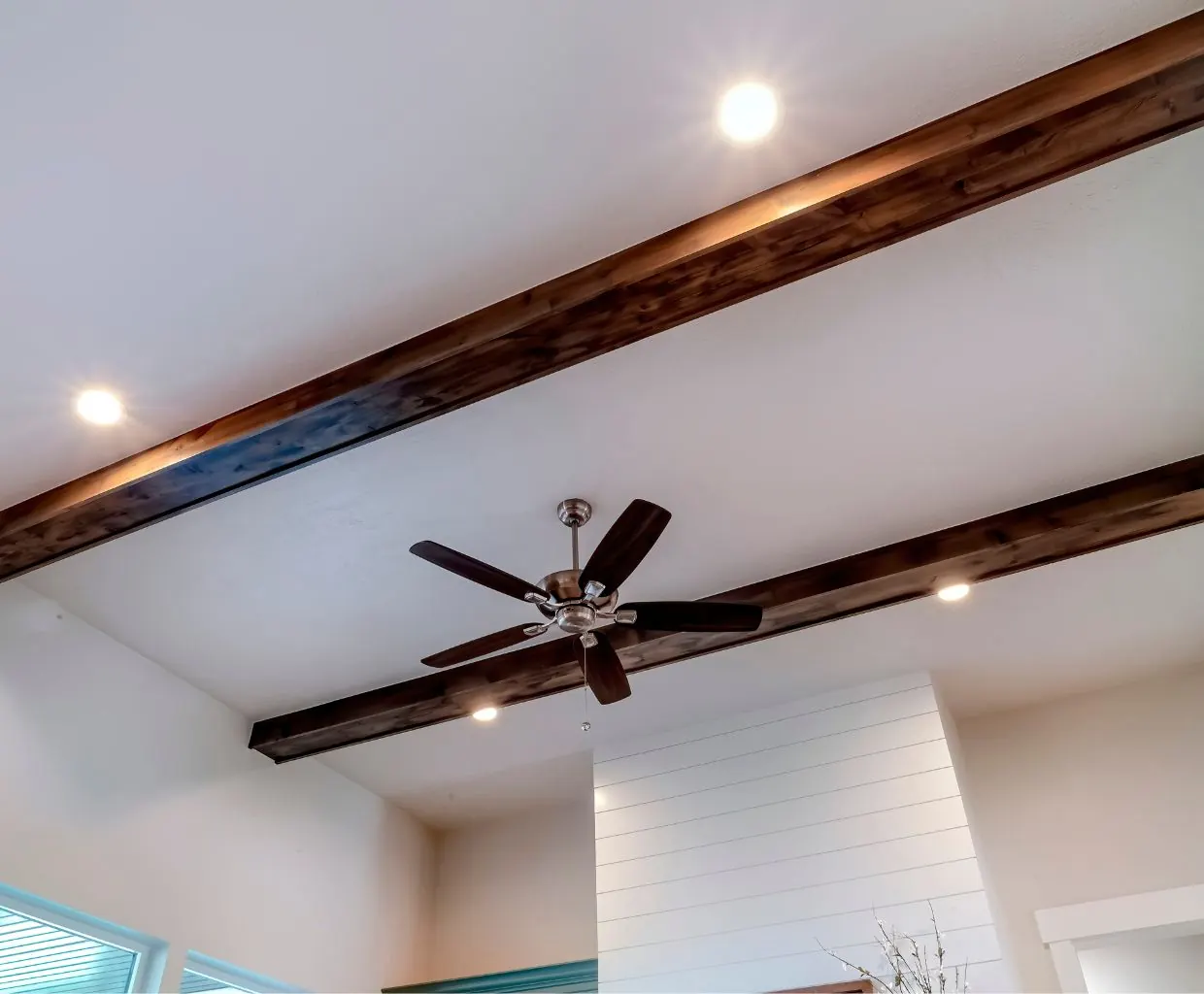
The short answer: in summer, run your ceiling fan counterclockwise (looking up at it) on medium or high, so it pushes air down and you feel a breeze. In winter, switch it to clockwise on the lowest speed, so it gently pulls air up and pushes the warm air near the ceiling back down the walls without a draft.
Tip: The direction that matters is the airflow, not the clock. Run the fan on medium and stand under it. A clear breeze means summer mode; almost no breeze means winter mode. This works on every fan, whichever way its blades are angled.
| Season | Direction (looking up) | Speed | What you should feel |
|---|---|---|---|
| Summer | Counterclockwise | Medium to high | A steady downward breeze |
| Winter | Clockwise | Lowest | Little or no breeze |
| Vaulted or very high ceilings, winter | Clockwise on low, or forward on the very lowest speed | Lowest | No draft at seat height |
How to tell which way your fan is spinning
Stand directly under the fan and look up while it runs on a low speed:
- Counterclockwise: the blades sweep from right to left in front of you.
- Clockwise: the blades sweep from left to right.
Then do the breeze test, because it’s the one that counts. Which way the air moves depends on how the blades are pitched: when the blade’s higher edge leads, it pushes air down. Most fans sold in the US are pitched so that counterclockwise pushes air down, which is why “counterclockwise in summer” is the standard advice. If your fan blows down when it spins clockwise, trust the breeze, not the rule.
Summer: counterclockwise for a cooling breeze
A ceiling fan doesn’t lower the temperature of a room. It cools you, by moving air over your skin so sweat evaporates faster (the wind-chill effect).
How much cooler does it feel? Research from UC Berkeley’s Center for the Built Environment puts it at roughly 4°F cooler for air moving at about 100 feet per minute, which is a gentle breeze. Even the lowest speed on many three-speed fans moves around 150 feet per minute directly underneath, which feels more than 5°F cooler.
That’s where the savings come from. Because you feel cooler, you can raise the thermostat a few degrees and stay just as comfortable. The US Department of Energy has long said that a ceiling fan lets you set the thermostat about 4°F higher with no loss of comfort. A fan uses a small fraction of the power of central air conditioning: in one set of lab tests, a 60-inch fan drew about 11.5 W on low and 30 W on medium.
To get the most out of it in summer:
- Run the fan counterclockwise on medium or high. If you can’t feel the breeze, turn it up.
- Raise the thermostat a couple of degrees at a time until you find your comfortable setting.
- Turn the fan off when you leave the room. Fans cool people, not rooms, so a fan in an empty room just wastes power. ENERGY STAR gives the same advice.
Winter: clockwise on low to move warm air down
Warm air rises, so in winter the warmest air in a room collects near the ceiling while your feet stay cool. Running the fan clockwise on its lowest speed pulls air up toward the ceiling. That pushes the warm layer out across the ceiling and down the walls, mixing it back into the room without blowing a draft on you. The Department of Energy and ENERGY STAR both recommend this setting.
Keep the speed low. On medium or high, even clockwise, the fan starts to create a draft, and moving air makes you feel colder, which defeats the purpose.
How much does winter mode really help?
Less than many articles claim, and it depends a lot on the room:
- Rooms with high or vaulted ceilings gain the most, because more warm air collects up high. The same goes for rooms heated by a wood stove or fireplace, and draughty or poorly insulated rooms.
- Typical rooms with 8 to 9 ft ceilings in a well-insulated home see only a small effect. In a 2015 Harvard study of rooms with 9 to 12 ft ceilings, a standard paddle fan on low raised the temperature near the floor by only about 0.3 to 1°F. Running it faster mixed the air better but caused drafts. The study was funded by fan maker Big Ass Solutions.
- “Save 15% on heating” claims have no study behind them. We couldn’t trace the widely repeated 10 to 15% (or 30%) figures to any government or peer-reviewed source. The building-science site Green Building Advisor calls them unsupported.
In short, winter mode is worth using in rooms you spend time in, especially tall ones. Don’t expect it to cut your heating bill dramatically.
High or vaulted ceilings
In tall rooms, either direction can mix the air if the fan runs slowly enough. The Center for the Built Environment’s ceiling fan design guide makes two points:
- Fans can destratify a room running forward or in reverse, but reverse takes more power to mix the same amount of air.
- Fans with airfoil-shaped blades work worse in reverse than fans with flat blades.
That’s why some retailers suggest leaving a fan in a vaulted room running forward all year: at that height, the breeze has slowed down by the time it reaches you. Our advice is to start with clockwise on low. If your fan has airfoil blades or a very low speed setting, try forward on its very lowest speed and keep whichever setting feels warmest at seat height without a draft.
How to change the direction on any ceiling fan
Every ceiling fan sold in the US has to be reversible, so yours can do it. How you switch it depends on the fan.
Fans with a switch on the motor housing (most AC fans)
- Turn the fan off and wait until the blades stop completely. Never flip the switch while the blades are turning.
- Use a sturdy step ladder, ideally with someone holding it.
- Find the small slide switch on the side of the motor housing, just above the blades. On some fans it’s hidden behind the light kit glass.
- Slide it to the other position, then turn the fan back on and do the breeze test.
The pull chain usually controls only speed and the light, not direction.
Fans with a remote or wall control
Look for a reverse button (often shown as two curved arrows). On some remotes you hold the fan button until the light blinks; Hunter remotes work this way. Check your fan’s manual.
Many cheap universal replacement remotes can’t reverse a fan, so if you’ve replaced the original remote, you may need to use the switch on the housing instead.
DC motor fans
DC fans often have no switch on the housing at all. You change direction from the remote’s reverse button or the fan’s app. See our AC vs DC ceiling fans guide for the differences.
Smart fans
Smart fans can switch direction from the app or by voice: for example Hunter’s HunterSMART app, or a Bond Bridge for fans with RF remotes. If you use automations or scenes, check that they don’t reverse the fan by accident; some Bond users report scenes switching direction unexpectedly. See our guide to the best smart ceiling fans.
When to switch
A simple way to remember it: “Spring forward, fall back.” Switch to counterclockwise when you start using the air conditioning in spring, and back to clockwise when you turn the heating on in fall. In mild climates where you don’t heat much, you can leave the fan counterclockwise all year and simply turn it off on cool days.
Room-by-room guide
| Room | Summer | Winter |
|---|---|---|
| Living room / family room | Counterclockwise, medium to high | Clockwise, low, when the room is in use |
| Bedroom | Counterclockwise, low to medium (quieter for sleep) | Clockwise, low, or off |
| Vaulted or high ceiling | Counterclockwise, medium to high | Clockwise on low, or forward on the very lowest speed (see above) |
| Kitchen | Counterclockwise, medium | Usually off; cooking already heats the room |
| Covered porch or patio | Counterclockwise, high (also keeps insects away) | Off |
Choosing a new fan for a bedroom? See quietest ceiling fans. For a room with a low ceiling, see low-profile ceiling fans. Not sure what size to buy? Our ceiling fan size calculator works it out from your room size and ceiling height.
Common myths
- “A fan cools the room.” It doesn’t change the air temperature; it cools the people in its breeze. Turn it off when nobody is there.
- “Winter mode heats your home.” It only moves warm air that’s already there. It won’t warm a room by itself.
- “Reversing your fan cuts your energy bill by 15 to 30%.” There’s no study behind these numbers. The real savings come in summer, from setting the thermostat higher.
- “Clockwise is always winter.” It is on most fans, but it depends on the blade pitch. The breeze test tells you for sure.
Frequently asked questions
Does reversing a ceiling fan really work in winter?
It helps a little, and most in rooms with high or vaulted ceilings. On low and clockwise, the fan mixes the warm air that collects near the ceiling back into the room without blowing on you. In a typical 8 to 9 ft room the effect is small, and you shouldn't expect big savings on your heating bill.
How do I tell if my ceiling fan is spinning clockwise or counterclockwise?
Stand under the fan and look up. If the leading edge of the blades moves from right to left, it's counterclockwise; left to right is clockwise. The more reliable check is the breeze: on medium, summer mode pushes air down so you feel it, while winter mode pulls air up so you feel little or nothing.
How do I know if my ceiling fan is set for summer or winter?
Run it on medium and stand underneath. If you feel a clear downward breeze, it's in summer mode. If you feel almost nothing, it's in winter mode. This works whichever way the blades are pitched.
Should I leave my ceiling fan on all the time in winter?
Only while the room is in use. Run it clockwise on the lowest speed when you're in the room and the heating is on, and turn it off when you leave. A fan doesn't warm the air; it only moves it.
Which way should a ceiling fan turn with the air conditioning on?
Counterclockwise (summer mode), so it blows air down on you. The breeze lets you set the thermostat a few degrees higher and still feel comfortable, which is where the savings come from. Turn the fan off in empty rooms.
Is it bad to sleep with a ceiling fan on all night?
For most people it's fine. A fan running all night can dry out your eyes, nose and skin and stir up dust, especially if the blades are dirty. Clean the blades regularly, use a lower speed or a timer, and use a humidifier if the air is dry.
Related guides
How-To
Ceiling Fan Wobble: Why It Happens and How to Fix It
Most wobbly fans need tightened screws and a balancing kit, not a new fan. Here's the fix in order, and the signs that wobble is a safety problem.
7 min read
Buying Guides
AC vs DC Ceiling Fans: Which Should You Buy?
DC fans use far less power, have more speeds and run quieter; AC fans cost less and keep things simple. Here's how to choose.
6 min read