Ceiling Fan Downrod Length: Chart by Ceiling Height
Which downrod length fits your ceiling height, the simple formula behind it, and what changes on sloped ceilings and with flush-mount fans.
By Cool Ceiling Ideas editorial teamUpdated 7 min read
In this article
The short answer: pick a downrod that puts the fan blades about 8 ft above the floor. On a 9 ft ceiling that’s usually the short rod in the box, on a 10 ft ceiling about 12 in, and on a 12 ft ceiling 36 in. Below 8 ft, skip the downrod and use a low-profile fan.
Ceiling fan downrod length chart
| Ceiling height | Downrod length | Where the number comes from |
|---|---|---|
| Under 8 ft | None: use a low-profile (hugger) fan | Hunter, ENERGY STAR |
| 8 ft | Flush mount or the short rod in the box | Big Ass Fans, Casablanca |
| 9 ft | The rod in the box (usually 3–6 in) | Hunter chart, ENERGY STAR |
| 10 ft | 12 in (Hunter’s chart allows 12–18 in) | Hunter chart |
| 11 ft | 18–24 in | Hunter chart |
| 12 ft | 36 in | Hunter chart |
| 13 ft | 48 in | Hunter chart |
| 14 ft | 60 in | Hunter chart |
| 15 ft | 72 in | Hunter chart |
| 16 ft | 84 in (two rods and a coupler) | Worked out from Hunter’s formula |
| 17 ft | 96 in | Worked out from Hunter’s formula |
| 18 ft | 108 in | Worked out from Hunter’s formula |
| 19 ft | 120 in | Worked out from Hunter’s formula |
| 20 ft | 120–132 in | ENERGY STAR lists 120 in; the formula gives 132 in |
Hunter’s own chart stops at 15 ft, and we couldn’t find a manufacturer chart that goes higher. The 16–20 ft rows are our arithmetic using Hunter’s formula below, with a 12 in fan and blades at 8 ft. Treat them as a starting point and check your fan’s manual. Our ceiling fan size calculator runs the same numbers for your exact ceiling height and also suggests a blade span.
The formula: work out any downrod length
Hunter’s method is simple:
Ceiling height − fan height − desired blade height = downrod length
- Ceiling height: measure floor to ceiling in inches (10 ft = 120 in).
- Fan height: the distance from the ceiling to the blades without a rod. It’s on the spec sheet. Home Depot says most fan housings are 8–12 in tall; 12 in is a safe default if you haven’t picked a fan yet.
- Desired blade height: 96 in (8 ft) is Hunter’s ideal and a good default.
Hunter’s example: a 12 ft ceiling (144 in) minus a 12 in fan minus 96 in leaves a 36 in downrod. If the answer is zero or negative, you don’t need a rod: use flush mounting or the short rod that comes with the fan.
Tip: Measure your fan’s real height before you order. A fan that’s 8 in tall instead of 12 in needs a rod about 4 in longer to land at the same blade height.
How high should the blades be?
Every source we checked agrees on the floor limit, and the ideal height is close. (Our ceiling fan height guide covers mounting height on its own.)
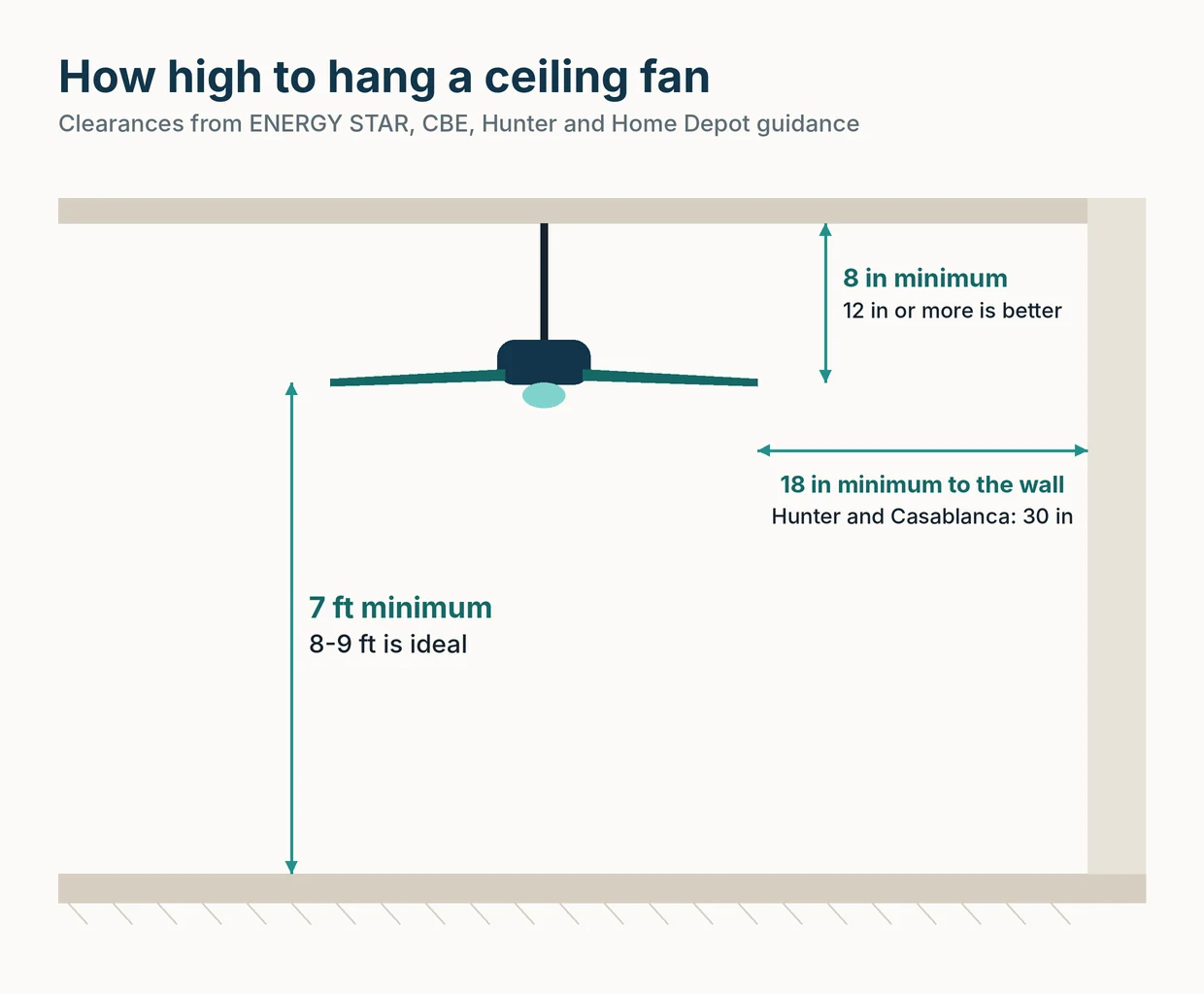
- Minimum: 7 ft from the floor to the bottom of the blades. ENERGY STAR, Hunter, Casablanca, Minka-Aire, Home Depot and UC Berkeley’s Center for the Built Environment (CBE) all use this figure.
- Ideal: 8–9 ft. ENERGY STAR says 8–9 ft gives the best airflow if your ceiling allows it. Hunter puts the ideal at 8 ft.
- From the ceiling: keep the blades at least 8 in below the ceiling. CBE says 12 in or more is better, because a fan too close to the ceiling is “starved” of air.
- From the walls: at least 18 in from blade tip to wall (ENERGY STAR); Hunter and Casablanca ask for 30 in.
In our view, aiming for 8 ft and accepting anything between 8 and 9 ft is the right call for most rooms. Going lower than 8 ft only makes sense on a low ceiling, where a low-profile ceiling fan is the better choice anyway.
Sloped and vaulted ceilings
On an angled ceiling, two things change: the mount has to handle the slope, and the blades need enough drop to clear the ceiling on the high side. Our guide to ceiling fans for sloped ceilings covers angle-mount fans in more depth.
Slope limits for the standard mount vary by brand and model:
| Brand | Standard mount works up to |
|---|---|
| Hunter | Under 32° |
| Casablanca | 34° (steeper needs an angled mounting kit) |
| Minka-Aire Supra | 20° |
| Minka-Aire Rainman | 18° |
Home Depot says ceilings angled 34–56° need a slope-mount or angle-mount fan. Above your fan’s limit, you need the maker’s angle-mount kit, sold separately.
Steeper ceilings also need longer rods. One manufacturer’s downrod sheet (hosted by Lowe’s; the part numbers point to Fanimation) gives a minimum rod by roof pitch:
| Roof pitch | Angle | Minimum downrod |
|---|---|---|
| 1/12 | 4.8° | Standard rod |
| 2/12 | 9.5° | 6 in |
| 3/12 and 4/12 | 14.0° and 18.4° | 12 in |
| 5/12 and 6/12 | 22.6° and 26.5° | 18 in |
| 7/12 and 8/12 | 30.3° and 33.7° | 24 in |
| 9/12 to 12/12 | 36.9° to 45.0° | 36 in |
Use whichever is longer: the slope minimum or the length from the height chart. Then check that the blades still sit at least 7 ft above the floor. A fan hung too close to a vaulted ceiling can also wobble; a Harbor Breeze manual lists a longer downrod as the fix. If yours already shakes, see our guide to ceiling fan wobble.
Are downrods universal?
No, and this is where most ordering mistakes happen.
- Diameters differ. ENERGY STAR says 1/2 in and 3/4 in are common, but they aren’t the only sizes.
- Threading differs. Hunter’s Original fans use a double-threaded rod made for that line, while many other Hunter fans use a single-threaded rod. So even within one brand, rods don’t always swap.
- Ratings and finish matter too. On a porch or patio, the rod should match the fan’s damp or wet rating, and you’ll want the same finish as the fan.
We’d buy the downrod the fan’s maker lists for your exact model, rather than a “universal” rod. Check the manual or the brand’s accessory page for the part number. If you shop online, search by brand and model:
Available on AmazonSearch ceiling fan downrodsSee today's price, ratings and delivery options
Check priceFlush-mount fans and downrods
A flush-mount (hugger) fan sits tight to the ceiling. The Department of Energy defines a hugger as a fan whose lowest blade point is 10 in or less from the ceiling. ENERGY STAR says huggers suit ceilings under 8 ft but move less air, because the blades are so close to the ceiling.
Can you add a downrod to one? Only if it’s a multi-mount fan, one that DOE recognizes as installable in both standard and hugger configurations. Its manual will show both setups. A fan sold for flush mounting only isn’t designed for a rod, and we’d skip any attempt to adapt one.
Going the other way works on many standard fans: Casablanca’s manuals offer a shorter rod for close-to-ceiling mounting, and the same downrod sheet lists a close-to-ceiling kit. If you’re choosing between styles, our ceiling fan size guide explains how mount type affects airflow.
Ceilings over 15 ft: couplers and very long rods
Single rods on the charts we found top out at 72 in. For anything longer, the downrod sheet says to join two rods with a coupler. ENERGY STAR lists extended downrods from 6 in (for a 9 ft ceiling) up to 120 in (for a 20 ft ceiling). Big Ass Fans sells rods from 7 to 60 in for its own fans.
Our advice for very tall rooms:
- Use the coupler and rods your fan’s maker specifies, not parts mixed from different brands.
- Make sure everything is tight. Hunter lists a loose or wrong-length downrod among the causes of wobble, and a long rod magnifies any looseness.
- Consider a bigger fan. CBE suggests large spaces with ceilings of 11 ft or more look at large-diameter fans (over 7 ft across).
Important: A longer downrod puts more leverage on the mount. The fan must hang from a fan-rated box marked for fan support, secured to the framing, and the power must be off at the breaker while you work. If you’re not sure your box is fan-rated, or the wiring doesn’t match the manual, hire a licensed electrician.
Frequently asked questions
What size downrod do I need for a 10 ft ceiling?
About 12 in. Hunter's chart gives 12 to 18 in for a 10 ft ceiling, and the formula (120 in minus a 12 in fan minus 96 in) gives 12 in, which puts the blades about 8 ft above the floor.
How low should a ceiling fan hang?
The blades must be at least 7 ft above the floor, and ENERGY STAR says 8 to 9 ft gives the best airflow. Keep the blades at least 8 in below the ceiling, and 12 in or more if you can.
Are ceiling fan downrods universal?
No. Diameters (often 1/2 or 3/4 in) and threading differ between brands and even between lines from the same brand. Buy the downrod your fan's maker lists for your model.
Can you put a downrod on a flush mount ceiling fan?
Only if the fan is a multi-mount model whose manual lists a downrod option. A fan sold for flush mounting only is built to sit against the ceiling without a rod.
What is the longest downrod you can use?
Single rods on the charts we found go up to 72 in. Past that, two rods are joined with a coupler, and ENERGY STAR lists extended downrods up to 120 in for a 20 ft ceiling.
How do you measure for a ceiling fan downrod?
Measure floor to ceiling in inches, then subtract the fan's own height (on the spec sheet; 12 in is a safe default) and your target blade height of 96 in. The result is the downrod length; zero or less means you don't need one.
Related guides
Buying Guides
Ceiling Fan Height: How High to Hang a Ceiling Fan
The 7 ft minimum, the 8 to 9 ft sweet spot, ceiling and wall clearances by source, and which mount and downrod fit your ceiling height.
9 min read
How-To
Ceiling Fan Wobble: Why It Happens and How to Fix It
Most wobbly fans need tightened screws and a balancing kit, not a new fan. Here's the fix in order, and the signs that wobble is a safety problem.
8 min read
How-To
Ceiling Fan Speeds: Which Setting to Use for Summer, Winter and Sleep
What low, medium and high really do, which ceiling fan speed to use in summer, winter and at night, and how speed changes watts, cost and noise.
8 min read

How-To
Best Ceiling Fan Remote Kits (2026): Universal and Brand Remotes
Universal and brand remote kits compared: what fits your fan, why DC fans need their own remote, reverse and dimming limits, and pairing.
10 min read
How-To
Best Ceiling Fan Dusters (2026) for Every Ceiling Height
Ceiling fan dusters and extension poles from OXO, Swiffer, Unger, DocaPole and Quickie, matched to your ceiling height, plus how to dust safely from the floor.
6 min read