Ceiling Fan Styles: A Guide to Modern, Farmhouse, Vintage and More
Eight ceiling fan styles explained: what defines each look, which rooms it suits, one real example, and how to match fan finishes to your fixtures.
By Cool Ceiling Ideas editorial teamUpdated 9 min read
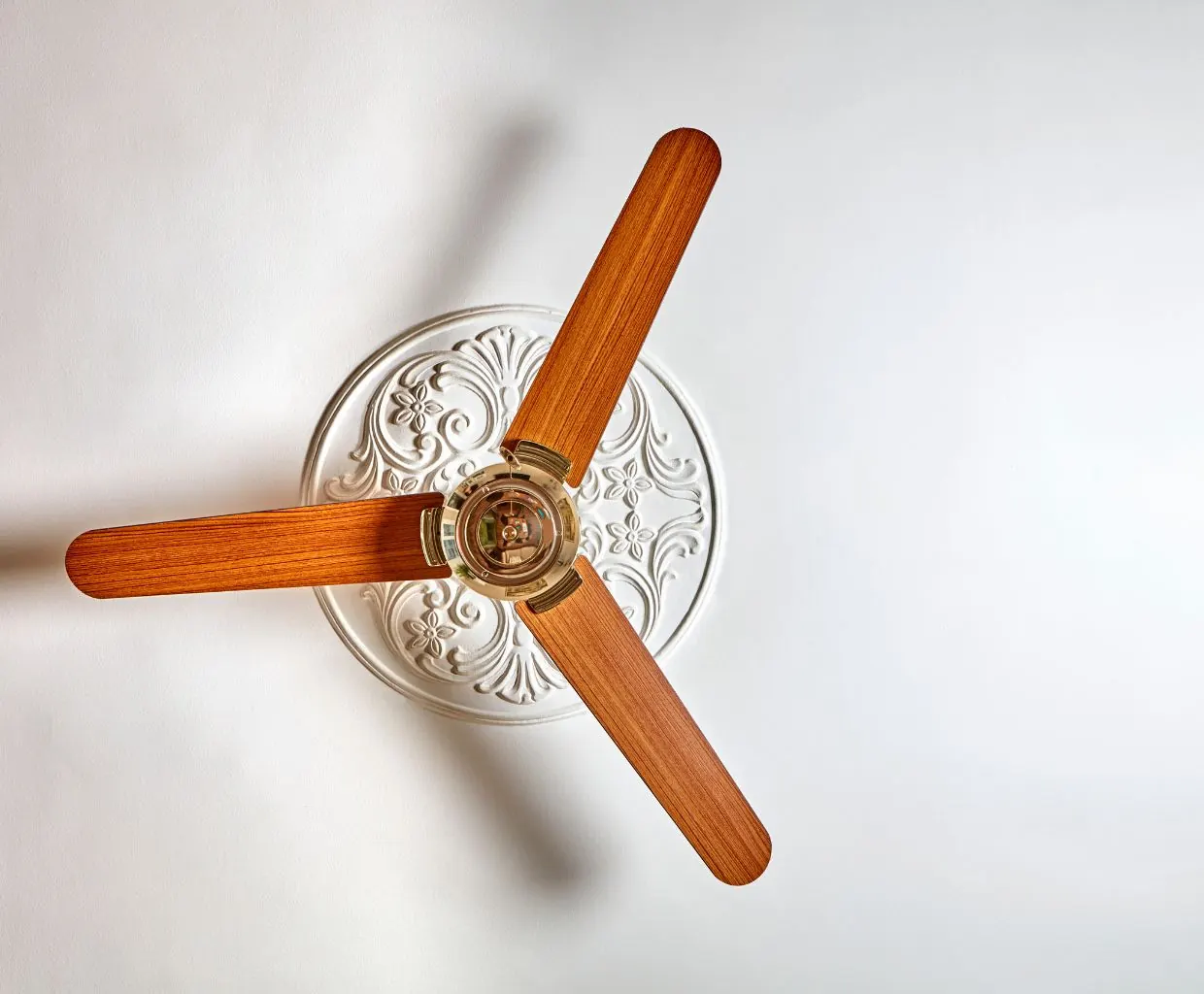
Most ceiling fan styles fall into eight families: modern/minimal, farmhouse, industrial, vintage/traditional, ornate, wood-blade, gold/brass and tropical. Pick the style that matches the room’s existing metals and woods, then check size and location rating, because a fan that looks right but is too small or not rated for a porch is still the wrong fan.
Quick style picker
If you’re not sure where to start, let the room decide:
- Lots of brushed nickel, chrome or white: a modern/minimal fan, or a white fan that blends into the ceiling.
- Wood floors, shiplap or open shelving: farmhouse or wood-blade.
- Exposed brick, ductwork or concrete: industrial or caged.
- Older house with trim and crown molding: vintage/traditional, or ornate in formal rooms.
- Warm metals and mid-century furniture: gold or brass.
- Sunroom, porch or coastal decor: tropical, with a damp or wet rating to match the spot.
Ceiling fan styles at a glance
| Style | What defines it | Rooms it suits | Example |
|---|---|---|---|
| Modern / minimal | Simple shapes, few details, matte or brushed metal | Living rooms, lofts, offices | Modern Fan Co. Ball 52 |
| Farmhouse | Weathered wood tones, bronze or black, schoolhouse-style lights | Kitchens, family rooms, bedrooms | Hunter Crestfield 52 |
| Industrial | Exposed hardware, dark or brushed metal, cages | Lofts, basements, garages | Hunter Sentinel 60 |
| Vintage / traditional | Classic housing, four or five wood-tone blades | Older homes, porches, dens | Hunter Original 52 |
| Ornate | Carved, cast or scrolled details | Formal rooms, period homes | Hunter 1886 Limited Edition 60 |
| Wood-blade | Real or wood-look blades as the focal point | Bedrooms, great rooms | Modern Fan Co. Arbor DC 54 |
| Gold / brass | Warm metallic housing | Dining rooms, glam or mid-century rooms | Minka Aire Molino 65 |
| Tropical | Palm-leaf, bamboo or wicker-look blades | Sunrooms, porches, coastal homes | Hunter Bayview 54 |
Modern and minimalist
Modern fans strip things back: a smooth motor housing, slim blades, no decorative trim and finishes like brushed aluminum, matte black or white. Many hide the light inside a flat LED disc rather than a glass bowl. They suit open-plan living rooms, lofts and home offices. If you want to take the idea further, look at bladeless ceiling fans, which hide or enclose the blades entirely.
Example: Modern Fan Co. Ball 52. A die-cast aluminum body in Brushed Aluminum or Gloss White, with aluminum, white or maple blade colors. It’s an AC fan rated at 4,401 CFM on high at 63.04 W, ETL listed for dry and damp locations, and ships with 6 in. and 16 in. downrods. An LED light is optional. The motor warranty is lifetime in dry locations and 10 years in damp ones. It’s also made in a 42 in. size and as the Ball Flush for low ceilings.
Check the Modern Fan Co. Ball 52 on Amazon
Farmhouse
Farmhouse fans mix wood or weathered-wood blades with bronze, black or brushed nickel, and often a light kit with seeded or opal glass. The look is relaxed and a little rustic. It fits kitchens, family rooms and bedrooms, especially with wood floors or shiplap.
Example: Hunter Crestfield 52. Hunter describes it as having “subtle farmhouse and vintage details.” It has a 3-light LED fixture and comes in Noble Bronze, Brushed Nickel, Fresh White or Matte Silver, with Bleached Grey Pine, Fresh White or Light Gray Oak blades. Its EnergyGuide label lists 3,552 CFM at 47 W. It’s indoor only, runs on pull chains and costs around $240. A 42 in. low-profile Crestfield is also sold.
Check the Hunter Crestfield 52 on Amazon
For a big farmhouse great room or porch, the Minka Aire Barn H2O 84 in. scales the look up: 10 barnwood-look ABS blades, a wet rating and 12,402 CFM on high.
Industrial
Industrial fans borrow from factories and workshops: exposed screws, metal blades or cages, dark bronze, black or brushed nickel, and bare-bulb lights. They work in lofts, basements and converted spaces with exposed ductwork. Our guide to caged ceiling fans covers the most industrial version of the look and its airflow trade-off.
Example: Hunter Sentinel 60. Hunter tags it Farmhouse, Industrial and Modern, which is a fair summary. It has three blades, a Brushed Nickel housing, reversible Light Gray Oak / Greyed Walnut blades and two 9 W LED bulbs. A handheld remote is included, and the three-position mount covers regular, low and angled ceilings. The EnergyGuide label lists 3,602 CFM at 52 W. Indoor only.
Check the Hunter Sentinel 60 on Amazon
Vintage and traditional
This is the fan most people picture: a rounded metal housing, four or five wood-tone blades and a pull chain. Traditional fans suit older homes, dens, libraries and screened porches. In our view, it’s the style least likely to look dated in ten years.
Example: Hunter Original 52 (Outdoor). Hunter, founded in 1886, still sells its Original with a cast-iron housing and what Hunter describes as an oil-bath AC motor. The 52 in. outdoor version is damp-rated for covered porches and screened patios, not for spots rain can reach. Its EnergyGuide label lists 4,710 CFM at 54 W. Finishes include Matte Black with Walnut blades, White, Chestnut Brown with Cherry and Matte Silver with Barnwood. It’s heavy: Hunter says it must be mounted directly to the building structure, and Original fans use their own double-threaded downrods. Expect to pay around $750.
Check the Hunter Original 52 on Amazon
If you like the traditional look but want a DC motor, the Casablanca Panama DC 54 is ENERGY STAR certified and comes with a remote and six speeds.
Ornate
Ornate fans add carving, cast detail, scrollwork or decorative glass. They belong in formal living and dining rooms and period homes where the ceiling has its own detail, like a plaster medallion or crown molding. We’d skip them in small, plain rooms, where they can look out of scale.
Example: Hunter 1886 Limited Edition 60. Two carved basswood blades in Distressed Dark Cherry and a sand-cast motor housing in Midas Black. It’s an indoor, dry-rated AC fan with a pull chain, three speeds and a 12 in. downrod included. It costs around $900, and Hunter’s store listed it as out of stock in October 2026.
Check the Hunter 1886 Limited Edition on Amazon
For a traditional, more decorative fan that can also go outdoors, the Minka Aire Gauguin 52 sits in Minka’s Traditional collection and is wet-rated.
Wood-blade
Here the blades are the feature. The key question is whether they’re real wood or a wood-look finish. Many wood-tone blades are molded ABS with a wood-look finish, like the barnwood blades on the Minka Aire Barn H2O. Real wood looks richer up close but needs gentler care, and warranties on blades can be short: Quorum and Sea Gull cover blades and finishes for 90 days, and Progress Lighting excludes blade warping.
Example: Modern Fan Co. Arbor DC 54. Solid wood blades in Ebony, Graywash, Mahogany, Maple or Whitewash on a die-cast aluminum body. It has a 6-speed reversible DC motor and is rated at 5,312 CFM on high at 30.68 W. It’s ETL listed for dry and damp locations, but the manual warns that a damp rating isn’t a promise the finish will hold up. An Arbor Flush DC is available for low ceilings, and you can see more flush options in our low profile ceiling fans guide.
Check the Modern Fan Co. Arbor DC on Amazon
Tip: Hunter notes that teak-bladed Hunter Original fans may need an occasional oil treatment. Check your manual before using any product on real wood blades.
Gold and brass
Gold, soft brass and antique brass housings warm up a room. Brushed or soft brass reads modern and mid-century, while polished brass leans traditional. Brass works well in dining rooms and bedrooms with other warm metals.
Example: Minka Aire Molino 65 (Soft Brass). A 65 in. DC fan with three Seashore Grey ABS blades, a 20 W dimmable LED with an etched opal shade and a handheld remote. Minka lists 7,166 CFM on high at 45.1 W. It shows a wet-location rating, so it works on open patios as well as indoors. It’s also sold in Burnished Nickel and Coal Black.
Check the Minka Aire Molino on Amazon
Note: Brass outdoors needs care. Matthews Fan Company’s spec sheets note that some finishes, such as polished brass, are damp-rated only with a protective powder or clear coat.
Tropical
Tropical fans use palm-leaf, bamboo, rattan or wicker-look blades, often on a bronze or rust-finish motor. They suit sunrooms, porches and coastal or British-colonial rooms.
Example: Hunter Bayview 54. Palm-leaf blades in Antique Dark on a Provencal Gold housing, or all white. It’s a damp-rated AC fan for covered porches, with a pull chain and three speeds. Hunter lists 5,314 CFM on high at 44 W. It costs around $270, though Hunter’s own store showed it out of stock in October 2026.
Check the Hunter Bayview 54 on Amazon
Are ceiling fans outdated?
Our view: no, but a lot of old ceiling fans are. What dates a fan is usually the details, like a shiny finish nobody uses anymore, a frosted-glass light kit or a wobble that never got fixed. The fan itself isn’t the problem.
Current fans have moved on in a few ways:
- Cleaner designs. Minimal housings, integrated LEDs, and fans that sit almost flush to the ceiling.
- Better motors. DC motors are quieter and usually offer more speeds. ENERGY STAR says certified fans are up to 44% more efficient than conventional models.
- Remote and smart control. Many fans now come with a remote, and some work with Alexa, Google Home or Apple Home.
We’d replace a fan that looks dated rather than remove it. As ENERGY STAR puts it, fans cool people, not rooms, and that’s as true of a sleek DC fan as a classic one.
How to match fan finishes to your fixtures
A fan reads as part of the room’s lighting, so a few rules keep it looking intentional:
- Match the housing to your main metal. Look at the light fixtures, door hardware and faucets nearby. If they’re brushed nickel, a brushed nickel or white fan blends in. If they’re black or bronze, go dark.
- Use the blades to tie into wood. Match blade tone to the floor or furniture for a calm look, or contrast it on purpose. Reversible blades, like the Sentinel’s oak/walnut set, give you two options.
- Decide whether the fan should disappear. A white fan on a white ceiling fades into the background. A black or brass fan becomes a feature.
- Match the light to the room. In kitchens, the fan’s light often needs to do real work. Our guide to kitchen ceiling fans with lights covers that.
- Check the rating before the look. Covered porches need at least a damp rating, and spots that rain can reach need a wet rating. See our outdoor ceiling fans guide.
Whatever style you choose, get the size right first. Our ceiling fan size calculator suggests a blade span from your room’s dimensions and ceiling height. If you’re comparing makers on warranty and parts, our best ceiling fan brands guide does the side-by-side.
Important: Turn off power at the breaker before replacing a fan, hang it from a fan-rated ceiling box or the building structure, and follow the manual and local code. Heavy fans like the Hunter Original need structural mounting. Hire a licensed electrician if you’re unsure.
Frequently asked questions
What ceiling fan style is most timeless?
In our view, a simple traditional fan with wood or wood-look blades and a plain metal housing ages best, because it doesn't lean on a passing trend. Hunter's Original design is the classic example.
Are ceiling fans outdated?
We don't think so. Dated finishes and fussy light kits can look tired, but current fans come in clean modern shapes, often with DC motors, remotes and smart controls.
Should a ceiling fan match the light fixtures in the room?
It doesn't have to match exactly, but the fan housing should sit in the same metal family as the room's main fixtures and hardware. Blades can then match or contrast the floor and furniture.
Are wood ceiling fan blades real wood?
Often not. Many wood-look blades are molded ABS, such as the barnwood-look blades on the Minka Aire Barn H2O. Real-wood options exist, like the solid wood blades on the Modern Fan Co. Arbor DC and the carved basswood blades on the Hunter 1886 Limited Edition.
Can I put an outdoor ceiling fan indoors?
Yes. Hunter notes that outdoor-rated fans can also be used indoors, which widens your style choices for kitchens, sunrooms and covered porches that connect to living spaces.
What color ceiling fan looks best on a white ceiling?
It depends on whether you want the fan to disappear or stand out. A white fan on a white ceiling fades into the background, while a black, bronze or brass fan becomes a feature. Either way, match the housing to the room's main metal.
Related guides
Ceiling Fans
Caged Ceiling Fans: Industrial Style, Kids' Rooms and 5 Picks
Most caged ceiling fans only cage the light. What a cage really does, where these fans make sense, how to clean them, and five verified picks.
7 min read
Ceiling Fans
Best Outdoor Ceiling Fans in 2026: Damp vs Wet Rated Picks
Damp-rated fans belong under a solid roof; wet-rated fans can take rain. Six picks for porches, pergolas and the coast, plus the warranty fine print.
11 min read
Ceiling Fans
Best Ceiling Fans Without Lights (2026): Fan-Only Picks
Fan-only ceiling fans for rooms with recessed lighting, high ceilings, bedrooms and porches, including models you can add a light kit to later.
7 min read
Ceiling Fans
Best Low Profile Ceiling Fans in 2026 for Low Ceilings
Hugger fans for ceilings under 8 ft: how low each one sits, how much air it moves, and which to pick for small, standard and large rooms.
12 min read