Best Ceiling Fans for Kids' Rooms in 2026: Safe, Simple Picks
Low-profile, remote-controlled and enclosed-blade fans for kids' and teens' bedrooms, plus the height, clearance and mounting rules that keep them safe.
By Cool Ceiling Ideas editorial teamUpdated 9 min read
Our picks at a glance
- Check price on Amazon
Best overall
Hunter Dreska 44 in. Low Profile
A flush-mount fan with a remote and a dimmable, tunable-white LED, so nothing dangles within reach.
- 44 in. blades
- 9.21 in. ceiling-to-blade
- Remote, dimmable LED
- Check price on Amazon
Best budget
Eleve Comfort 44 in. Low Profile M1
A DC motor, six speeds and a dimmable light on the remote at a budget price.
- 44 in. blades
- DC motor, 6 speeds
- Dimmable LED
- Check price on Amazon
Best for shared rooms
A 52 in. hugger with a remote and a light that dims from 10 to 100% for bigger or shared bedrooms.
- 52 in. blades
- Flush mount
- Dimmable 10-100%
- Check price on Amazon
Best enclosed-blade fan
Progress Lighting Gulliver 23 in.
Progress says the blades sit inside a three-band cage, the closest thing to a guarded ceiling fan.
- 23 in. blades
- Blades inside cage
- Remote, dimmable
- Check price on Amazon
Best smart fan for teens
Hunter ZenTech 44 in. Smart Fan
A DC smart fan with app and voice control for teens' rooms with taller ceilings.
- 44 in. blades
- DC motor, 6 speeds
- App + voice
Prices change often; Amazon shows the current price. As an Amazon Associate, Cool Ceiling Ideas earns from qualifying purchases.
The short answer: the best ceiling fans for kids’ rooms sit tight to the ceiling, run from a remote instead of pull chains, and have a dimmable light so the fan can be the room’s only fixture. Our pick is the Hunter Dreska 44 in. Low Profile: its blades sit 9.21 in below the ceiling, and the remote handles speed and a dimmable, tunable-white LED. On a budget, the Eleve Comfort 44 in. adds a DC motor for less. For an enclosed-blade design, the Progress Lighting Gulliver is the one to look at.
This guide covers kids’ and teens’ bedrooms in general. If the room has a bunk or loft bed, read our guide to ceiling fans for bunk beds first, and for a baby’s room see our nursery ceiling fans picks.
Safe height and clearance come first
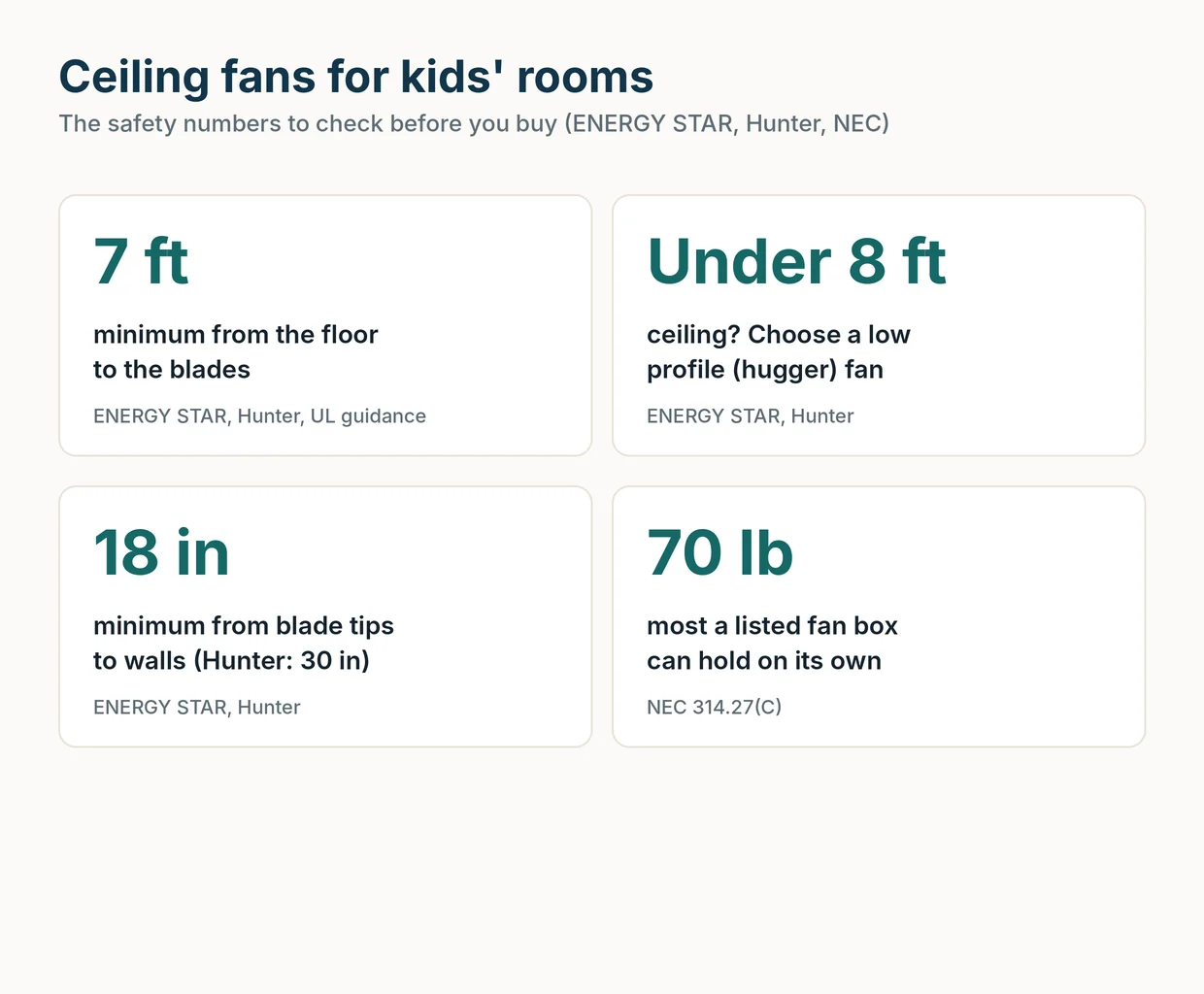
Every fan manual in our research sets the same floor: at least 7 ft from the floor to the bottom of the blades. ENERGY STAR adds that the fan should sit in the middle of the room, at least 18 in from walls, and that 8 to 9 ft gives the best airflow if the ceiling allows. Hunter asks for more room to the sides: 30 in from the blade tips to the nearest wall or obstruction, which it describes as a UL and ETL guideline.
In a child’s room, “obstruction” includes the furniture kids climb on. A 2023 Pediatrics study based on CPSC emergency-room data estimated about 2,300 pediatric head injuries a year from contact with ceiling fans. Toddlers were usually hurt when an adult lifted them toward a spinning fan; older kids, when jumping off bunk or loft beds. The researchers’ advice is simple: keep beds and other furniture away from the fan, and don’t lift children up toward it.
- Measure from the floor to where the blades will spin, not to the ceiling.
- Keep beds, dressers, desks and shelves out of the blade sweep.
- On a ceiling under 8 ft, Hunter and ENERGY STAR both point you to a low-profile (hugger) fan.
- From 9 ft up, Hunter says a downrod fan is the better choice.
Our ceiling fan height guide walks through the math for every ceiling height.
Important: A ceiling fan needs an electrical box marked as acceptable for fan support. Hunter’s manual calls for a box marked for 70 lb (31.8 kg) or mounting to the building structure, and most boxes installed for light fixtures don’t qualify. Turn off power at the breaker before any work, follow the manual and local code, and hire a licensed electrician if you’re unsure. Our fan-rated box guide shows how to check yours.
How we chose
We don’t test fans. We started from the current models in our research files, drawn from manufacturer spec sheets, product pages and the ENERGY STAR certified-fan database, and looked for features that matter in a kid’s room: a flush mount or a guarded design, a remote or wall control instead of pull chains, and a dimmable light. We left out discontinued and clearance models and gave the bunk-bed, nursery and caged guides their own picks, so this list leans toward everyday kids’ and teens’ bedrooms. Specs are the makers’ own; the Amazon links are searches, and we haven’t confirmed Amazon stocks each model.
Ceiling fans for kids’ rooms compared
| Fan | Blade span | Mount | Controls | Light |
|---|---|---|---|---|
| Hunter Dreska | 44 in | Flush, 9.21 in to blades | Remote | 22 W LED, dimmable, 3000-5000 K |
| Eleve Comfort M1 | 44 in | Flush, 8.23 in to blades | Remote, 6 speeds | 18 W LED, dimmable, 3000/4000/6000 K |
| Prominence Home Espy | 52 in | Flush | Remote | 18.5 W LED, dimmable 10-100% |
| Progress Lighting Gulliver | 23 in | Dual-mount canopy, 18.1 in tall | Remote | 3 dimmable LED bulbs |
| Hunter ZenTech 44 | 44 in | Downrod (6 in included) or angled | Remote, app, voice | 25 W LED, tunable 3000-5000 K |
The best ceiling fans for kids’ rooms
Hunter Dreska 44 in. Low Profile
Who it’s for: a typical kids’ bedroom with an 8 ft ceiling, where the fan is also the main light.
The Dreska is one of Hunter’s newer low-profile fans. Its blades sit 9.21 in below the ceiling and the whole fan is 12.36 in deep. The remote runs three speeds and an integrated 22 W LED that dims and switches between 3000 and 5000 K, so you get warm light at bedtime and cooler light for homework. Hunter publishes 3,972 CFM on high at 39 W, the most airflow of the 44 in. fans here. The motor carries Hunter’s limited lifetime warranty and the light kit three years. It’s around $200 at hunterfan.com, in matte black, fresh white or brushed nickel.
The trade-off: the motor is AC, and reverse isn’t on the remote. Our math: on an 8 ft ceiling the blades sit about 7 ft 2.8 in above the floor, and the light hangs just under 7 ft, so center it over open floor, not a walkway a tall adult uses.
Check the Hunter Dreska on Amazon
Eleve Comfort 44 in. Low Profile M1
Who it’s for: parents who want a quiet DC motor and a dimmable light without a premium price.
Sold by Hunter Fan Co., the Eleve Comfort is a DC fan with six speeds, reverse on the remote and an 18 W LED that dims and switches between 3000, 4000 and 6000 K. Blades sit 8.23 in below the ceiling (10.15 in overall). Airflow on high is 3,411 CFM at 23 W. It’s around $110 at hunterfan.com. UC Berkeley’s Center for the Built Environment calls brushless DC the quietest of the common motor types, and more speeds mean a slower, quieter setting at night; see our quietest ceiling fans guide for more.
The trade-off: the warranty is two years on the DC motor and one year on parts, far shorter than Hunter-branded fans.
Check the Eleve Comfort 44 in. on Amazon
Prominence Home Espy 52 in.
Who it’s for: larger kids’ rooms, shared bedrooms and playrooms.
ENERGY STAR’s chart puts rooms of 225 to 400 sq ft at 50 to 54 in., and the Espy is a 52 in. three-blade hugger with a remote and three speeds. Its integrated 18.5 W LED dims from 10 to 100%, and that low end is useful as a soft light at bedtime. Prominence says it can work with Google Home or Alexa only through a separately sold Bond hub. It’s around $180 at prominencehome.com, in white, gun metal or matte black.
The trade-off: Prominence doesn’t publish airflow, wattage or a ceiling-to-blade figure, so you can’t check the 7 ft clearance from the spec sheet before buying. We’d measure after unboxing and before mounting.
Check the Prominence Home Espy on Amazon
Progress Lighting Gulliver 23 in.
Who it’s for: small rooms with taller ceilings, where you want the blades behind a guard.
Most “caged” fans only wrap the light. Progress says the Gulliver’s three blades sit inside a three-band cage, which is rare. It’s 23.5 in wide and 18.1 in tall, uses a dual-mount canopy, and is cETLus damp listed. A remote runs three speeds and three included, dimmable 5.5 W vintage LED bulbs. Airflow on high is 1,099 CFM at 32 W, which suits a small room. It’s around $600 at progresslighting.com.
The trade-off: it’s the most expensive fan here and the deepest. At 18.1 in tall, its bottom would hang about 6.5 ft above the floor on an 8 ft ceiling, so we’d only use it on a 9 ft ceiling or higher. Reverse isn’t on the remote, and a cage is not a reason to skip the 7 ft rule.
Check the Progress Lighting Gulliver on Amazon
Hunter ZenTech 44 in. Smart Fan
Who it’s for: teens’ rooms with 9 ft or taller ceilings, and kids who’d rather say “fan off” than find the remote.
The ZenTech is a DC smart fan that works with the HunterSMART app and with Alexa, Google and Siri/HomeKit, plus a handheld remote with six speeds and reverse. Hunter rates it for rooms up to about 100 sq ft. It’s ENERGY STAR certified, with 4,493 CFM on high at 21.3 W per ENERGY STAR’s record. A 6 in downrod is included, and the integrated 25 W LED puts out 2,000 lumens, tunable from 3000 to 5000 K. It’s damp rated and carries Hunter’s limited lifetime motor warranty. It’s around $380 at hunterfan.com.
The trade-off: it’s a downrod fan, not a hugger, so it doesn’t belong on an 8 ft ceiling. It also costs nearly twice as much as the Dreska.
Check the Hunter ZenTech 44 in. on Amazon
What to look for in a kids’ room fan
Remotes instead of pull chains
A pull chain is the one part of a fan built to be grabbed. In our view, kids’ rooms are better off with a remote or wall control, so nothing hangs from the fan. Hunter says its universal remote gives the same control as a wall unit from up to 40 ft away. Two things to know:
- The wall switch stays on. A remote-controlled fan won’t run if its wall switch is off, because the switch supplies the power.
- Store remotes out of reach. Hunter’s remote manual warns that a swallowed lithium coin battery can cause severe internal burns and death in as little as 2 hours.
Already have a pull-chain fan? Hunter says an add-on remote kit can control it, as long as the chains stay set to high and light on. A DC fan needs a remote made for that fan.
Flush mounts and caged or enclosed fans
On a ceiling under 8 ft, a flush mount is the only way to keep the blades 7 ft up; our low profile ceiling fans guide compares the lowest models. ENERGY STAR notes that huggers move less air because the blades sit close to the ceiling, so compare the airflow (CFM) on the EnergyGuide label.
Cages come in two kinds. On fans like the Gulliver the blades are enclosed; on most farmhouse “caged” fans only the light is. Read the product description before you count on a cage as a guard.
Tip: Use the ceiling fan size calculator with your room’s length, width and ceiling height. It suggests a blade span and tells you whether you need a flush mount or a downrod.
Durable blades and a fan that stays balanced
Kids’ rooms see thrown balls and stuffed animals. None of our research files lists blade materials for these picks, so we can’t rank them on toughness. What Hunter does say is that warped or bent blades are a common cause of wobble, and warped blades can’t be balanced and should be replaced. If something hits the blades, turn the fan off and check each blade for damage before you run it again. Dust on the blades also adds wobble, and Hunter suggests dusting every 1 to 3 months.
Night light and dimming
None of the fans in our research lists a separate night-light mode. The closest thing is a light that dims low from the remote: the Espy goes down to 10%, and the Dreska, Eleve Comfort and ZenTech also let you pick a warmer color temperature at bedtime. For a true all-night glow, we’d add a plug-in night light rather than leave a ceiling light on.
Note: A humming fan is often caused by a regular light dimmer on the fan circuit. Hunter recommends a plain on/off wall switch plus the fan’s own remote or fan control for dimming.
Themed vs timeless designs
Fans with cartoon blades or sports themes look great at age six and dated at twelve, and a fan is a wiring job to replace. We’d pick a plain white, black or nickel fan and bring the theme in with bedding, wall decals and lampshades, which change in minutes. A neutral fan also suits the room when it becomes a teen’s room, a guest room or an office.
Frequently asked questions
Are ceiling fans safe in a kid's room?
They can be, if the fan is installed correctly: blades at least 7 ft above the floor, at least 18 in from walls (Hunter says 30 in), on a box marked for fan support, and with beds and furniture kept out of the blade sweep. A 2023 Pediatrics study found older kids were most often hurt jumping off bunk or loft beds into a fan.
How high should a ceiling fan be in a child's bedroom?
The blades need at least 7 ft of clearance from the floor, and ENERGY STAR says 8 to 9 ft is ideal if the ceiling allows. On a ceiling under 8 ft, choose a low-profile (hugger) fan.
Is a remote better than a pull chain in a kids' room?
In our view, yes. A remote or wall control means there's nothing hanging from the fan to grab or swing on. Keep the remote out of small children's reach, since Hunter warns that swallowed coin batteries can cause severe internal burns.
What size ceiling fan is right for a kid's bedroom?
ENERGY STAR suggests 36 to 42 in. for rooms of 76 to 144 sq ft and 44 in. for 144 to 225 sq ft. A typical 10 x 12 ft kids' room is 120 sq ft, so a 42 or 44 in. fan is the usual choice.
Are caged ceiling fans safer for kids?
Only if the cage covers the blades. Progress says the Gulliver's blades sit inside its cage, but many caged-style fans only cage the light and leave the blades open. Either kind still needs the 7 ft rule.
Can kids control a smart ceiling fan?
Yes. Fans like the Hunter ZenTech work with an app and with Alexa, Google or Siri, so a teen can change speed or dim the light by voice. The wall switch still has to stay on for the fan to respond.
Related guides
Room Ideas
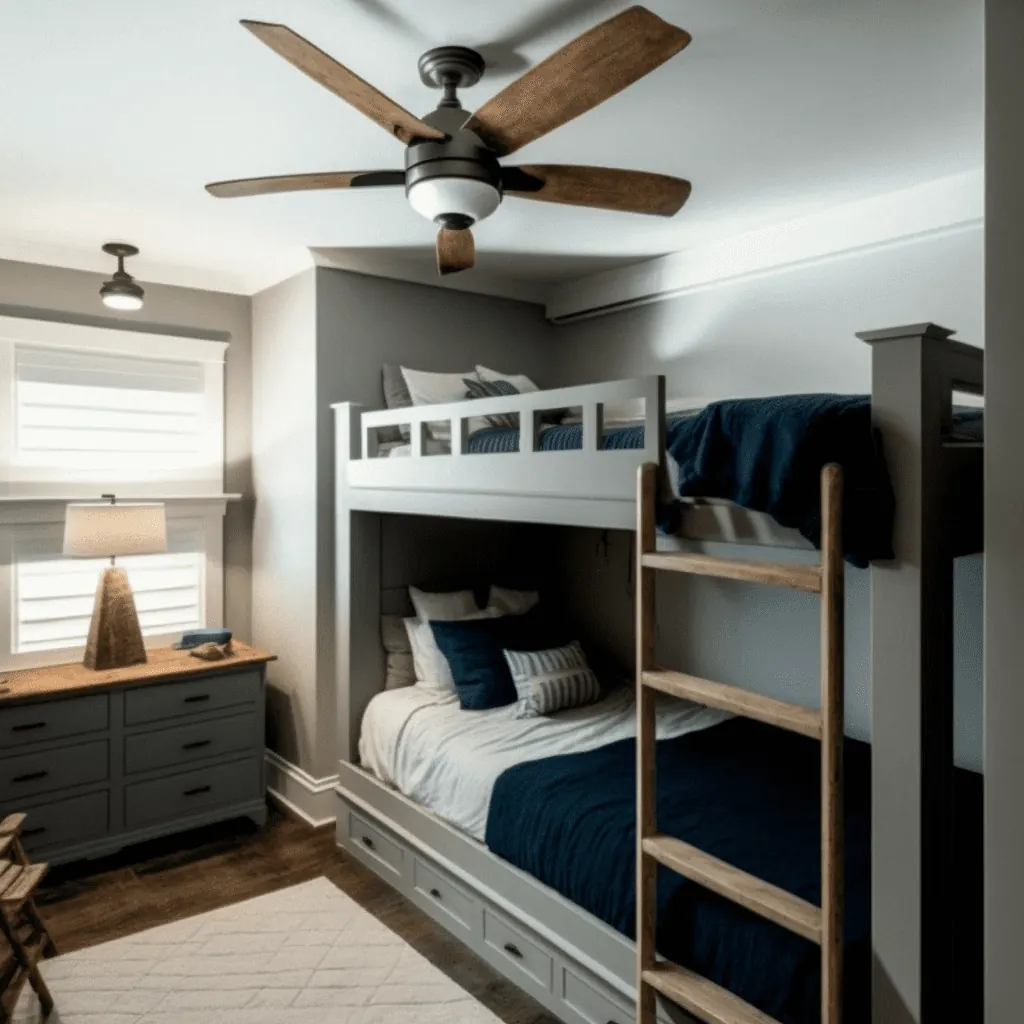
Ceiling Fans for Bunk Beds: Clearance, Placement and Safer Options
No ceiling fan is rated for use over a top bunk. How to measure, where to put the fan instead, and the caged, low-profile and clip-on fans worth a look.
9 min read
Room Ideas
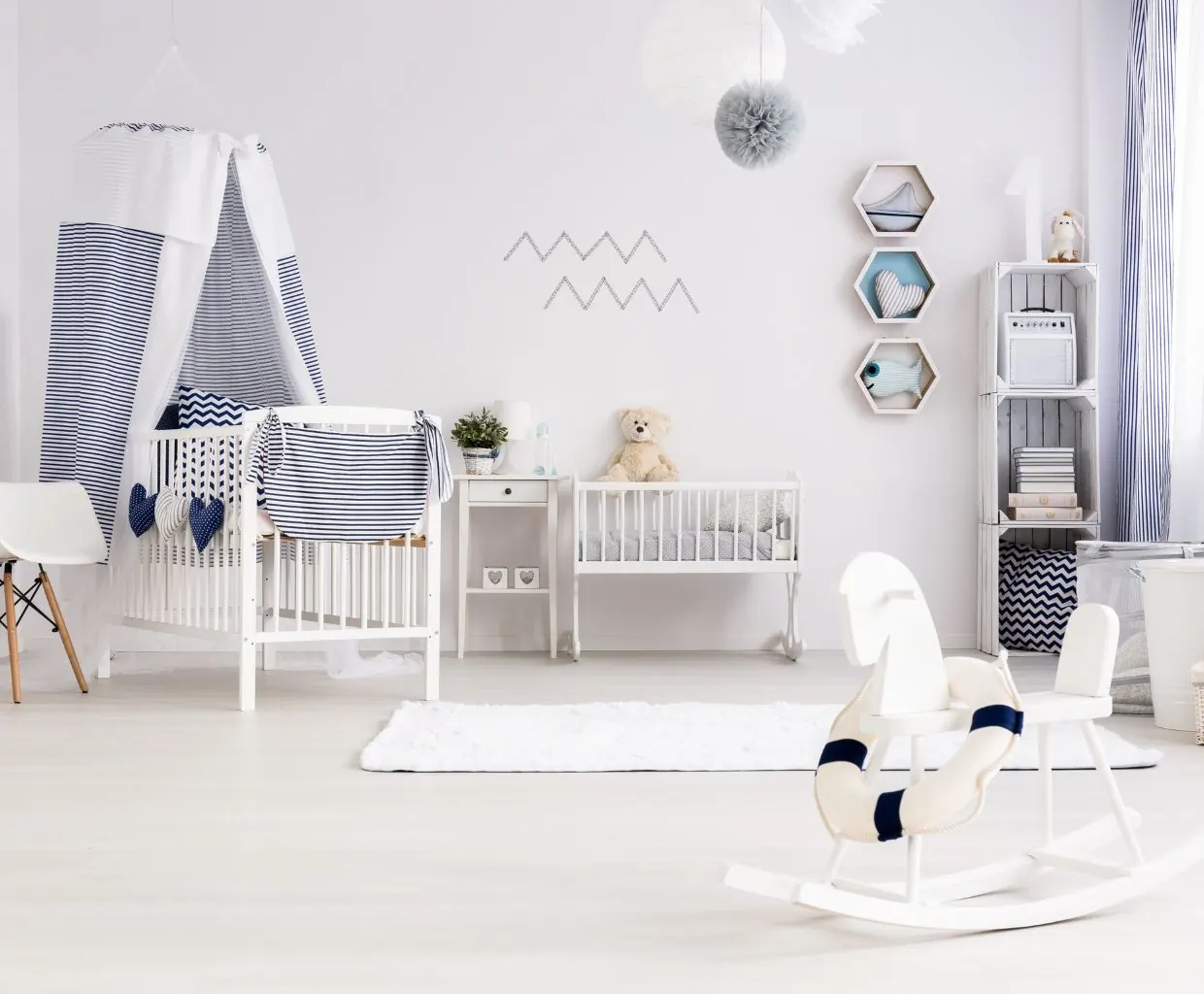
Best Nursery Ceiling Fans in 2026: Quiet, Safe Picks
Quiet DC and low-profile fans with dimmable lights and remotes for a baby's room, plus safe mounting, crib placement and what the AAP says about overheating.
9 min read
Room Ideas
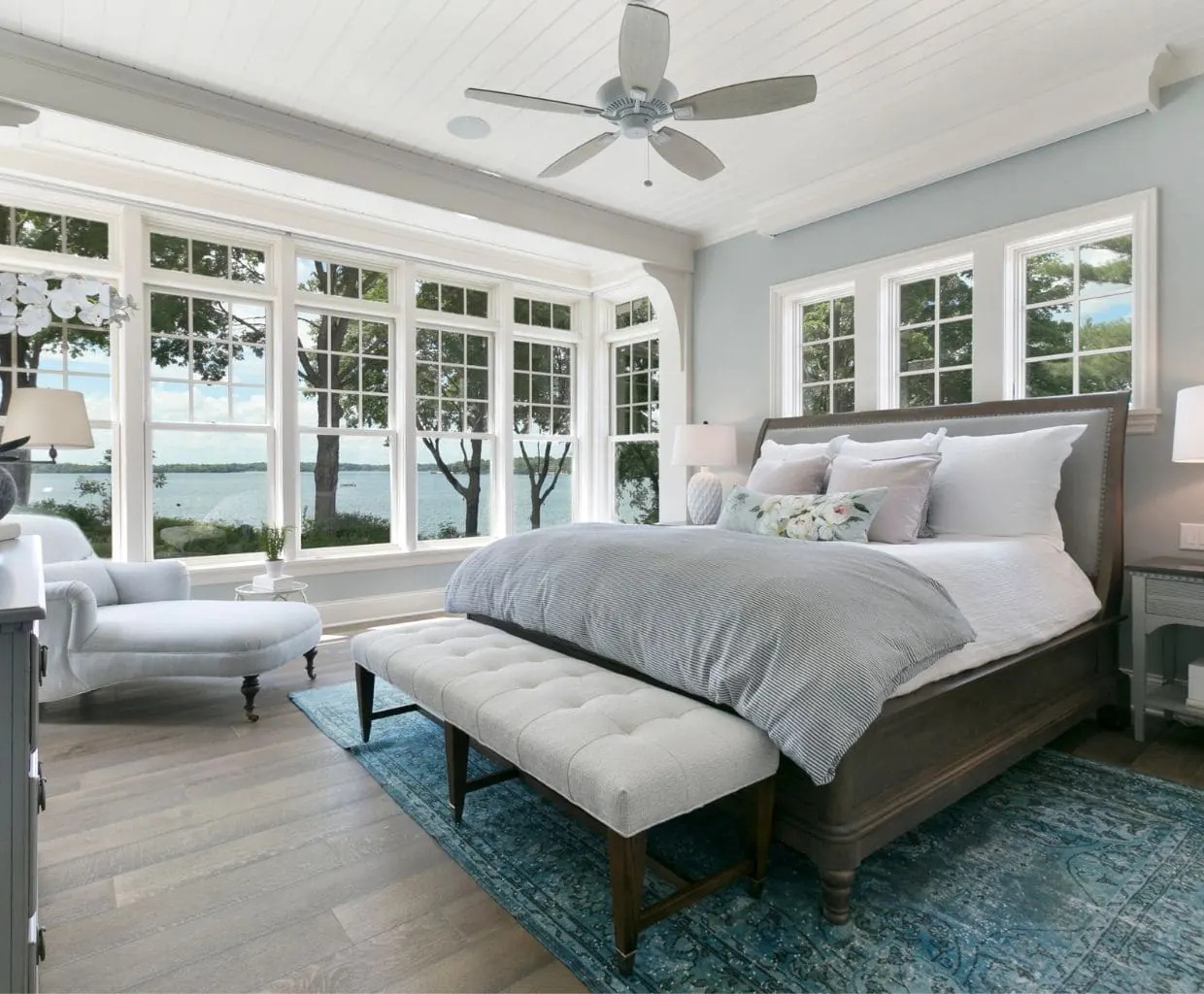
Quietest Ceiling Fans in 2026: Picks for Bedrooms
What independent lab testing says about quiet ceiling fans, six bedroom picks with honest notes on missing noise data, and how to quiet a fan you own.
8 min read
Room Ideas
Bathroom Ceiling Fans: Ratings, Sizing and Safe Placement
A bathroom ceiling fan needs the right damp or wet rating, a small blade span and room to clear walls and heads. What the 2023 NEC zone means, plus four picks.
8 min read