Fan Rated Box: How to Tell If Your Ceiling Box Can Hold a Fan
A ceiling fan needs a box listed and marked for fan support, or its own support from the framing. Here's what the code says and how to check your box.
By Cool Ceiling Ideas editorial teamUpdated 8 min read
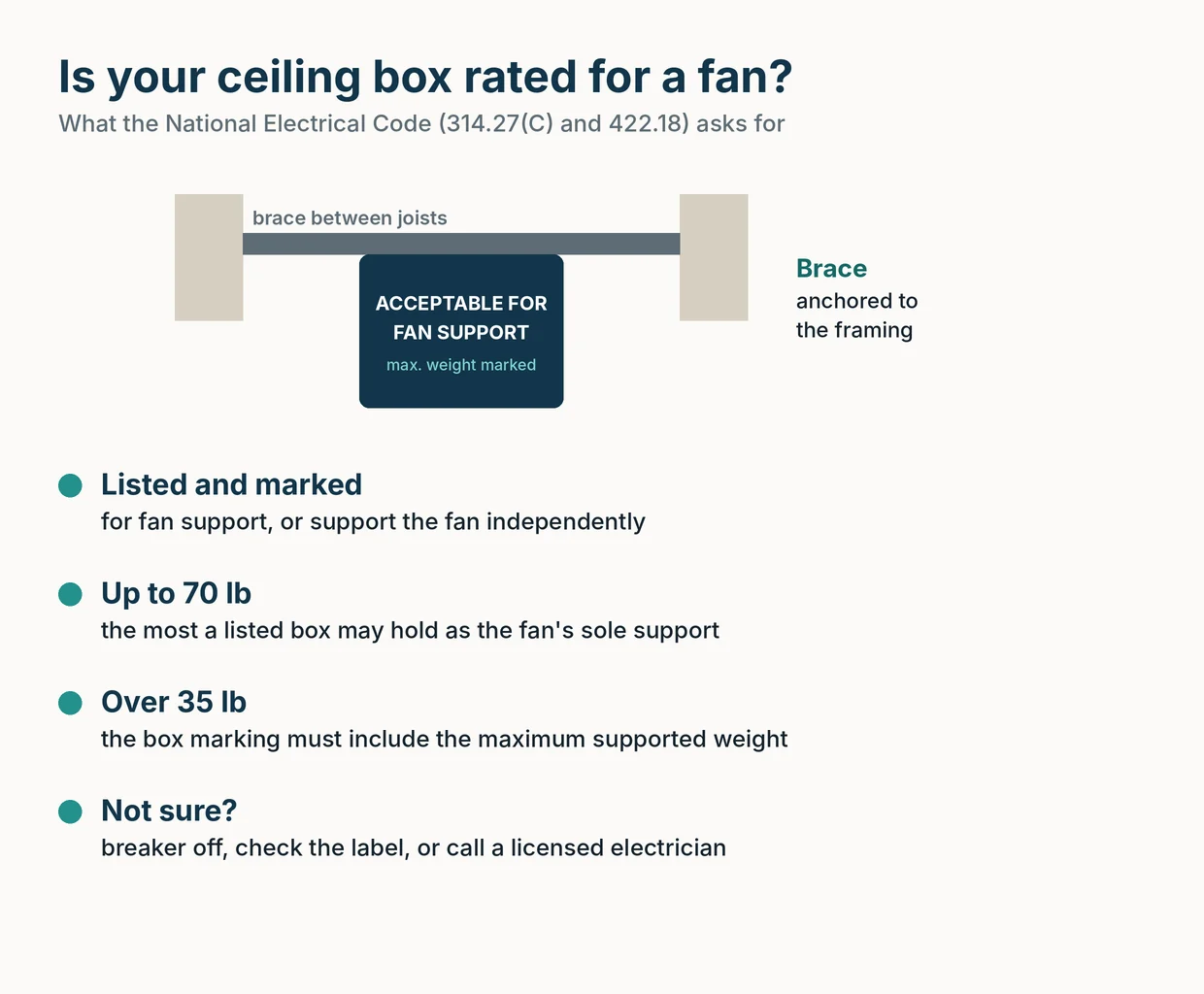
The short answer: a fan rated box is a ceiling electrical box that is listed and marked as suitable for fan support. The National Electrical Code (NEC) lets such a box be a fan’s only support up to 70 lb, and for fans over 35 lb the box has to be marked with its maximum weight. If your box has no such marking, treat it as not rated: either replace it with a fan-rated box or support the fan from the framing, and call a licensed electrician if you’re unsure.
What a fan rated box is, and why a light box isn’t enough
A ceiling fan is heavier than most light fixtures, and it moves. Every turn of the blades pushes on the mount. That’s why fan makers and the electrical code treat a fan box differently from an ordinary light box.
Harbor Breeze’s manual puts it bluntly: the box must be securely attached to the building structure and able to hold the fan’s full weight, and failure can cause serious injury or death. The same manual notes that most boxes used for light fixtures aren’t acceptable for fan support and may need replacing.
Hunter describes a fan-rated box this way:
- Round or octagonal in shape.
- Attached to a ceiling joist, a wood block or an adjustable brace, not just to drywall.
- Marked “Approved for Ceiling Fans” or with a weight rating (Hunter’s example marking reads “Rated for 75lbs”).
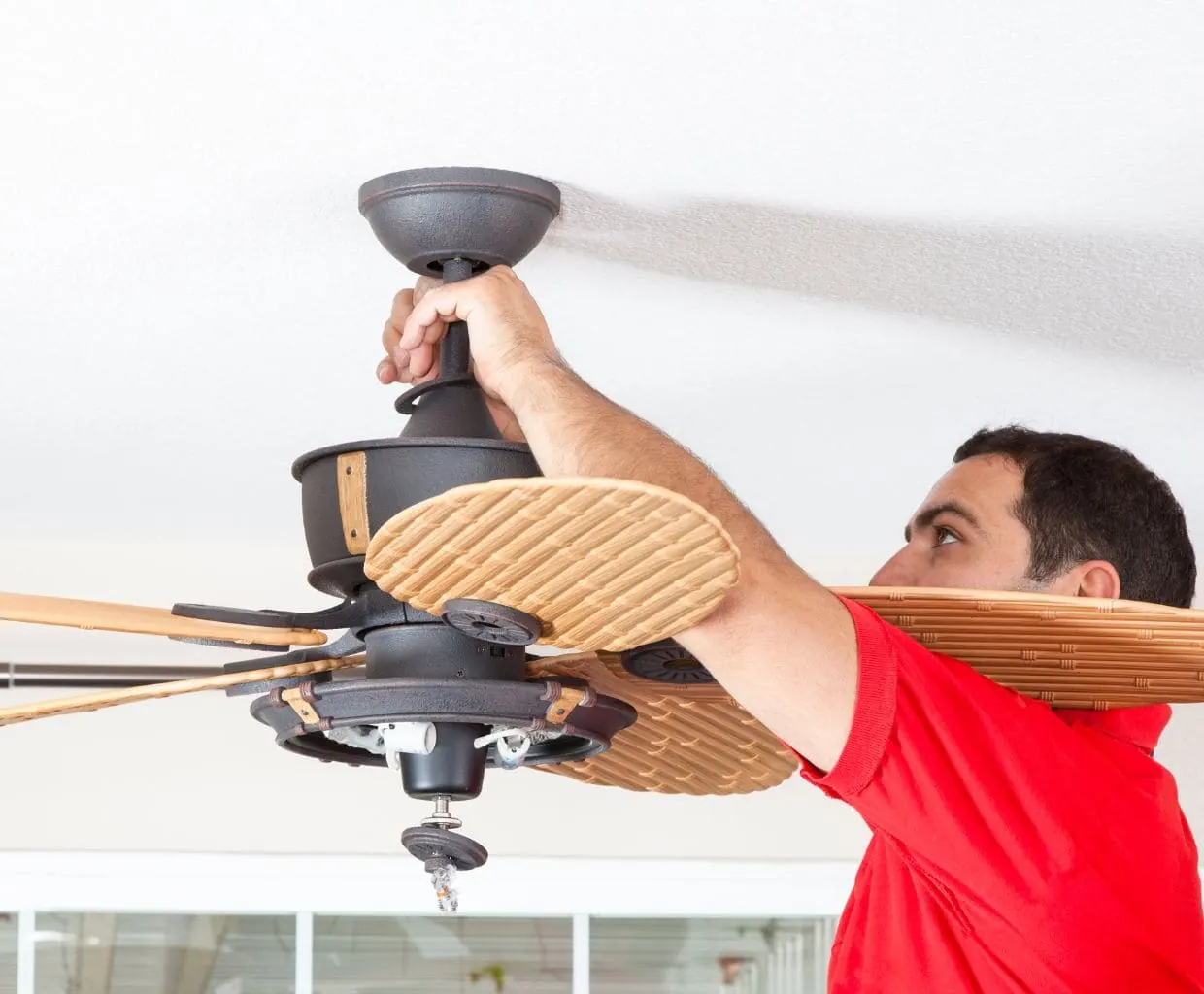
A solid box also matters for comfort. Harbor Breeze says box stability is essential to minimizing wobble and noise. If your fan sways at the mount, our ceiling fan wobble guide explains how to tell mount wobble from blade wobble.
What the National Electrical Code requires
The rules sit in two NEC sections. The summaries below follow electrical code expert Mike Holt’s Q&As in EC&M, which are based on the 2017 NEC. Your city or county may have adopted a different edition, so check with your local building department.
NEC 422.18 says a ceiling paddle fan must be supported in one of three ways:
- Independently of the outlet box, for example from the framing.
- By a listed box or box system identified for fan support (section 314.27(C)).
- By a listed locking support and mounting receptacle system (section 314.27(E)).
NEC 314.27(C) then sets the box rules:
- A box used as the sole support of a ceiling paddle fan must be listed and marked as suitable for fan support.
- That box may not support a fan heavier than 70 lb.
- For fans over 35 lb, the box marking must include the maximum weight it supports. Otherwise the fan has to be supported independently.
| Fan weight | What the box needs (NEC 314.27(C), 2017) |
|---|---|
| Up to 35 lb | Listed and marked as suitable for fan support |
| Over 35 lb, up to 70 lb | Listed for fan support and marked with a maximum weight at least equal to the fan |
| Over 70 lb | Can’t be the sole support; support the fan independently |
Note: NFPA 70, the code itself, is paywalled, so these are paraphrases from EC&M rather than the official text. Your fan’s manual and your local inspector have the final word.
The spare-wire rule
There’s one more rule in 314.27(C) that’s easy to miss. In a home, if a ceiling box sits in a spot suitable for a paddle fan and has spare, separately switched ungrounded conductors running to it, that box must be listed for paddle-fan support. In plain terms, an extra switched hot wire (often red) is a sign the circuit was laid out for a fan and a light on separate switches.
In our view, that wire is a hint, not proof. Older wiring, remodels and swapped boxes happen, so always check the box marking itself.
What fan manufacturers ask for
Manuals often go further than the code minimum. Here’s what the manuals in our research specify for the box:
| Manufacturer | Box requirement in the manual | Material |
|---|---|---|
| Hunter | Mount from building structure and/or a box marked acceptable for fan support of 70 lb (31.8 kg) | Not specified |
| Casablanca | Box marked acceptable for fan support of 70 lb (31.8 kg), or mount to building structure | Not specified |
| Minka-Aire | Box and its support must handle the fan’s moving weight, at least 50 lb | UL-listed metal box, not plastic |
| Harbor Breeze (13 lb fan) | Octagonal box marked “acceptable for fan support of 35 lbs. or less” | Metal, no plastic box |
Two things stand out. First, several brands ask for more capacity than the fan actually weighs, because the load moves. Minka-Aire’s wording is “moving weight.” Second, a box that’s fine for one fan may not meet another brand’s manual. We’d always read the manual for the fan you’re installing before you buy anything for the ceiling.
Metal vs plastic boxes
The code talks about boxes listed for fan support; it doesn’t ban a material outright in the summaries we have. The manuals are stricter:
- Minka-Aire asks for a UL-listed metal box, not plastic.
- Harbor Breeze requires a metal octagonal box and says no plastic box.
Our pick is simple: if your fan’s manual says metal, use metal, even if a plastic box carries a fan marking.
How to tell if your ceiling box is fan rated
Important: Turn off power at the circuit breaker, not just the wall switch, before you remove a fixture or canopy. Hunter suggests confirming it’s off with a voltage tester. If the breaker can’t be locked off, tag the panel so nobody switches it back on.
- Remove the old fixture or fan canopy so you can see inside the box.
- Look for the marking. It’s usually stamped or printed inside the box: “Acceptable for fan support,” “Approved for Ceiling Fans,” or a weight such as “Rated for 75lbs.” Note the weight and compare it with your fan’s weight on its spec sheet. For example, Hunter lists its Bayview 54 inch palm-leaf fan at 21.25 lb.
- Check the shape. Hunter says fan-rated boxes are round or octagonal.
- Check what holds it up. The box should be fastened to a joist, a wood block or an adjustable brace. Push on it gently: it shouldn’t move.
- Hold up the fan’s mounting bracket. Hunter’s rule of thumb: if the bracket is wider than the box, the box is probably not fan-rated.
- Check the material against your fan’s manual (see above).
No marking, or you can’t read it? Treat the box as not rated.
Brace bars between joists
Ceiling boxes rarely land exactly on a joist. ENERGY STAR’s advice is to anchor the fan to a ceiling joist, and if the joist isn’t centered where you want the fan, to install a ceiling-fan mounting bracket with spiked ends between the joists. That’s the brace bar in the diagram above: it spans the gap, bites into the framing on both sides and carries the box in the middle.
When the brace and box are the fan’s only support, NEC 422.18 calls for a listed box or box system identified for fan support, so check the packaging and marking for fan support and the weight it carries. Hunter lists an adjustable brace among the acceptable ways to secure a fan box.
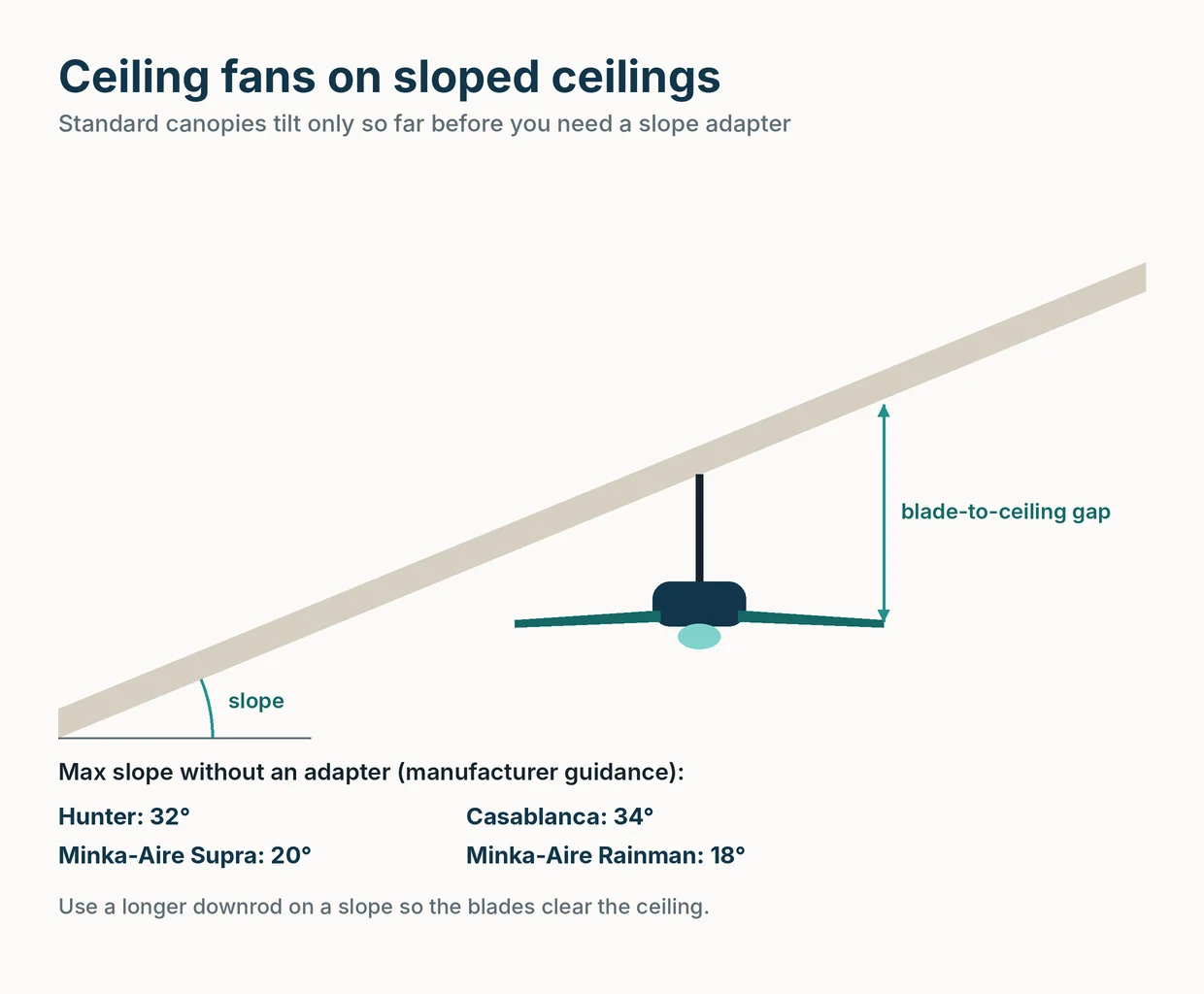
Tip: Brace bars and fan boxes also affect where the fan ends up. Check your planned blade height with our ceiling fan height guide before you fix the box location, and if the ceiling is angled, read our guide to ceiling fans for sloped ceilings for mount angle limits.
Signs your box is not fan rated
Stop and fix the box before you hang the fan if you see any of these:
- No fan marking or weight rating inside the box.
- A box that the fan’s mounting bracket overhangs, which Hunter says usually means it isn’t fan-rated.
- A plastic box when your fan’s manual calls for metal.
- A box held only by drywall clips or the ceiling surface, not by a joist, block or brace.
- A box that moves when you push on it, or a fan canopy that shifts when the fan runs.
- A fan heavier than the box’s marked weight, or over 70 lb.
If an existing fan is already hanging from a box like this, turn it off at the breaker and don’t use it until the mount is corrected. A box that isn’t rated or isn’t secured to the framing is a fall hazard.
When to call a licensed electrician
Replacing a ceiling box means disconnecting and reconnecting house wiring, often working inside a finished ceiling. Manufacturers say to use a qualified or licensed electrician if you’re unfamiliar with wiring, if your house wire colors differ from the instructions, if there’s no fan-rated box, or if the switch has no power with the breaker on. Hunter recommends a certified electrician whenever you need a fan-rated box.
We’d also call one if:
- You’d need to cut into the ceiling or reach framing from the attic.
- The box has more wires than you expected, or wires with damaged insulation.
- You’re unsure which breaker feeds the box.
All wiring has to follow the NEC and your local code, and permit rules vary by town, so ask your local building department before you start. No box in the ceiling at all? More step-by-step guides are in our how-to section.
Frequently asked questions
What is a fan rated box?
It's a ceiling electrical box that is listed and marked as suitable for fan support. Under NEC 314.27(C), as summarized by EC&M for the 2017 code, such a box can be the fan's only support for fans up to 70 lb. Hunter says it is usually round or octagonal, fastened to a joist, wood block or adjustable brace, and marked 'Approved for Ceiling Fans' or with a weight rating.
Can I hang a ceiling fan from a regular light fixture box?
Usually not. Harbor Breeze's manual says most outlet boxes used for light fixtures aren't acceptable for fan support and may need replacing. A fan is heavier than most lights and it moves, so the box must be rated for fans or the fan must be supported independently from the framing.
How much weight can a fan rated box hold?
Check the marking on your box. The NEC caps a listed fan box at 70 lb as a fan's sole support, and for fans over 35 lb the box must be marked with the maximum weight it supports. Fans heavier than that must be supported independently of the box.
Can a plastic box be fan rated?
The code summaries in our research don't ban plastic outright, but several fan makers rule it out for their fans. Minka-Aire asks for a UL-listed metal box, not plastic, and Harbor Breeze requires a metal octagonal box. Follow your fan's manual.
How do I know if my ceiling box is fan rated?
Turn off the breaker, remove the old fixture and look inside the box for a marking such as 'Acceptable for fan support' with a weight. Hunter adds that if the fan's mounting bracket is wider than the box, the box is probably not fan-rated. No marking means treat it as not rated.
Do I need an electrician to install a fan rated box?
Replacing a ceiling box is wiring work, so you need the breaker off and the job done to local code. Hunter recommends a certified electrician if you need a fan-rated box, and manufacturers say to hire a licensed electrician if you're unsure about any step.
Related guides
How-To
Ceiling Fan Wobble: Why It Happens and How to Fix It
Most wobbly fans need tightened screws and a balancing kit, not a new fan. Here's the fix in order, and the signs that wobble is a safety problem.
7 min read
How-To
Ceiling Fan Speeds: Which Setting to Use for Summer, Winter and Sleep
What low, medium and high really do, which ceiling fan speed to use in summer, winter and at night, and how speed changes watts, cost and noise.
8 min read
How-To
Ceiling Fan Direction: Which Way Should It Spin in Summer and Winter?
Counterclockwise in summer, clockwise on low in winter. How to check which way your fan spins, how to switch it on any fan, and how much it really helps.
8 min read
Room Ideas
Ceiling Fans for Sloped Ceilings: Angle Limits, Adapters and Downrods
How steep a ceiling a standard fan mount handles, when you need an angle adapter, how to measure the pitch and which downrod keeps the blades clear.
8 min read