Ceiling Fans for Bunk Beds: Clearance, Placement and Safer Options
No ceiling fan is rated for use over a top bunk. How to measure, where to put the fan instead, and the caged, low-profile and clip-on fans worth a look.
By Cool Ceiling Ideas editorial teamUpdated 9 min read
Our picks at a glance
- Check price on Amazon
Best enclosed-blade fan
Progress Lighting Gulliver 23 in.
Progress says its three blades sit inside a three-band cage, which few ceiling fans can claim.
- 23 in. blades
- Blades inside cage
- Remote, dimmable
- Check price on Amazon
Caged fan on clearance
A 23 in. blade span inside a 34 in. cage, with a wall control instead of pull chains.
- 23 in. blades
- 34 in. overall cage
- Wall control
- Check price on Amazon
Best low-profile fan for the room
Hunter Minimus 44 in. Low Profile
Blades sit just 7.89 in. below the ceiling and a remote replaces the pull chains.
- 44 in. blades
- 7.89 in. ceiling-to-blade
- Remote control
- Check price on Amazon
Best for the top bunk
Vornado Pivot Clip and Pivot3 Clip
Small clip-on circulators that put a breeze on the top bunk with no ceiling blades nearby.
- 1.5 in. clip opening
- 3 speeds
- 4 in. grille (Pivot Clip)
- Check price on Amazon
Best cordless clip fan
USB-rechargeable, so there's no mains cord running up the bunk.
- Rechargeable battery
- 4 in. blade
- Gooseneck arm
Prices change often; Amazon shows the current price. As an Amazon Associate, Cool Ceiling Ideas earns from qualifying purchases.
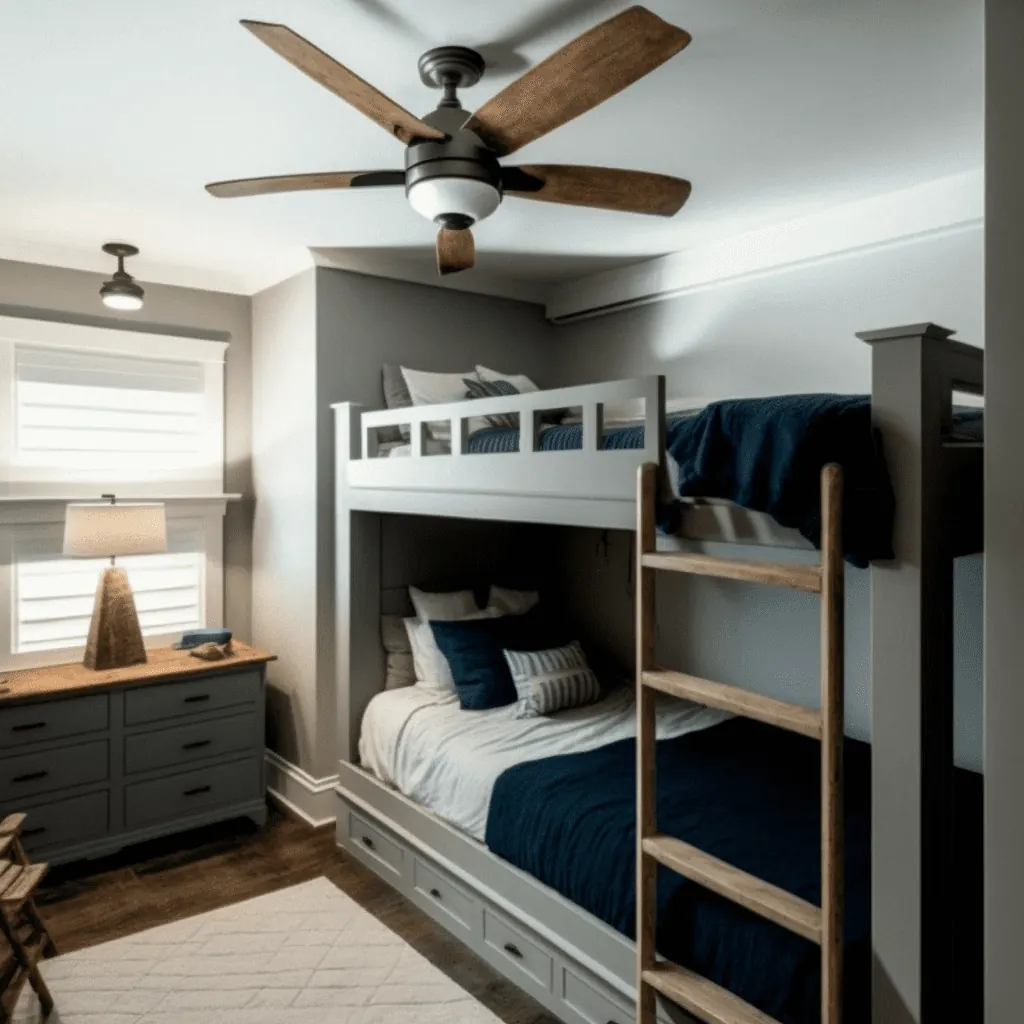
The short answer: there is no such thing as a ceiling fan rated for use over a bunk bed. Fan makers require at least 7 ft from the floor to the blades, and none of the manuals or product pages in our research says any model is suitable above a top bunk. So the safe approach is to put the ceiling fan where nobody on the top bunk can reach it, choose a low-profile or caged design, and cool the top bunk with a small clip-on fan instead.
Important: A child sitting up on a top bunk is far closer to the blades than the 7 ft rule assumes. If the only spot for the fan is above the bunk, move the bunk or skip the ceiling fan.
Why bunk beds and ceiling fans are a bad mix
The 7 ft minimum shows up everywhere: in Hunter, Minka-Aire and Casablanca manuals, on ENERGY STAR’s ceiling fan basics page, and in UC Berkeley’s ceiling fan design guide, which says the point is to prevent accidental contact with the blades. Our guide to ceiling fan height covers the floor-to-blade rules in detail. That rule is written for people standing on the floor. A top bunk lifts a child several feet closer to the ceiling, which cancels most of that margin.
Injury data backs this up. A 2023 study in Pediatrics, based on US emergency room data collected by the Consumer Product Safety Commission, estimated about 2,300 head injuries a year in children from contact with ceiling fans (20,523 from 2013 to 2021). Older children were usually hurt jumping off bunk or loft beds, while babies and toddlers were usually hurt when they were lifted up toward a spinning fan. Most injuries were cuts, and the advice reported with the study was simple: keep furniture, especially bunk beds, away from ceiling fans.
You may see fans labeled “bunk bed ceiling fan” online. Prominence Home, for example, tags its 28 in. Hero fan that way in its store. That’s a merchandising tag, not a clearance rating, and it doesn’t change the 7 ft rule.
Measure before you buy
Grab a tape measure and write down four numbers:
- Ceiling height: floor to ceiling.
- Top mattress height: floor to the top of the upper mattress.
- Headroom on the top bunk: ceiling height minus mattress height.
- The fan’s drop: the distance from the ceiling to the blades, listed on the spec sheet or dimension diagram.
Here’s an example with made-up but typical numbers. In a room with an 8 ft (96 in.) ceiling and a top mattress 60 in. off the floor, there are 36 in. of headroom. A low-profile fan whose blades hang 7.89 in. below the ceiling would leave only about 28 in. between the mattress and the blades if it hung over the bunk. That’s well within reach of a child sitting up in bed, even though the blades are still more than 7 ft above the floor.
Then check the horizontal distance. Hunter’s manuals, including the Fennec manual, ask for 30 in. from the blade tips to the nearest wall or obstruction; ENERGY STAR and Minka-Aire use 18 in. to walls. We’d treat the top bunk, its guardrail and its ladder as obstructions and use the larger figure. For a 44 in. fan (22 in. from center to blade tip), that means keeping the nearest edge of the top bunk at least 52 in. from the center of the fan.
Where to put the fan
- Over the open floor, not the bed. (No bunks? See our picks of ceiling fans for kids’ rooms.) In most shared kids’ rooms, that’s the center of the play space or the walkway between the bunk and the door.
- Away from the ladder. Keep the ladder end of the bunk far from the blades.
- Not above a loft bed or desk riser either. The same reach problem applies to any raised sleeping or play platform.
- Can’t get enough distance? In our view, skip the ceiling fan and use a clip-on or floor fan instead.
For size, ENERGY STAR suggests 29 to 36 in. for rooms up to 75 sq ft, 36 to 42 in. for 76 to 144 sq ft, and 44 in. for 144 to 225 sq ft. Our ceiling fan size calculator does the math for your room.
Choose a safer design
Low-profile (hugger) fans keep the blades as close to the ceiling as possible. ENERGY STAR and Hunter both suggest them for ceilings under 8 ft. They add headroom, but they don’t make a fan safe over a bunk. See our full list of low profile ceiling fans.
Caged fans come in two very different kinds. On some, the cage surrounds the blades; on most, it only wraps the light while the blades stay open. Read the product description carefully.
“Bladeless” retractable fans aren’t the answer here. Fanaway’s retractable design folds its blades away when the fan is off, but they extend and are fully exposed while it runs.
Our picks
We don’t test fans. These picks come from manufacturer spec sheets, manuals and product pages, and every spec below comes from those sources.
| Fan | Type | Size | Controls | Where it goes |
|---|---|---|---|---|
| Progress Lighting Gulliver 23 in. | Ceiling fan, blades inside a cage | 23 in. blades | Remote | Ceiling, away from the bunk |
| Hunter Fennec 23 in. | Ceiling fan in a 34 in. cage | 23 in. blades | Wall control | Ceiling, away from the bunk |
| Hunter Minimus 44 in. Low Profile | Low-profile ceiling fan, open blades | 44 in. blades | Remote | Ceiling, over open floor |
| Vornado Pivot Clip / Pivot3 Clip | Clip-on circulator | 4 in. grille (Pivot Clip) | On-unit control | Clipped to the top bunk rail |
| O2COOL Gooseneck Clip Fan | Rechargeable clip fan | 4 in. blade | On-unit control, rechargeable | Clipped to the top bunk rail |
Progress Lighting Gulliver 23 in.
The Gulliver is one of the few ceiling fans we found whose blades are actually enclosed: Progress says the three-blade fan sits inside a three-band cage. It’s our pick if you want a ceiling fan with the blades behind a barrier. It has a 23 in. blade span, an AC motor with 3 speeds, and a remote. The light uses three 5.5 W vintage-style LED bulbs (included) and is dimmable. Progress lists 1,099 CFM at 32 W, a dual-mount canopy and a cETLus damp listing.
Trade-off: it’s 18.1 in. tall and 23.5 in. wide, so it needs a ceiling high enough to keep the blades at least 7 ft up, and it costs around $600. Progress doesn’t say it’s suitable over a bunk either, so place it away from the bed.
Check the Progress Lighting Gulliver on Amazon
Hunter Fennec 23 in.
The Fennec puts a 23 in. blade span inside a 34 in. overall cage and hangs from an included 4.5 in. downrod (an angled mount also works). It has an AC motor with 3 speeds, four dimmable LED bulbs and a wall control, so there are no pull chains to grab. Hunter backs the motor with a limited lifetime warranty.
Trade-off: Hunter lists it as clearance and final sale, so it may be near the end of its run, and final-sale items usually can’t be returned. The downrod also means it hangs lower than a hugger fan.
Check the Hunter Fennec on Amazon
Hunter Minimus 44 in. Low Profile
If the fan will hang over open floor and you just want to maximize headroom, the Minimus is a sensible choice. Hunter calls it “Ultra Low Profile”: the blades sit 7.89 in. below the ceiling, and the whole fan is 10.29 in. tall. The remote handles speed (3 speeds), dimming of the 16 W integrated LED and reverse. Hunter lists 3,181 CFM at 40 W, a limited lifetime motor warranty and a 3-year light kit warranty.
Trade-off: the motor is AC, not DC, and it costs around $330. If budget matters more than a remote, Hunter’s Low Profile IV 42 in. has an even shorter 7.53 in. ceiling-to-blade drop, but it uses pull chains.
Check the Hunter Minimus on Amazon
Vornado Pivot Clip and Pivot3 Clip
For the top bunk itself, we’d pick a clip-on fan over any ceiling fan. Both Vornado models clip onto anything up to 1.5 in. thick, so measure the bunk rail first.
- Pivot Clip: a small circulator with a 4 in. grille, 3 speeds and a 6 ft cord. Vornado lists 17, 8 and 6 W and 48, 44 and 41 dBA by speed, with a 3-year guarantee. Around $25.
- Pivot3 Clip: the larger model, rated 270, 186 and 130 CFM at 34, 21 and 14 W, and 51, 48 and 46 dBA by speed, with a 5-year guarantee. Around $45.
Trade-off: the Pivot Clip runs on a 120 V cord, so route it down the back of the bunk and away from the child. Vornado’s safety instructions require supervision for children 12 and younger during installation, use and cleaning, and say the product is not a toy.
Check the Vornado Pivot Clip on Amazon
Check the Vornado Pivot3 Clip on Amazon
O2COOL Gooseneck Clip Fan
The O2COOL is USB-rechargeable, so there’s no mains cord running up the bunk. It has a 4 in. blade, 3 speeds and an adjustable gooseneck arm for aiming the breeze. It costs under $25.
Trade-off: O2COOL’s runtime claims weren’t something we could verify, and no warranty is listed in our research. Keep the charging cable out of the bed when it’s not charging.
Check the O2COOL Gooseneck Clip Fan on Amazon
Note: We left out the Air King 9145 clip-on fan, a common recommendation, because Lasko’s site showed it as unavailable in October 2026.
Tips for kids’ and teen rooms
- Use a remote or wall control, not pull chains. We’d avoid a dangling chain in a kids’ room; it invites tugging. If you use a remote, keep it out of small children’s reach: Hunter’s remote manual warns that a swallowed lithium coin battery can cause severe internal burns and death in as little as 2 hours.
- Set rules about the top bunk. No standing, jumping or reaching up, whatever the fan is doing. That’s the injury pattern the Pediatrics study found in older kids.
- Follow the age guidance. Hunter’s Avel fan manual says children 8 and older may use the appliance only with supervision or instruction, and shouldn’t play with it or clean it unsupervised. Vornado’s line is supervision for 12 and younger.
- Adults do the cleaning. Hunter suggests dusting a fan every 1 to 3 months. Turn it off, wait for the blades to stop, and use a step ladder, never the top bunk.
- For teens, think quiet and smart. A fan running all night should be quiet; see our quietest ceiling fans. App and voice control are handy for older kids; see the best smart ceiling fans.
- For a baby or toddler sharing the room, the rules get stricter. See our guide to nursery ceiling fans.
Important: Installing a ceiling fan is electrical work. Turn off power at the breaker, mount the fan to a box marked for fan support (or to the building structure), follow the manual and local code, and hire a licensed electrician if you’re unsure.
Frequently asked questions
Can you put a ceiling fan over a bunk bed?
We wouldn't. Every fan manual in our research requires at least 7 ft from the floor to the blades, and no manufacturer says any model is suitable over a bunk bed. Put the fan elsewhere in the room and keep the bunk well outside the blade sweep.
How much clearance do you need between a top bunk and a ceiling fan?
No manufacturer gives a top-bunk figure. Hunter's manuals ask for 30 in. from blade tips to the nearest wall or obstruction, and ENERGY STAR and Minka-Aire use 18 in. to walls. Treat the bunk as an obstruction, use the larger figure, and never place a bunk under the blades.
Are caged ceiling fans safe for kids' rooms?
A caged fan adds a barrier, but check what the cage covers. Progress says the Gulliver's blades sit inside its cage, while many 'caged' fans only cage the light and leave the blades open. Either way, install it per the 7 ft rule and away from the bunk.
What's the best way to cool a child on the top bunk?
A small clip-on fan, such as the Vornado Pivot Clip or the battery-powered O2COOL Gooseneck Clip Fan, aimed at the top bunk. Vornado requires supervision for children 12 and younger, so an adult should set it up and check it.
What size ceiling fan is right for a kids' bedroom?
ENERGY STAR suggests 29 to 36 in. for rooms up to 75 sq ft, 36 to 42 in. for 76 to 144 sq ft, and 44 in. for 144 to 225 sq ft. Our ceiling fan size calculator works it out from your room's dimensions.
Can you put a ceiling fan above a loft bed?
We wouldn't, for the same reason as a top bunk: a raised bed puts a child far closer to the blades than the 7 ft floor-to-blade rule assumes, and the 2023 Pediatrics study found older kids were often hurt jumping off bunk or loft beds. Hang the fan over open floor instead.
Related guides
Room Ideas
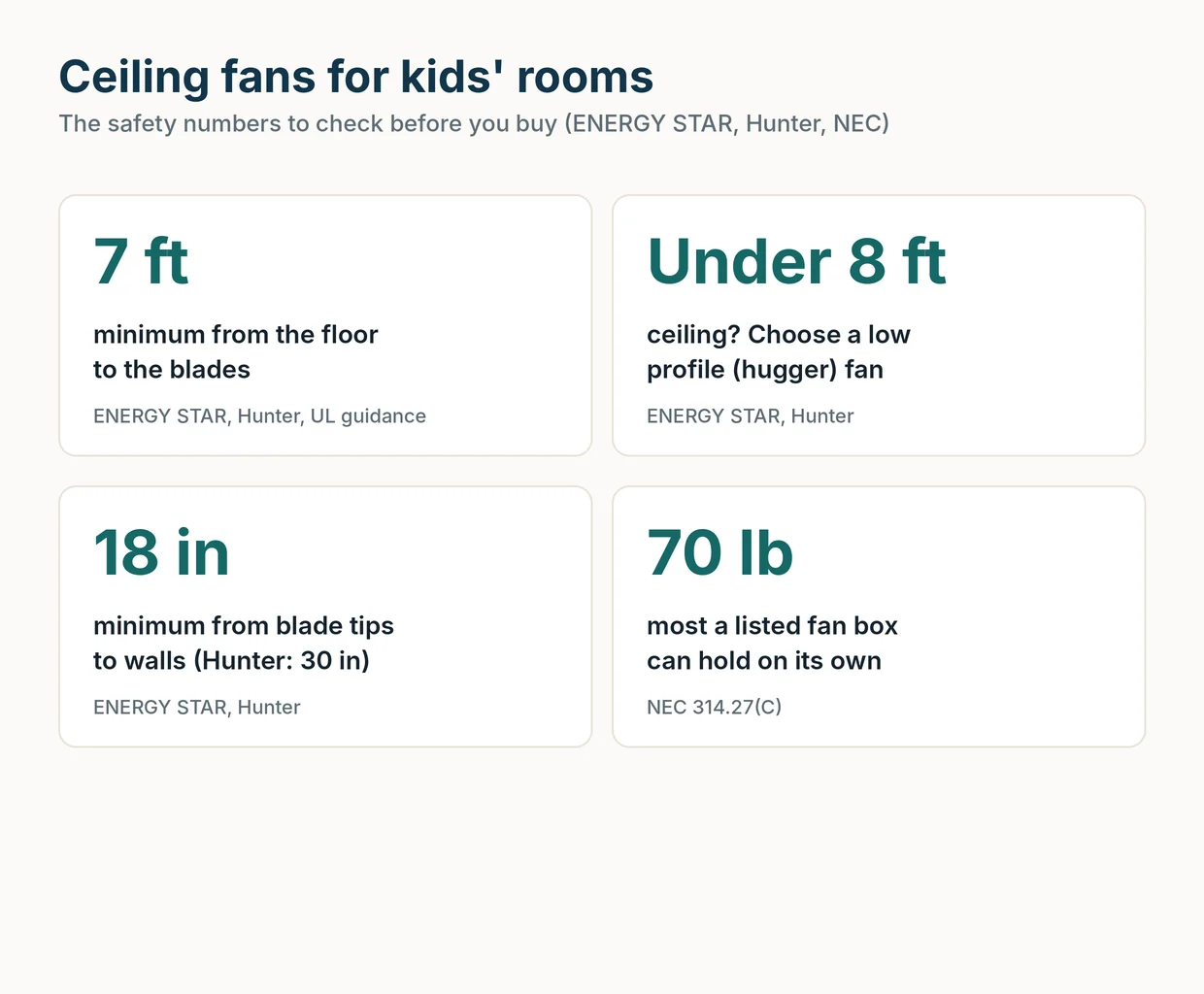
Best Ceiling Fans for Kids' Rooms in 2026: Safe, Simple Picks
Low-profile, remote-controlled and enclosed-blade fans for kids' and teens' bedrooms, plus the height, clearance and mounting rules that keep them safe.
9 min read

Room Ideas
Best Nursery Ceiling Fans in 2026: Quiet, Safe Picks
Quiet DC and low-profile fans with dimmable lights and remotes for a baby's room, plus safe mounting, crib placement and what the AAP says about overheating.
9 min read
Room Ideas
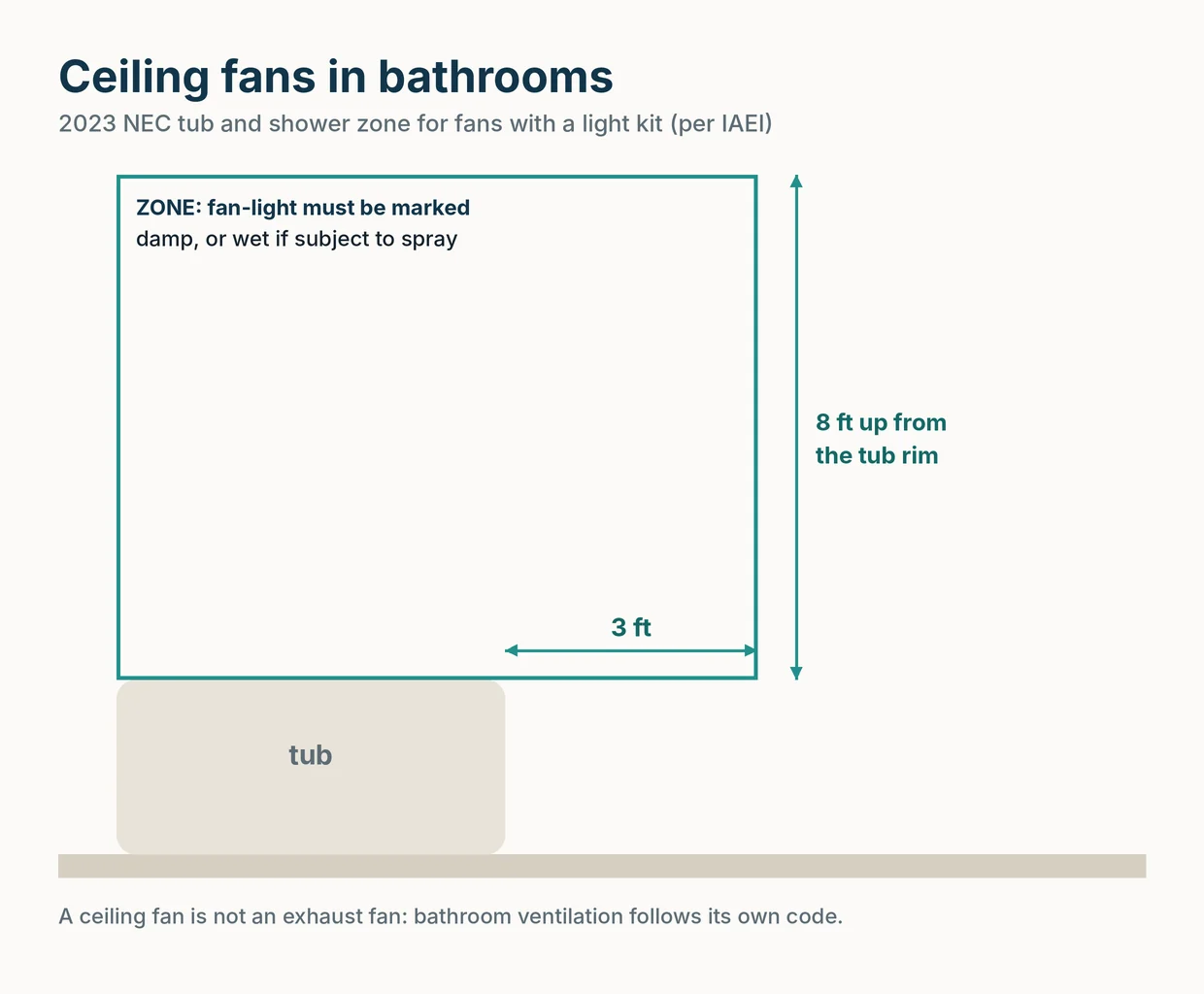
Bathroom Ceiling Fans: Ratings, Sizing and Safe Placement
A bathroom ceiling fan needs the right damp or wet rating, a small blade span and room to clear walls and heads. What the 2023 NEC zone means, plus four picks.
8 min read

Room Ideas
Quietest Ceiling Fans in 2026: Picks for Bedrooms
What independent lab testing says about quiet ceiling fans, six bedroom picks with honest notes on missing noise data, and how to quiet a fan you own.
8 min read