Ceiling Fan Wiring: What Each Wire Does, With One or Two Switches
What the black, white, blue, red and green wires do, how one-switch and two-switch setups differ, and when to stop and call an electrician.
By Cool Ceiling Ideas editorial teamUpdated 8 min read
In this article
- Ceiling fan wire colors and what each one does
- What is the blue wire for?
- Wiring with one switch vs two switches
- Remotes and receivers change the wiring
- Dimmer switches and fans don’t mix
- The box matters as much as the wires
- Step overview: what a fan installation involves
- When to stop and call an electrician
The short answer: on a typical US ceiling fan, black powers the fan motor, blue powers the light, white is the neutral and green or bare is the ground. A red wire in the ceiling box means you have two wall switches, one for the fan and one for the light. This guide explains what you’re looking at so you can follow your fan’s manual or talk to an electrician with confidence. It isn’t a substitute for the manual or your local electrical code.
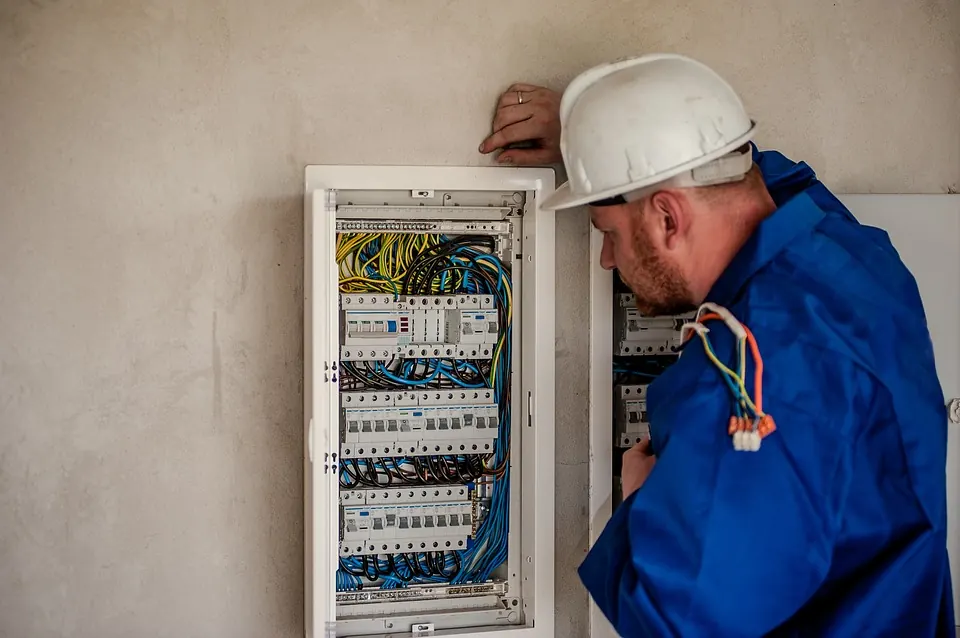
Important: Before you touch any wire, turn off the circuit breaker for the fan and its wall switch, not just the switch. If the breaker can’t be locked off, tape a note on the panel. Then confirm the power is off with a voltage tester. Follow your fan’s manual and local code, and hire a licensed electrician if anything doesn’t match what you see here.
Ceiling fan wire colors and what each one does
| Wire | Where you’ll find it | What it does |
|---|---|---|
| Black | Ceiling box and fan | Hot. From the ceiling, the switched power; on the fan, the lead for the motor |
| Blue | Fan only | Hot lead for the light kit |
| White | Ceiling box and fan | Neutral (the common return path) |
| Green or bare copper | Ceiling box and fan | Ground |
| Red (or a second black) | Ceiling box | A second switched hot, used when fan and light have separate wall switches |
These are the colors Hunter and Harbor Breeze use in their wiring instructions, and most US fans follow the same scheme. Hunter’s wiring guide labels the red ceiling wire “ungrounded (dual switch only)”, which means it carries power only in a two-switch setup.
Important: If the wires in your ceiling box are different colors from the ones in your manual, stop. Harbor Breeze’s manual says to have an electrician take over in that case, and we agree. Old or modified wiring can use colors in ways you can’t guess safely.
What is the blue wire for?
The blue wire is the light kit’s power lead. Fans that include a light have two hot leads, black for the motor and blue for the light, so the two can be powered together or separately.
- One wall switch: the blue joins the fan’s black on the ceiling’s black wire, and the pull chains choose fan speed and light.
- Two wall switches: the blue goes to the second switched hot (usually red), so one switch controls the light on its own.
If your fan has no light kit, or you’re leaving one off, the manual tells you how to handle the unused lead. Don’t leave a bare wire end loose in the canopy. To add a light later, check which ceiling fan light kits fit your fan first. Then follow our step-by-step light kit install.
Wiring with one switch vs two switches
Here’s how the two common setups compare, based on Hunter’s and Harbor Breeze’s instructions:
| Ceiling wire | One switch (pull chains control fan and light) | Two switches (fan and light separate) |
|---|---|---|
| Black | Fan black and fan blue | Fan black only (motor) |
| Red | Not present | Fan blue (light) |
| White | Fan white | Fan white |
| Green or bare | All grounds together | All grounds together |
How do you know which you have? With the breaker still off, look in the box. One black, one white and a ground usually means a single switch. A red (or second black) wire usually means two switches. Two wall switches that both seem to belong to the fan are the other clue.
Our view: if you already have two switched wires, use them. Separate wall control of fan and light is handy, and it means you rarely need the pull chains. If you have only one switch and want separate control, a ceiling fan remote kit is often easier than running new cable (more on that below).
Remotes and receivers change the wiring
Most remote kits put a small receiver inside the fan’s canopy, between the house wiring and the fan. A few points from the manufacturers’ instructions:
- The wall switch still supplies power. A remote-controlled fan won’t run with its wall switch off, so leave that switch on.
- A second wall switch stops working. Hunter notes that with a canopy-mounted receiver, the second wall switch no longer does anything.
- No dimmers or variable controls. Hampton Bay warns not to use its receiver with any variable (rheostat) wall control, and that wrong wire connections will damage the receiver.
- DC fans need their own receiver. Hunter’s universal kit 99770 doesn’t work with DC-motor fans or its Original line. A DC fan needs the remote and receiver made for it. See AC vs DC ceiling fans for why.
For app or voice control, see the best smart ceiling fans.
Dimmer switches and fans don’t mix
Hunter says an existing wall dimmer has to be replaced with a plain on/off switch, because a dimmer can’t operate a ceiling fan (see ceiling fan wall control for the options that do work). Harbor Breeze goes further: controlling fan speed with a full-range dimmer causes loud humming and is a fire and shock risk. Speed controls are brand-specific too. Hunter says to use only its own solid-state controls, while Harbor Breeze says not to use any solid-state speed control at all.
We’d use only the wall control your fan’s manual names.
The box matters as much as the wires
A ceiling fan is heavy and it moves, so it can’t hang from just any electrical box. Here’s the short version; our guide to the fan-rated box goes into braces, weight ratings and replacement.
- What a fan-rated box looks like. Hunter describes it as round or octagonal, fastened to a joist, a wood block or an adjustable brace, and usually marked “Approved for Ceiling Fans” or with a weight rating. If the fan’s bracket is wider than the box, Hunter says the box probably isn’t fan-rated.
- Weight markings. Harbor Breeze requires a metal octagonal box marked “acceptable for fan support of 35 lbs. or less” (no plastic) for its 13 lb fan. Hunter’s manual calls for a box marked for fan support of 70 lb, or mounting to the building structure. Minka-Aire asks for a UL-listed metal box that can carry at least 50 lb of moving weight.
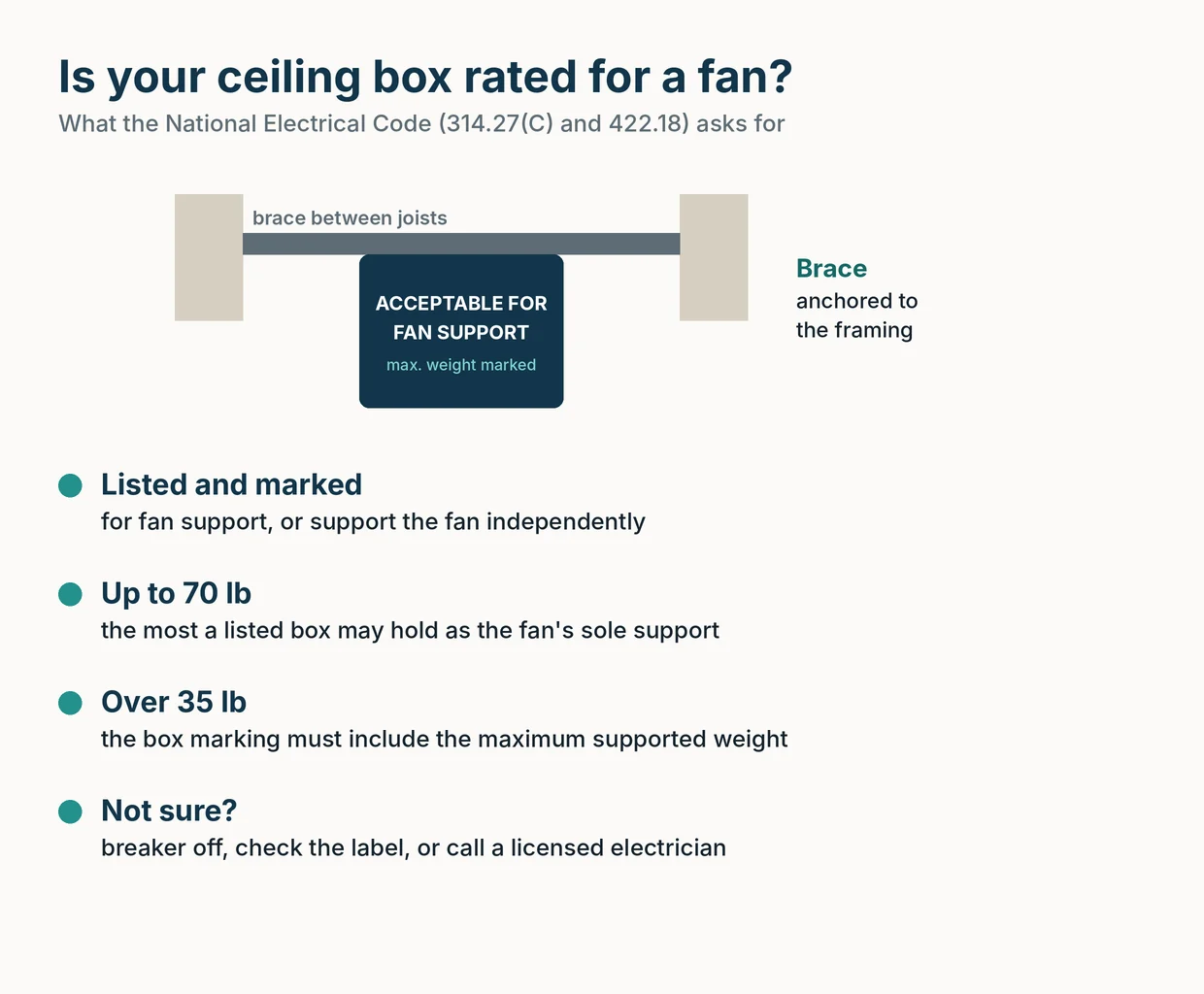
- What the code says. Under the National Electrical Code (2017 edition, as summarized by code expert Mike Holt), a box that is the only support for a fan must be listed and marked for fan support and can’t carry a fan over 70 lb. For fans over 35 lb, the marking must include the maximum weight. Otherwise the fan needs its own support.
- Light boxes usually don’t qualify. Harbor Breeze says most boxes used for light fixtures aren’t acceptable for fans and may need replacing.
ENERGY STAR adds that the fan should be anchored to a ceiling joist, or to a fan bracket with spiked ends that spans between joists when no joist is centered. A box that isn’t secure is a fall hazard, and an unstable box also causes ceiling fan wobble and noise.
Important: If you’re not sure your box is fan-rated, don’t hang the fan from it. Harbor Breeze warns that a box that can’t hold the fan’s full weight can cause serious injury or death. A licensed electrician can swap it for a rated box and brace.
Step overview: what a fan installation involves
This is an overview so you know what to expect, not a replacement for your fan’s instructions. Your manual’s order and connectors come first.
- Power off at the breaker. Switch off the circuit for the fan and wall switch, tag the panel if you can’t lock it, and test the wires with a voltage tester before touching them.
- Check the box. Confirm it’s marked for fan support and solidly attached to the framing.
- Identify the ceiling wires. Count them, note the colors and take a photo before you disconnect anything.
- Match your setup to the manual. Find the one-switch or two-switch diagram that matches your ceiling wires and the fan’s leads.
- Make the connections. Join the wires exactly as the diagram shows, using the connectors that came with the fan, and tuck them neatly into the box.
- Mount and test. Finish the assembly, restore power at the breaker, and check every speed and the light.
Available on AmazonSearch voltage testersSee today's price, ratings and delivery options
Check priceWhen to stop and call an electrician
Hunter and Harbor Breeze both say to use a qualified electrician if you’re unfamiliar with wiring. In our view, call one in any of these cases:
- The ceiling wire colors don’t match your manual.
- There’s no fan-rated box, or the box moves.
- The wall switch has no power even with the breaker on.
- You see scorched insulation, or hear crackling, or smell burning. Hunter says to cut the power immediately in that case.
- You need new wiring, a new switch run or a new circuit. Whether that needs a permit depends on your city or county, so check with your local building department.
All fan wiring has to follow the National Electrical Code (NFPA 70) and your local code.
Frequently asked questions
What color wires go together on a ceiling fan?
In a typical US setup, white goes to white (neutral), green or bare goes to green or bare (ground), and the ceiling's black goes to the fan's black. The fan's blue wire goes to the ceiling's black on one switch, or to the red wire if you have two switches. Always follow your fan's manual.
What is the blue wire on a ceiling fan for?
The blue wire is the hot lead for the light kit. It lets the light be powered separately from the fan motor, which is how a second wall switch can control the light.
What is the red wire in my ceiling box?
It's usually a second switched hot wire from a two-switch setup. Hunter labels it for dual-switch use only. It normally connects to the fan's blue (light) wire.
Can I put a ceiling fan on a dimmer switch?
No. Hunter says a wall dimmer can't operate a ceiling fan and should be replaced with an on/off switch, and Harbor Breeze warns that a full-range dimmer causes loud humming and is a fire and shock risk. Use the fan control your manual lists.
Can I hang a ceiling fan from a regular light fixture box?
Usually not. Most boxes used for light fixtures aren't rated to carry a moving fan. The box must be marked as acceptable for fan support and fastened to the framing, or the fan must be supported independently.
Do I need an electrician to wire a ceiling fan?
Manufacturers say to use a qualified electrician if you're unfamiliar with wiring, if your house wires are different colors from the instructions, if there's no fan-rated box, or if anything doesn't match. New wiring is a job for a licensed electrician.
Related guides
How-To
How to Install a Ceiling Fan Light Kit, Step by Step
Check that your fan can take a kit, cut the power at the breaker, open the switch housing, connect the light lead, mount the kit and fit bulbs within the limit.
7 min read
How-To
Fan Rated Box: How to Tell If Your Ceiling Box Can Hold a Fan
A ceiling fan needs a box listed and marked for fan support, or its own support from the framing. Here's what the code says and how to check your box.
8 min read
How-To
Best Ceiling Fan Remote Kits (2026): Universal and Brand Remotes
Universal and brand remote kits compared: what fits your fan, why DC fans need their own remote, reverse and dimming limits, and pairing.
10 min read
How-To
Ceiling Fan Wobble: Why It Happens and How to Fix It
Most wobbly fans need tightened screws and a balancing kit, not a new fan. Here's the fix in order, and the signs that wobble is a safety problem.
8 min read