Ceiling Fan vs Air Conditioner: Running Costs and When to Use Each
A ceiling fan costs about half a cent an hour on high; a small window AC about 10 cents. What each one really does, and how to use both to save money.
By Cool Ceiling Ideas editorial teamUpdated 6 min read
In this article
The short answer: a ceiling fan is far cheaper to run, but it does a different job. A typical ENERGY STAR 52-inch fan on high costs about half a cent an hour, while a small 8,000 Btu window air conditioner costs roughly 10 cents an hour while its compressor runs. The AC actually lowers the room temperature; the fan only makes the people in its breeze feel cooler. For most homes, the best answer is to use them together and raise the thermostat.
Fans cool people, AC cools rooms
ENERGY STAR sums it up in five words: ceiling fans cool people, not rooms. A fan doesn’t change the air temperature. It moves air over your skin so sweat evaporates faster, which feels cooler. Research from UC Berkeley’s Center for the Built Environment (CBE) puts it at about 4°F cooler for a gentle breeze of 100 feet per minute, and the lowest speed of a typical three-speed fan often gives about 150 feet per minute under the fan, or more than 5°F of cooling effect.
An air conditioner removes heat from the room. That’s why it keeps working when nobody is home, and why a fan in an empty room does nothing useful at all.
| Ceiling fan (52 in, ENERGY STAR) | Window AC (8,000 Btu, ENERGY STAR) | |
|---|---|---|
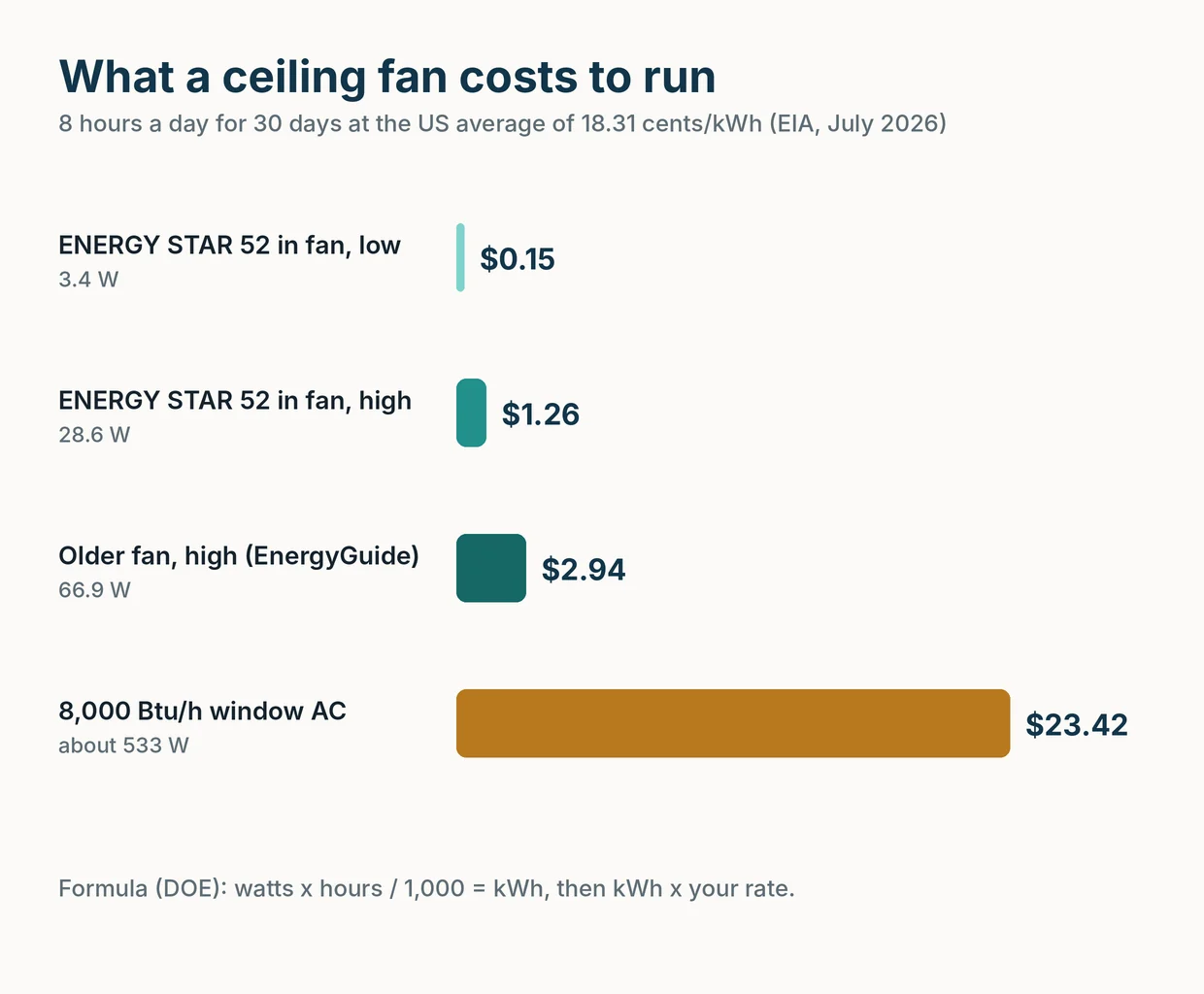
| Power while running | About 3.4 W on low, 28.6 W on high | About 533 W (our estimate) |
| Cost per hour at 18.31¢/kWh | Under 0.1¢ (low), about 0.5¢ (high) | About 9.8¢ |
| Cost for 8 h a day, 30 days | $0.15 (low), $1.26 (high) | About $23.42 |
| Lowers room temperature? | No, cools people in the breeze | Yes |
| Worth running in an empty room? | No | Sometimes, to pre-cool |
How to work out running costs
The Department of Energy gives a simple formula (our guide to how much electricity a ceiling fan uses applies it to more fan sizes and speeds):
- Watts × hours per day ÷ 1,000 = kWh per day
- kWh per day × days = kWh for the period
- kWh × your price per kWh = cost
The DOE also points out that a fan uses more power on high than on low, so the speed you use matters.
Note: The DOE’s Energy Saver pages were offline when we checked in October 2026, so we read the formula from an archived copy. The window AC wattages below are our estimates derived from ENERGY STAR data, not published figures.
For the numbers below we use:
- Electricity price: 18.31 cents per kWh, the US average residential price for July 2026, the latest month the EIA had published. Summer months run higher than the yearly average, so your annual cost may be a bit lower. Check your own bill for your actual rate.
- Fan power: the median ENERGY STAR certified 52-inch ceiling fan uses 3.4 W on low and 28.6 W on high, from our calculation on ENERGY STAR’s official dataset (626 fans). Certified fans lean toward efficient DC models, so an older fan may use more.
- Window AC power: ENERGY STAR certified 8,000 Btu/h window units have a median efficiency (CEER) of 15, which works out to about 533 W while the compressor runs. That’s our estimate derived from ENERGY STAR data, not a published wattage. A 12,000 Btu/h unit works out to about 800 W.
Worked examples
Ceiling fan on high, 8 hours a day for a month 28.6 W × 8 h × 30 days ÷ 1,000 = 6.86 kWh × $0.1831 = $1.26
Ceiling fan on low, same schedule 3.4 W × 8 h × 30 days ÷ 1,000 = 0.82 kWh × $0.1831 = $0.15
8,000 Btu window AC, same schedule 533 W × 8 h × 30 days ÷ 1,000 = 127.92 kWh × $0.1831 = $23.42 This assumes the compressor runs the whole time. In real use it cycles on and off, so the actual cost is usually lower.
12,000 Btu window AC, same schedule 800 W × 8 h × 30 days ÷ 1,000 = 192 kWh × $0.1831 = about $35.16
Ceiling fan on high, never switched off, for a whole year 28.6 W × 24 h × 365 days ÷ 1,000 = 250.54 kWh × $0.1831 = $45.87
An older, less efficient fan on high, 8 hours a day for a month One EnergyGuide label for a fan sold at Lowe’s shows 66.9 W on high. 66.9 W × 8 h × 30 days ÷ 1,000 = 16.06 kWh × $0.1831 = $2.94
Remote-controlled and DC fans also draw a little standby power. The median for ENERGY STAR 52-inch fans is 0.6 W, which comes to roughly $1 a year.
Central air conditioning uses far more than a window unit. We couldn’t find a current government wattage figure; Hunter, a fan maker, puts central AC at 2,000 to 5,000 W while running, so treat that as a rough range. The EIA says air conditioning used about 19% of all US home electricity in 2020.
Using a ceiling fan and AC together
This is where the real savings are. Because the fan’s breeze makes you feel cooler, you can set the thermostat higher and stay just as comfortable.
- How much higher? The Department of Energy has long said a ceiling fan lets you raise the thermostat about 4°F with no loss of comfort. That DOE page is currently offline, so we checked the idea against live sources: ENERGY STAR’s usage tips say to adjust your thermostat when you use a fan, and CBE’s research puts the cooling effect of a gentle breeze at about 4°F.
- Run the fan counterclockwise on medium or high in summer so it blows down on you. Our ceiling fan direction guide shows how to check.
- Turn the fan off when you leave the room. It does nothing for an empty room.
Tip: Raise the thermostat a degree or two at a time while the fan runs, and stop when the room stops feeling comfortable. That finds your own setting without guesswork.
Does the fan’s own power cancel out the savings? Hardly. In our arithmetic, a 28.6 W fan on high uses about 5% of the power of a 533 W window AC. If raising the thermostat cuts the AC’s running time by more than that, you come out ahead. We couldn’t find a current government figure for how much each degree saves, so we won’t put a dollar amount on it.
When is a ceiling fan enough without AC?
The DOE has said that in moderate climates, fans can sometimes replace air conditioning. In our view, a fan alone is usually enough when:
- The room is warm but not hot, and you mostly want a breeze while you’re in it.
- You’re cooling one person or a few people, not the whole house.
- It’s a bedroom at night, where a fan on low is quiet and cheap (see our ceiling fans for bedrooms guide).
You’ll still want AC when the room itself is too hot to be comfortable even with a breeze, or when you need to cool a space before anyone is in it. A fan can’t lower the temperature, so on the hottest days it can only do so much.
Getting the most out of a ceiling fan
- Buy the right size. An undersized fan won’t move enough air to feel. Our ceiling fan size guide and ceiling fan size calculator work it out from your room.
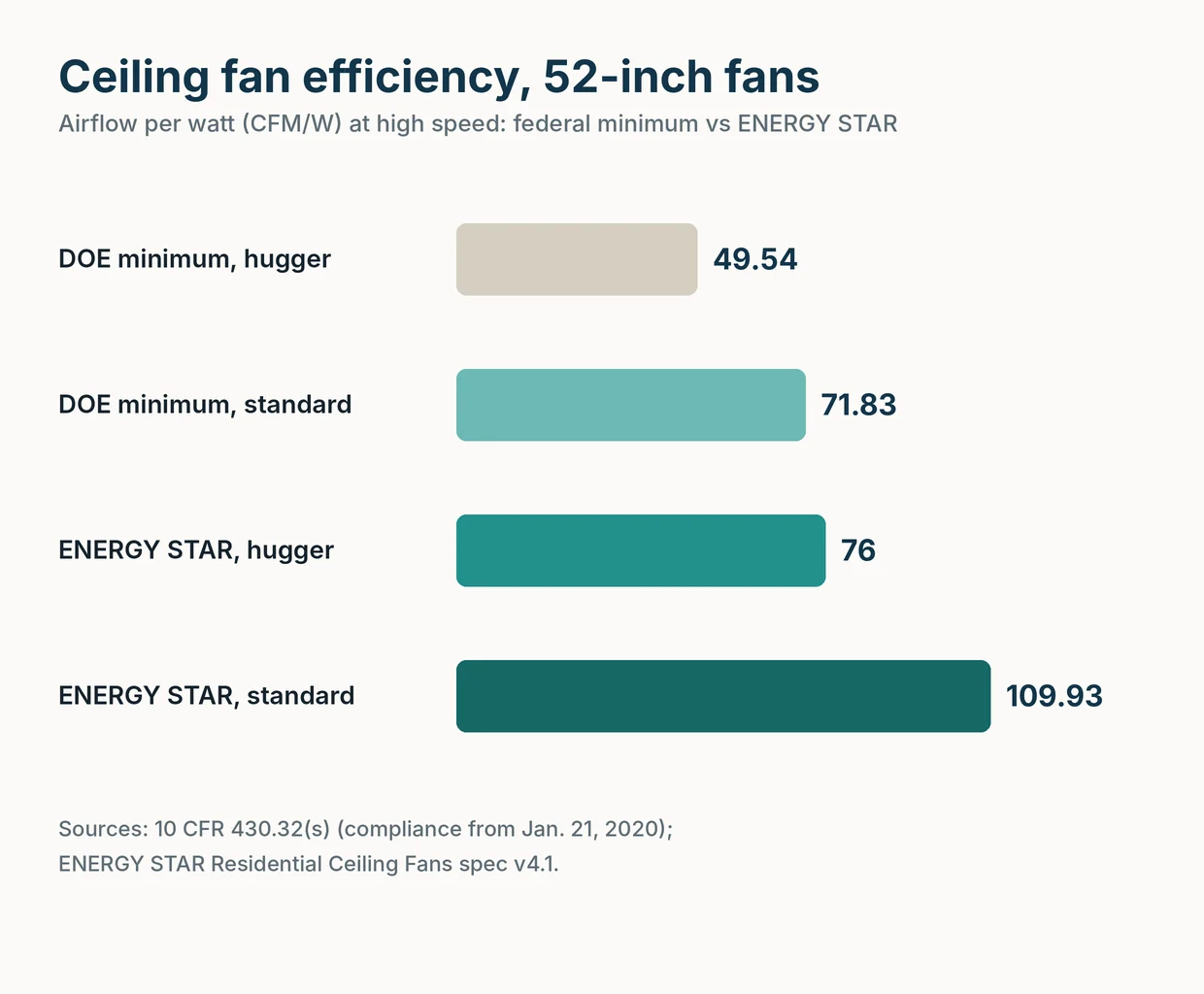
- Look for ENERGY STAR. ENERGY STAR says certified fans are up to 44% more efficient than conventional ones. Our guide to energy efficient ceiling fans explains what to compare.
- Consider a DC motor. CBE found that a brushless DC motor often uses 70% less energy than an AC motor on small fans. See AC vs DC ceiling fans for the trade-offs.
- Big or hot rooms: a fan that moves more air helps; see our picks for high CFM ceiling fans.
We’d pick a fan as the first thing to switch on and the AC as the backup, not the other way round. Even running all summer, a fan costs a few dollars, and it can make a higher thermostat setting feel just as comfortable.
Frequently asked questions
Is it cheaper to run a ceiling fan or an air conditioner?
A ceiling fan, by far. At the July 2026 US average price of 18.31 cents per kWh, a typical ENERGY STAR 52-inch fan on high costs about half a cent an hour, while an 8,000 Btu window AC costs roughly 10 cents an hour while its compressor runs.
Can a ceiling fan replace an air conditioner?
Sometimes. The Department of Energy has said that in moderate climates fans can sometimes replace air conditioning. A fan doesn't lower the room temperature, though, so on very hot days it can only make you feel cooler, not cool the room.
Should I run a ceiling fan with the AC on?
Yes, in rooms you're using. The breeze makes you feel cooler, so you can raise the thermostat (the DOE has said by about 4°F) and stay comfortable. Turn the fan off when you leave the room.
How much does it cost to run a ceiling fan all day?
A median ENERGY STAR 52-inch fan on high uses about 28.6 W. Running 24 hours costs about 13 cents a day at 18.31 cents per kWh, or about $46 a year if it never stops. On low it's a small fraction of that.
Does a ceiling fan cool an empty room?
No. ENERGY STAR puts it simply: ceiling fans cool people, not rooms. A fan in an empty room just uses electricity, so switch it off when you leave.
How many watts does a window air conditioner use?
Based on ENERGY STAR data, a certified 8,000 Btu window unit draws about 533 W while its compressor runs and a 12,000 Btu unit about 800 W. Those are our estimates from the units' median efficiency, not published wattages, so check your unit's label.
Related guides
Ceiling Fans
How Much Electricity Does a Ceiling Fan Use? Watts and Running Cost
A typical ENERGY STAR ceiling fan uses about 3 W on low and 29 W on high, roughly half a cent an hour. Here's the math, a cost table and how to cut it.
8 min read
Buying Guides
AC vs DC Ceiling Fans: Which Should You Buy?
DC fans use far less power, have more speeds and run quieter; AC fans cost less and keep things simple. Here's how to choose.
7 min read
Buying Guides
Best Energy Efficient Ceiling Fans in 2026, Ranked by CFM per Watt
The most efficient ceiling fans we found in ENERGY STAR and EnergyGuide data, plus how CFM per watt, DOE minimums and DC motors work.
11 min read
Buying Guides
High CFM Ceiling Fans: What the Airflow Numbers Mean and 6 Strong Picks
How CFM is measured and labeled, how much airflow a fan of your size should move, why CFM per watt matters too, and six high-airflow fans with verified numbers.
10 min read