AC vs DC Ceiling Fans: Which Should You Buy?
DC fans use far less power, have more speeds and run quieter; AC fans cost less and keep things simple. Here's how to choose.
By Cool Ceiling Ideas editorial teamUpdated 6 min read
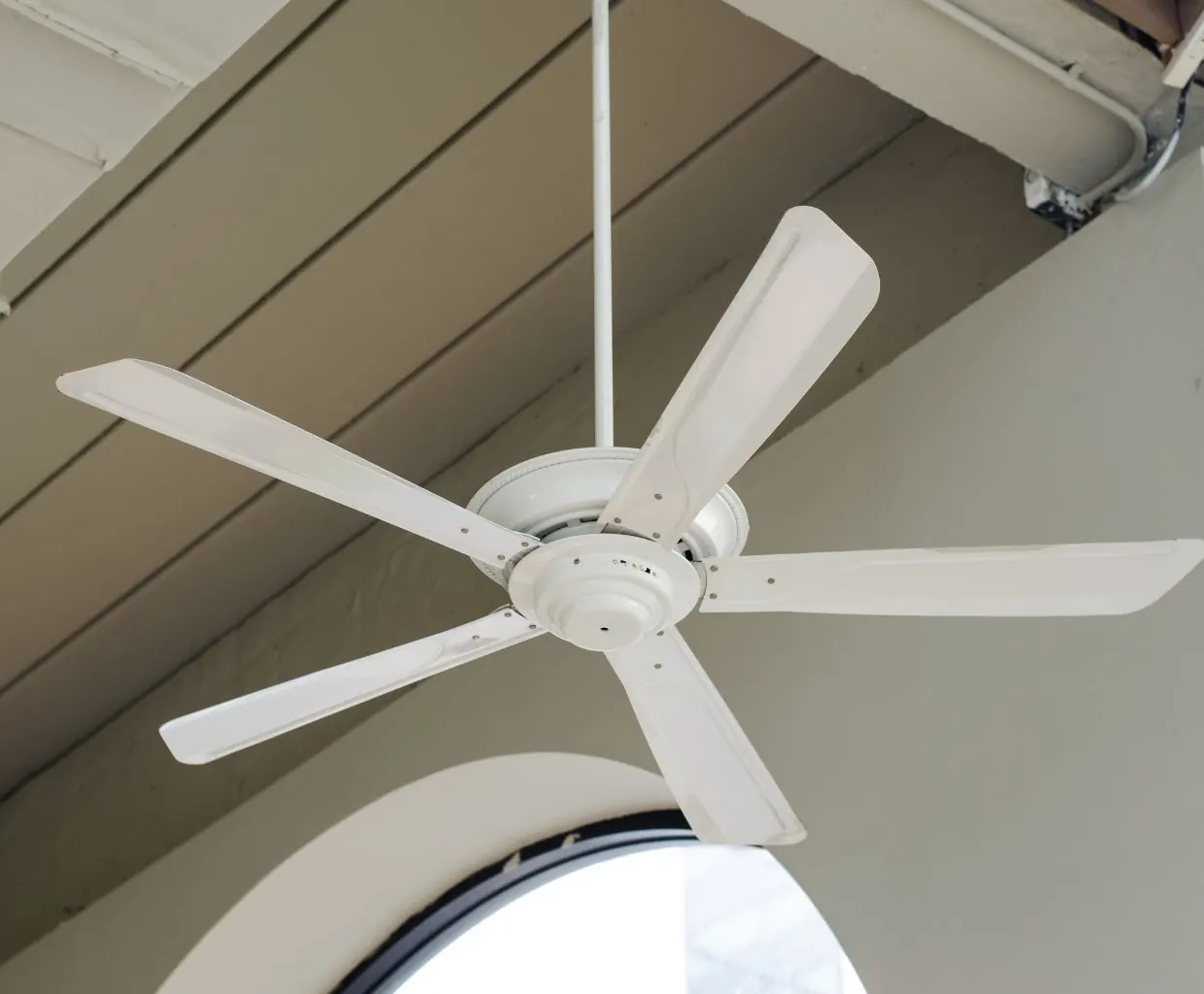
The short answer: buy a DC ceiling fan for rooms where the fan runs for hours every day, like bedrooms and living rooms. It uses much less power, usually has more speeds and tends to run quieter. Buy an AC fan if you’re on a tight budget, the fan will see occasional use, or you want the simplest controls with the fewest electronics.
This page is about the decision. For how each motor works, see our explainer on ceiling fan motor types.
AC vs DC ceiling fans at a glance
| Feature | AC motor | DC (brushless) motor |
|---|---|---|
| Efficiency | Must meet the federal minimum (about 72 CFM/W for a 52 in standard fan) | Often about 70% less energy on home-size fans (CBE) |
| Speeds | Usually three fixed speeds | Tend to have more speed levels |
| Noise | Can hum on some wall speed controls (Hunter) | Quietest motor type (CBE) |
| Reversing | Depends on the model: housing switch, remote, wall control or app | Same: check the spec sheet |
| Price | Basic fans under $100 (CBE, 2020) | Quality DC fans from about $400 (CBE, 2020); some big-box models around $250 today |
| Standby power | Only if it has a remote receiver | Always some (DOE assumed 0.7 W) |
| Reliability | DOE assumed 2.5% need repair | DOE assumed 9% need repair (disputed) |
| Wall speed controls | Only a fan speed control the manual approves; never a light dimmer | Only the remote or control made for that fan |
Efficiency and running cost
This is the biggest difference. UC Berkeley’s Center for the Built Environment (CBE) says a brushless DC motor often uses about 70% less energy than an AC motor on the small motors in home ceiling fans. The DOE explains why: brushless DC motors avoid the rotor energy losses of induction motors. On very large fans (over 7 ft), CBE says the gain is much smaller.
AC fans aren’t inefficient by accident, though. Since January 21, 2020, every new fan has had to meet a federal minimum, and the DOE set it at a level AC fans can reach with larger induction motors.
What does that mean in dollars? The EnergyGuide label doesn’t list the motor type, so here’s a rough comparison between a less efficient fan and a typical efficient one:
| Fan | Watts on high | Yearly cost on high* |
|---|---|---|
| Fan from one EnergyGuide label (49–60 in class) | 66.9 W | About $29 |
| Median ENERGY STAR certified 52 in fan | 28.6 W | About $12 |
*Our arithmetic: 6.4 hours a day (the label’s assumption) at 18.31 cents per kWh, the US average residential price for July 2026 (EIA). Certified fans lean toward DC motors, but neither figure is labeled by motor type.
So an efficient fan can save roughly $16 a year if you run it on high every day, and less on lower speeds. Over the 13.8-year average fan life the DOE assumes, that’s around $225 at today’s prices. In our view, that’s enough to justify a DC fan you use daily, but not one in a guest room.
Either type costs far less to run than air conditioning.
Speeds and comfort
CBE says most standard fans have three fixed speeds, and those are usually AC fans. The catch is the bottom setting: on three-speed fans, CBE found the lowest speed often still moves about 150 ft per minute under the fan, which feels more than 5°F cooler. That can be too much on a cool night.
DC fans tend to have more speed levels, which gives you finer control and a better chance of a gentle low setting. CBE suggests a minimum speed under 80 ft per minute. For bedrooms and nurseries, we’d pick DC for this reason alone.
Noise
CBE rates brushless DC as the quietest motor type. AC fans have one specific weak spot: Hunter says solid-state variable speed controls on AC fans often cause a hum, and a light dimmer on the fan circuit can do the same.
Keep expectations realistic, though. Consumer Reports found that on high, most of a fan’s noise comes from moving air, not the motor, and fans with ridged or textured blades were louder. A DC motor won’t make a fast, high-airflow fan silent. See our picks for the quietest ceiling fans.
Reversing and controls
Every fan made since 2007 has to be reversible (outdoor and industrial fans excepted), so both types can switch to winter mode. Where the control sits varies: CBE says it can be on the wall control, the remote, the motor housing or an app. If you want to reverse the fan without a ladder, check the spec sheet for a reverse button on the remote or wall control.
Controls are where AC and DC differ most in daily life:
- AC fans work with a pull chain, a plain wall switch or a fan speed control. Hunter says to use only its own solid-state speed controls with its fans, and Harbor Breeze warns against any solid-state control or full-range dimmer. Read your manual first.
- DC fans need the remote or wall control made for that fan. Hunter’s universal remote kit, for example, works with most Hunter and Casablanca fans but not with DC-motor models. If the original remote breaks, you’ll need the matching replacement, so buy from a brand that sells one.
With either type, the wall switch still supplies power: a remote can’t start a fan whose switch is off. For app and voice control, see the best smart ceiling fans.
Important: Changing a wall control or swapping a fan means working on household wiring. Turn off the power at the breaker, use a fan-rated ceiling box, follow the manual and local code, and hire a licensed electrician if you’re unsure.
Price and reliability
DC fans cost more. CBE’s 2020 guide put quality efficient DC fans at about $400 and up, with basic fans starting under $100. Prices have come down at big-box stores: Home Depot’s Home Decorators Collection Wesley 52 in DC sells for around $250.
Reliability is the real question mark, and the evidence points both ways:
- The DOE’s assumption: for its cost analysis, the DOE assumed 9% of DC fans and 2.5% of AC fans would need repair, because the extra electronics likely make AC motors more reliable. It also noted DC motors are relatively new in ceiling fans, so problems might only show up as fans age. Efficiency advocates disputed this for lack of data.
- CBE’s view: DC fans tend to be more durable, with better bearings and construction.
Remotes and receivers are electronics too, and many brands cover them for only one year. We’d compare the electronics warranty as closely as the motor warranty. Our best ceiling fan brands guide lists the terms brand by brand.
Who should pick which
Choose a DC fan if:
- The fan runs for hours a day, in a bedroom, nursery, living room or home office
- You want a very low, gentle speed for sleeping
- You want a quiet fan and plan to use a remote or app anyway
Choose an AC fan if:
- It’s for a guest room or another space you use only now and then
- Your budget is tight
- You prefer a pull chain or an existing fan speed control and fewer electronics to fail
Whichever you choose, get the size right first with our ceiling fan size calculator. A well-sized AC fan beats a badly sized DC one.
Our verdict
For most rooms you actually live in, we’d pick a DC fan: lower running costs, more speeds and quieter operation outweigh the higher price over a fan’s life. Look for the ENERGY STAR label and a brand that sells replacement remotes. An AC fan is still the sensible budget choice for rooms where the fan rarely runs.
Frequently asked questions
Is a DC ceiling fan better than an AC one?
For a fan you run many hours a day, usually yes. UC Berkeley's Center for the Built Environment says a brushless DC motor often uses about 70% less energy on home-size fans, and DC fans tend to have more speeds and run quieter. AC fans cost less and are fine for rooms you use occasionally.
Do DC ceiling fans really save money?
Yes, but the savings are modest. In our example, a fan drawing 66.9 W on high costs about $29 a year to run 6.4 hours a day at 18.31 cents per kWh, while a typical ENERGY STAR 52 in fan at 28.6 W costs about $12. The gap grows the more you use the fan.
Can I use a wall speed control with a DC ceiling fan?
Only the control made for that fan. DC fans need their own remote or wall control; Hunter's universal remote kit, for example, doesn't work with its DC-motor fans. Never use a light dimmer to control any ceiling fan.
Are DC ceiling fans less reliable than AC fans?
Nobody has published good field data. The DOE assumed DC fans need repairs more often (9% vs 2.5%) because of their electronics, but efficiency advocates disputed that. CBE says DC fans tend to be better built. Check the warranty on the electronics before you buy.
Why are DC ceiling fans more expensive?
They need an electronic drive, and CBE notes they usually come with better bearings and construction. In 2020, CBE put quality DC fans at about $400 and up, though some big-box DC models now sell for around $250.
Related guides
Buying Guides
Ceiling Fan Motor Types: AC Induction vs Brushless DC Explained
Which motor is in a ceiling fan, how AC induction and brushless DC motors differ, and how efficiency, speeds, noise and standby power compare.
7 min read
Buying Guides
Ceiling Fan Size Guide: What Size Fan Does Your Room Need?
The right blade span for your room, how high to hang the fan, which downrod to buy, and how to read the airflow numbers on the box.
8 min read
Buying Guides
Best Ceiling Fan Brands in 2026: 16 Brands Compared
16 ceiling fan brands compared on motor warranty, DC and smart options, price and who owns them now, plus the warning signs of brands to avoid.
14 min read

Room Ideas
Quietest Ceiling Fans in 2026: Picks for Bedrooms
What independent lab testing says about quiet ceiling fans, six bedroom picks with honest notes on missing noise data, and how to quiet a fan you own.
8 min read