Ceiling Fan Height: How High to Hang a Ceiling Fan
The 7 ft minimum, the 8 to 9 ft sweet spot, ceiling and wall clearances by source, and which mount and downrod fit your ceiling height.
By Cool Ceiling Ideas editorial teamUpdated 8 min read
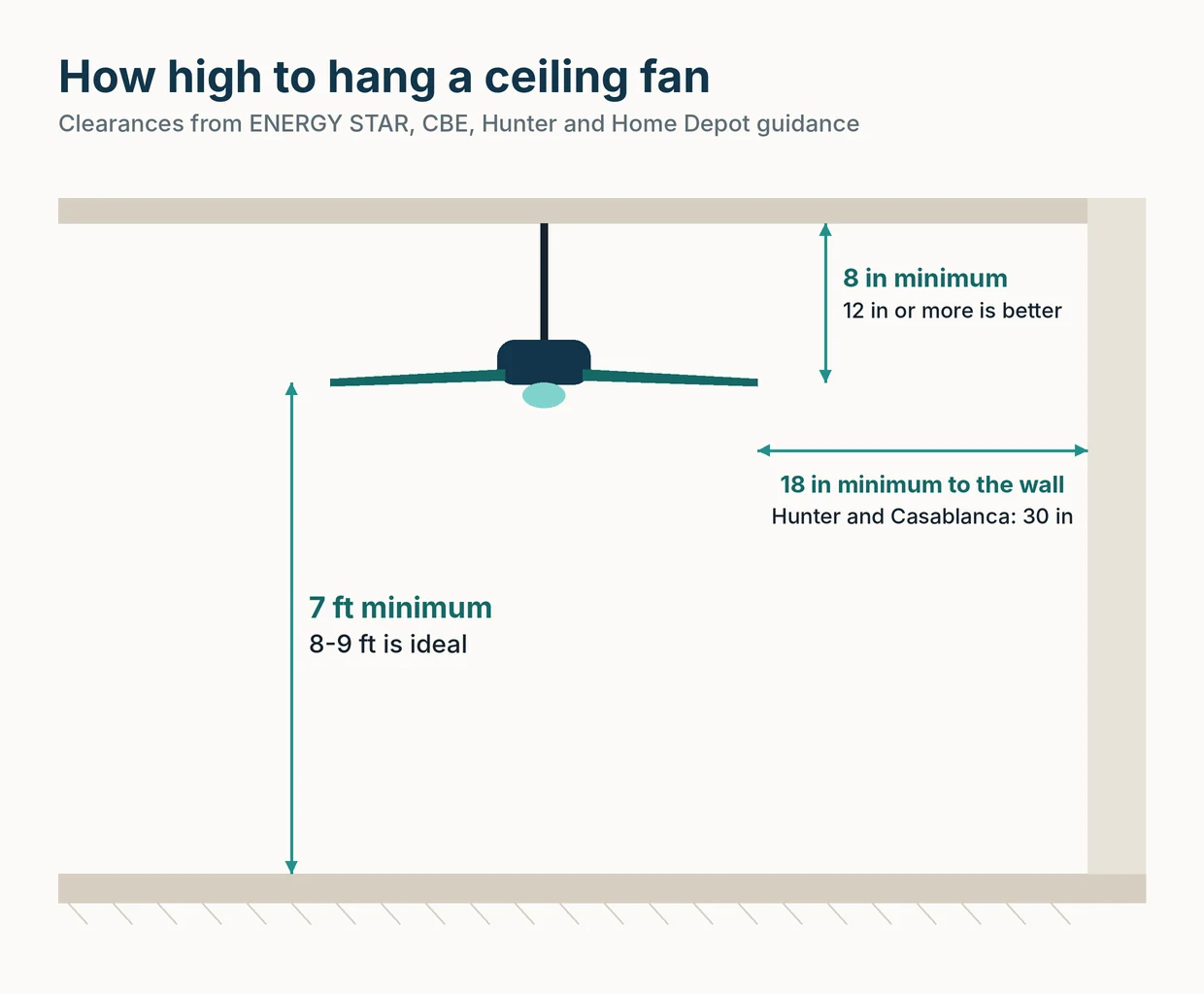
The short answer: hang a ceiling fan so the blades are at least 7 ft above the floor, and ideally 8 to 9 ft. Keep the blades at least 8 in below the ceiling (12 in or more is better) and the blade tips at least 18 in from the nearest wall. On ceilings under 8 ft that means a low-profile (hugger) fan; from 9 ft up, a downrod.
Those numbers aren’t one brand’s opinion. Every source in our research gives the same 7 ft minimum, and they mostly agree on the rest. Below we lay out what each source says, then turn it into a simple chart by ceiling height.
The 7 ft minimum: every source agrees
The one rule nobody disagrees on is the minimum height from the floor to the bottom of the blades: 7 ft (84 in).
- ENERGY STAR: mount the fan at least 7 ft above the floor and 18 in from walls.
- UC Berkeley’s Center for the Built Environment (CBE): standard fans must be at least 7 ft above the floor to prevent accidental contact with the blades.
- Hunter: blades no less than 7 ft from the floor, which Hunter describes as a UL and ETL guideline.
- Casablanca, Minka-Aire, Home Depot and Big Ass Fans: all 7 ft as well.
The rule is there so nobody walks or reaches into spinning blades. Measure it to the lowest point of the blades, not to the motor housing or the ceiling.
Note: The 7 ft rule is about the blades. A light kit can hang lower than the blades, which is a headroom question rather than a blade-safety one. Over a walkway, check the fan’s overall height on the spec sheet as well.
The ideal height: 8 to 9 ft
Seven feet is the floor, not the target. ENERGY STAR says that if your ceiling allows, 8 to 9 ft gives optimal airflow, and Big Ass Fans gives the same range. The other sources land close by:
| Source | Minimum (floor to blades) | Recommended |
|---|---|---|
| ENERGY STAR | 7 ft | 8–9 ft |
| Big Ass Fans | 7 ft | 8–9 ft |
| Hunter | 7 ft | 8 ft |
| Fanimation downrod sheet | Not stated | 7–9 ft |
| UC Berkeley CBE | 7 ft | 8–10 ft (downrod fans in higher-ceiling spaces) |
In our view, 8 ft is the number to plan around. It’s Hunter’s ideal, it sits inside ENERGY STAR’s range, and it’s the default our ceiling fan size calculator uses when it works out a downrod.
Clearances from the ceiling and the walls
Height above the floor is only half the picture. A fan also needs room above the blades to pull air in, and room around the tips.
| Clearance | Minimum | Better | Sources |
|---|---|---|---|
| Blades to ceiling | 8 in | 12 in or more; about 0.2 x fan diameter | CBE, Home Depot, Hunter |
| Blade tips to wall | 18 in | 2–3 ft (CBE) | ENERGY STAR, CBE, Home Depot, Minka-Aire |
| Blade tips to wall (stricter) | 30 in | Not stated | Hunter, Casablanca |
| Large-diameter fans to obstructions | About 3 ft | Not stated | CBE |
Blades to ceiling. CBE says industry standards recommend at least 8 in, and that 12 in or more keeps the fan from being “starved” of air. Its rule of thumb is a gap of at least 0.2 times the fan diameter; for a 52 in fan that works out to about 10.4 in.
Blades to walls. This is where sources split. ENERGY STAR, CBE, Home Depot and Minka-Aire say 18 in. Hunter and Casablanca ask for 30 in from the blade tip to any wall or obstruction. We’d follow whatever your fan’s own manual says, and aim for 30 in when the room allows. Note that Hunter and Casablanca measure to any obstruction, not just walls.
Hugger or downrod? It depends on the ceiling height
Your ceiling height decides the mount type, because the mount decides where the blades end up.
- Under 8 ft: use a low-profile (hugger) or flush-mount fan. ENERGY STAR calls huggers ideal for ceilings under 8 ft, and Hunter and Home Depot say the same. The Department of Energy defines a hugger as a fan whose lowest blade point is 10 in or less from the ceiling.
- About 8 ft: a hugger, flush mount or the short rod in the box. Big Ass Fans suggests flush mounting at 8 ft, while Casablanca’s manuals say their standard included rod is for 8 to 10 ft ceilings.
- 9 ft and up: use a downrod. Hunter says ceilings of 9 ft or more call for one, and Home Depot recommends a downrod fan above 9 ft.
There’s a trade-off at the low end. ENERGY STAR says huggers move less air than regular fans because the blades sit so close to the ceiling, and CBE says they typically have poorer energy performance. On a ceiling under 8 ft, though, a hugger is the only way to keep the blades at 7 ft. Our low profile ceiling fans guide lists models with published ceiling-to-blade measurements.
Tip: Some fans are multi-mount: the DOE notes they can be installed in either standard or hugger configuration. If you might move house or remodel, a multi-mount fan gives you both options.
Ceiling fan height chart by ceiling height
This table combines the mount advice above with Hunter’s downrod chart (ENERGY STAR for 20 ft). The blade heights are our arithmetic using Hunter’s formula: ceiling height minus fan height minus downrod length, with a fan that sits 12 in from the ceiling to the blades before any extra rod, as in Hunter’s own example. Home Depot says most fan housings are 8 to 12 in tall, so your result may differ by a few inches.
| Ceiling height | Mount type | Downrod | Resulting blade height (our math) |
|---|---|---|---|
| 7 ft 8 in | Hugger with blades 8 in or less below the ceiling | None | About 7 ft |
| 8 ft | Hugger or flush mount | None | About 7 ft 4 in (8 in hugger) |
| 9 ft | Standard mount | Rod in the box | About 8 ft |
| 10 ft | Downrod | 12 in (Hunter: 12–18 in) | About 8 ft |
| 11 ft | Downrod | 18–24 in | About 8 to 8.5 ft |
| 12 ft | Downrod | 36 in | About 8 ft |
| 13 ft | Downrod | 48 in | About 8 ft |
| 14 ft | Downrod | 60 in | About 8 ft |
| 15 ft | Downrod | 72 in | About 8 ft |
| 20 ft | Downrod (two rods and a coupler) | 120 in (ENERGY STAR) | About 9 ft |
Two things to notice. First, on an 8 ft ceiling a standard 12 in fan would put the blades at exactly 7 ft, the bare minimum, which is why sources point you to a hugger there. Second, past 15 ft no maker chart we found goes higher, so treat tall-ceiling rows as a starting point.
How to measure for the right height
You need three numbers. Measure in inches, since spec sheets use inches.
- Ceiling height. Measure from the floor to the ceiling where the fan box is (10 ft = 120 in).
- Fan height. Find the distance from the ceiling to the blades without an extra downrod on the fan’s spec sheet or in the manual. If you haven’t chosen a fan yet, 12 in is a safe planning number.
- Target blade height. Use 96 in (8 ft) unless you have a reason to go higher.
Then subtract: ceiling height − fan height − target blade height = downrod length. Example: a 10 ft ceiling is 120 in. Subtract a 12 in fan and 96 in, and you get a 12 in downrod, which matches Hunter’s chart. If the answer is zero or negative, skip the extra rod and use flush mounting or the rod in the box.
While you have the tape out, measure the room’s length and width too. Floor area sets the blade span, and the wider the fan, the more wall clearance it needs. Our ceiling fan size guide covers the sizing side, and the calculator does height and size together.
Important: Whatever the height, the fan must hang from an electrical box listed for fan support, anchored to the structure. Turn off power at the breaker before any work, follow the manual and local code, and hire a licensed electrician if you’re unsure. Our guide to the fan-rated box explains what to look for.
Large-diameter fans
Big fans play by stricter rules. CBE says most large-diameter fans (over 7 ft across) must have their blades at least 10 ft above the floor and need about 3 ft of clearance from obstructions. CBE also notes that UL 507 sets blade tip-speed limits for fans whose blades are below 10 ft. If you’re looking at a fan that size, its manual sets the exact mounting height; check it before you plan the downrod.
Sloped and vaulted ceilings
On a sloped ceiling the same 7 ft minimum applies to the blades, but the angle adds two checks:
- Mount angle. The standard bracket only handles so much slope: Hunter says under 32°, Casablanca 34°, and Minka-Aire’s manuals show 18° to 20° depending on the model. Steeper ceilings need an angled mount kit.
- Blade clearance from the slope. Minka-Aire notes a longer downrod may be needed on steep ceilings so the blades clear the ceiling. Fanimation’s sheet lists minimum downrods by pitch, from the standard rod at 1/12 up to 36 in at 9/12 to 12/12.
Our guide to ceiling fans for sloped ceilings covers angle mounts and the pitch chart in detail.
Special cases: bunk beds and lofts
The 7 ft rule assumes people are standing on the floor. Over a top bunk or a loft bed, the person is far closer to the blades than that rule allows for, and none of the manufacturers in our research say any model is suitable over a bunk bed. We’d skip a ceiling fan directly over a top bunk. Our ceiling fans for bunk beds guide covers safer options, such as clip-on fans or caged fans installed by the 7 ft rule.
Frequently asked questions
What is the minimum height for a ceiling fan?
The blades must be at least 7 ft above the floor. ENERGY STAR, UC Berkeley's Center for the Built Environment, Hunter, Casablanca, Minka-Aire, Home Depot and Big Ass Fans all give the same 7 ft minimum.
What is the ideal ceiling fan height?
ENERGY STAR and Big Ass Fans say 8 to 9 ft from the floor to the blades gives the best airflow. Hunter calls 8 ft ideal, and UC Berkeley's design guide suggests 8 to 10 ft for downrod fans in taller rooms.
How far should ceiling fan blades be from the ceiling?
At least 8 in, according to UC Berkeley's design guide, Home Depot and Hunter. The design guide says 12 in or more is better, or roughly 0.2 times the fan diameter, so the fan isn't starved of air.
How far should a ceiling fan be from the wall?
At least 18 in from the blade tips to the wall, per ENERGY STAR, Home Depot and Minka-Aire. Hunter and Casablanca ask for 30 in, and UC Berkeley's guide says 2 to 3 ft is often recommended.
Can I put a ceiling fan on an 8 ft ceiling?
Yes, but use a low-profile (hugger) fan or flush mounting. A hugger whose blades sit about 8 in below an 8 ft ceiling leaves them about 7 ft 4 in above the floor, which clears the 7 ft minimum.
How high should a large-diameter fan hang?
UC Berkeley's design guide says most large-diameter fans (over 7 ft across) need their blades at least 10 ft above the floor and about 3 ft of clearance from obstructions. Always follow that fan's manual.
Related guides
Buying Guides
Ceiling Fan Size Guide: What Size Fan Does Your Room Need?
The right blade span for your room, how high to hang the fan, which downrod to buy, and how to read the airflow numbers on the box.
8 min read
Buying Guides
Best Energy Efficient Ceiling Fans in 2026, Ranked by CFM per Watt
The most efficient ceiling fans we found in ENERGY STAR and EnergyGuide data, plus how CFM per watt, DOE minimums and DC motors work.
11 min read
Buying Guides
AC vs DC Ceiling Fans: Which Should You Buy?
DC fans use far less power, have more speeds and run quieter; AC fans cost less and keep things simple. Here's how to choose.
7 min read
Buying Guides
Ceiling Fan Motor Types: AC Induction vs Brushless DC Explained
Which motor is in a ceiling fan, how AC induction and brushless DC motors differ, and how efficiency, speeds, noise and standby power compare.
7 min read