Ceiling Fan Speeds: Which Setting to Use for Summer, Winter and Sleep
What low, medium and high really do, which ceiling fan speed to use in summer, winter and at night, and how speed changes watts, cost and noise.
By Cool Ceiling Ideas editorial teamUpdated 8 min read
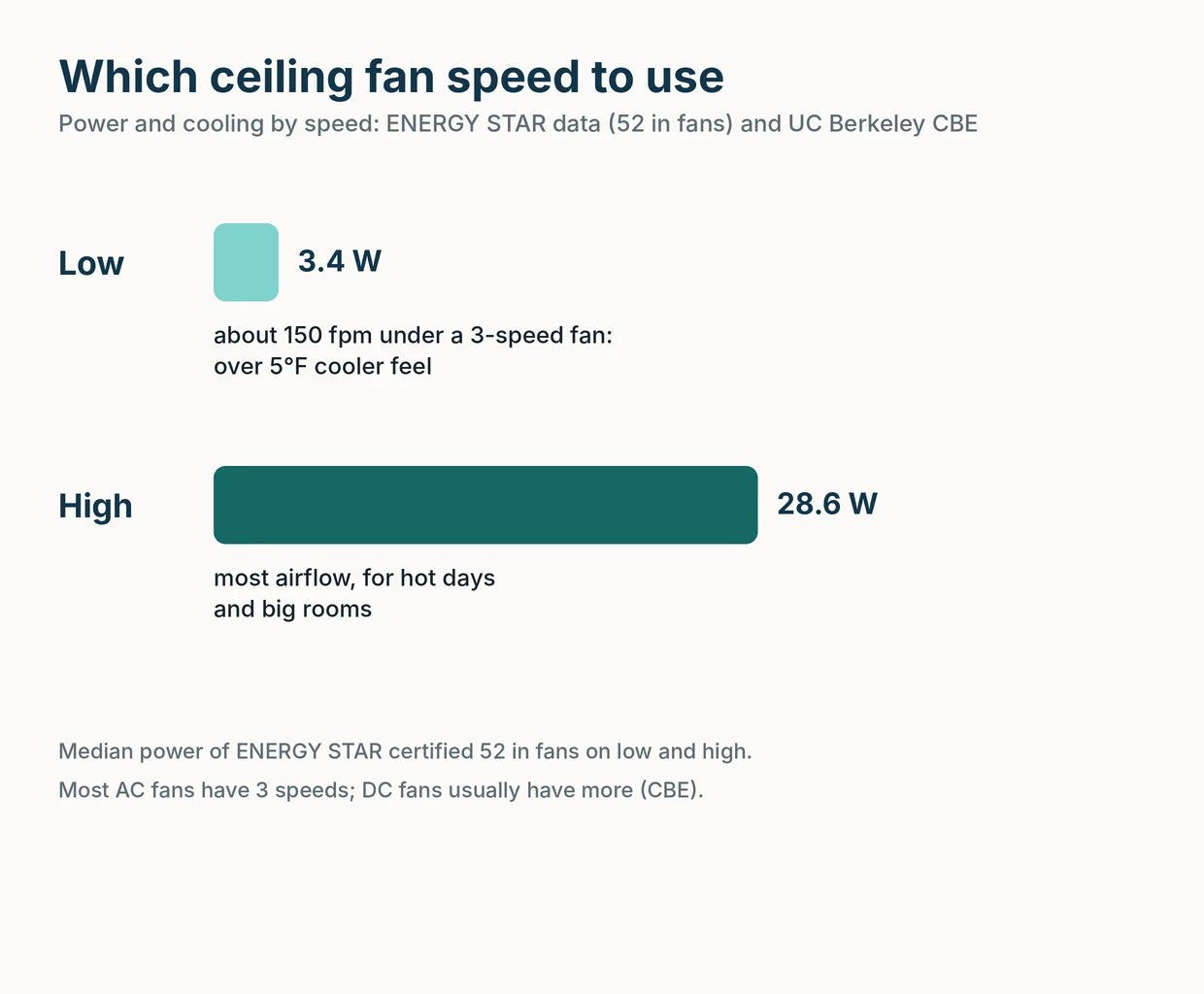
The short answer: use low for winter (clockwise) and for sleeping, and the lowest speed that feels comfortable in summer (counterclockwise), moving up to medium or high only on hot days or in large rooms. Low is not a weak setting: on a typical 3-speed fan it still gives a breeze that feels more than 5°F cooler, and it uses a small fraction of the power of high.
Below is what each speed actually does, how 3-speed AC fans differ from 6-speed DC fans, and what speed means for your electric bill and for noise.
What changes when you change speed
A ceiling fan’s speed setting changes how fast the blades turn (RPM). Everything else follows from that. UC Berkeley’s Center for the Built Environment (CBE) explains the relationships in its ceiling fan design guide:
- Airflow rises in step with RPM. For a given fan, airflow (CFM) and the air speed you feel in the room scale linearly with rotational speed.
- Power rises much faster. CBE notes that power rises with roughly the cube of rotational speed, so the last bit of speed costs the most watts.
- Low speed is far more efficient. Across the fans in CBE’s data, median efficacy was 165 CFM per watt at each fan’s lowest speed but only 79 CFM per watt at its highest speed.
That’s why one fan can look very different depending on which speed you measure. The DOE test procedure for regular home fans measures airflow with sensors 43 in below the blades, first at low speed and then at high speed. The efficiency rating on the EnergyGuide label and in ENERGY STAR listings is a time-weighted average across speeds plus standby power. CBE points out that this average ignores how much air a fan moves at its top and bottom speeds, so two fans with the same rating can feel quite different.
Note: Manufacturers rarely publish airflow or RPM for every speed. The CFM on the box and the EnergyGuide label is the high-speed figure, so compare fans on that, and read our guide to how much electricity a ceiling fan uses for the label basics.
There is also a ceiling on how fast blades may spin. Under the DOE test rules, a reversible fan with blade edges 3.2 to 4.8 mm thick counts as a regular low-speed fan only if its blade tips stay at or below 2,400 feet per minute (3,200 fpm for edges 4.8 mm or thicker). Faster fans fall into a separate high-speed class with different efficiency rules.
Low vs high at a glance
These are the medians for ENERGY STAR certified 52 in ceiling fans, plus CBE’s air-speed figures:
| Speed | Median power (52 in, ENERGY STAR) | What you get | Best for |
|---|---|---|---|
| Low | 3.4 W | About 150 fpm under a typical 3-speed fan, over 5°F cooler feel (CBE) | Sleep, mild days, winter mode |
| Medium | Not reported in the ENERGY STAR data | In between | Most summer evenings |
| High | 28.6 W | The fan’s full rated airflow | Hot afternoons, big rooms, after a workout |
The middle half of certified 52 in fans draw 2.6 to 5.1 W on low and 23.4 to 35.8 W on high, so your fan may land a little above or below these numbers.
Which speed to use: summer, winter and sleep
Summer
Run the fan counterclockwise so it blows air down; ENERGY STAR says you should feel a cool breeze standing under it. Start on low. CBE’s example design air speed of 100 fpm already gives about a 4°F cooling effect, and the low speed of most 3-speed fans often reaches about 150 fpm. Step up to medium or high when the room is hot or the fan has a lot of floor to cover.
Two habits matter more than the exact speed:
- Turn it off when you leave. ENERGY STAR’s rule is simple: fans cool people, not rooms.
- Raise the thermostat. The DOE says a ceiling fan lets you set the AC about 4°F higher without losing comfort.
Winter
Switch the ceiling fan direction to clockwise and use low. ENERGY STAR and the DOE both recommend this to push warm air that collects near the ceiling back down into the room. Keep it on low: in a Harvard study (funded by fan maker Big Ass Fans), medium speed mixed the air more but created drafty air speeds.
CBE adds a useful detail: a fan with a very low minimum speed running forward (summer direction) can mix winter air using less power than a fan with a higher minimum speed running in reverse. That’s one argument for fans with many speed steps.
Sleep
We’d pick the lowest speed that keeps you cool. It uses the least power and makes the least draft, and Healthline lists dry eyes, dry skin and congestion among the drawbacks of a fan blowing on you all night. CBE suggests fans should offer a minimum speed below 80 fpm (about a 3°F cooling effect) That’s well below the roughly 150 fpm many 3-speed fans give on low.
Tip: If your fan still feels too strong on low, a DC model with more speed steps is worth a look for the bedroom. Check its lowest-speed power or airflow on the spec sheet before you buy.
3-speed AC fans vs 6-speed DC fans
CBE says most standard ceiling fans have three fixed speeds and are usually AC-motor fans, while DC-motor fans tend to have more speed levels. Brushless DC motors are driven by electronics, and CBE calls them the most efficient and quietest motor type. Our explainer on ceiling fan motor types goes deeper, and the AC vs DC ceiling fan comparison covers price and reliability.
Here’s how speed counts look on current models in our research files (power from ENERGY STAR or the manufacturer):
| Fan | Motor | Speeds | Power on high | Power on low |
|---|---|---|---|---|
| Hunter Dempsey Low Profile 44 in | AC | 3 | 33 W | Not published |
| Hunter Builder Elite Outdoor 52 in | AC | 3 (pull chain) | 38 W | Not published |
| Hunter Embrook 52 in | DC | 6 | 17.1 W | 1.7 W |
| Hunter ZenTech 52 in | DC | 6 | 25.7 W | 3.1 W |
| Fanimation Odyn Custom 56 in | DC | 16 | 30.6 W | Not published |
The Big Ass Fans Haiku, another DC fan, has seven speeds, and the maker says it can draw as little as 2.4 W on low. In our view, the extra steps matter most in bedrooms and in winter, where you want a speed between “off” and the classic low.
Note: More speeds don’t mean more airflow. Airflow on high depends on the fan’s size, blades and motor; check the CFM on the spec sheet or EnergyGuide label.
How speed affects watts and running cost
The DOE formula for running cost is simple: watts × hours per day ÷ 1,000 = kWh per day, then multiply by days and by your electricity price. Using the median ENERGY STAR 52 in fan and the EIA’s US average residential price of 18.31 cents per kWh (July 2026):
| Scenario | Low (3.4 W) | High (28.6 W) |
|---|---|---|
| 8 h a day for 30 days | 0.82 kWh, about $0.15 | 6.86 kWh, about $1.26 |
| 6.4 h a day for a year (the EnergyGuide usage basis) | 7.9 kWh, about $1.45 | 66.8 kWh, about $12.23 |
Even on high, an efficient fan is cheap to run. The gap between speeds grows with the hours you run the fan and the number of fans in the house. A remote or DC fan also draws a little standby power: the median for certified 52 in fans is 0.6 W. The full breakdown, including AC comparisons, is in our article on how much electricity a ceiling fan uses.
How speed affects noise
Fan makers rarely publish decibel figures by speed, and none of the fans in our research files have verified dB data. What the manuals and support pages do say:
- Controls cause more hum than speed does. Hunter says a wall light dimmer or variable speed control on the fan circuit is a common cause of humming, and that solid-state variable speed controls used with AC motors often hum.
- Never use a light dimmer on a fan. Harbor Breeze warns that controlling fan speed with a full-range dimmer causes a loud hum and is a fire and shock risk.
- New fans settle in. Harbor Breeze allows a break-in period of a few days, during which a new fan may be noisier, especially at medium and high speeds.
- DC motors are quieter. CBE rates brushless DC as the quietest motor type, and Hunter markets its 6-speed Eco-DC motor as whisper-quiet.
For bedrooms, the Sleep Foundation cites research that noise as low as about 33 to 48 dB can affect sleep.
Changing how you control speed
Most fans come with a pull chain, a remote or a wall control, and the speeds you get depend on it. The Lutron Caseta fan control, for example, gives four speeds from the wall, but only for AC fans; it doesn’t work with DC motors or fans with their own speed modules. DC fans need the remote or wall control made for that fan. If you add a remote to a pull-chain fan, the chain usually has to stay on high so the remote can reach every speed. Our guide to choosing a ceiling fan wall control explains which types work with which fans.
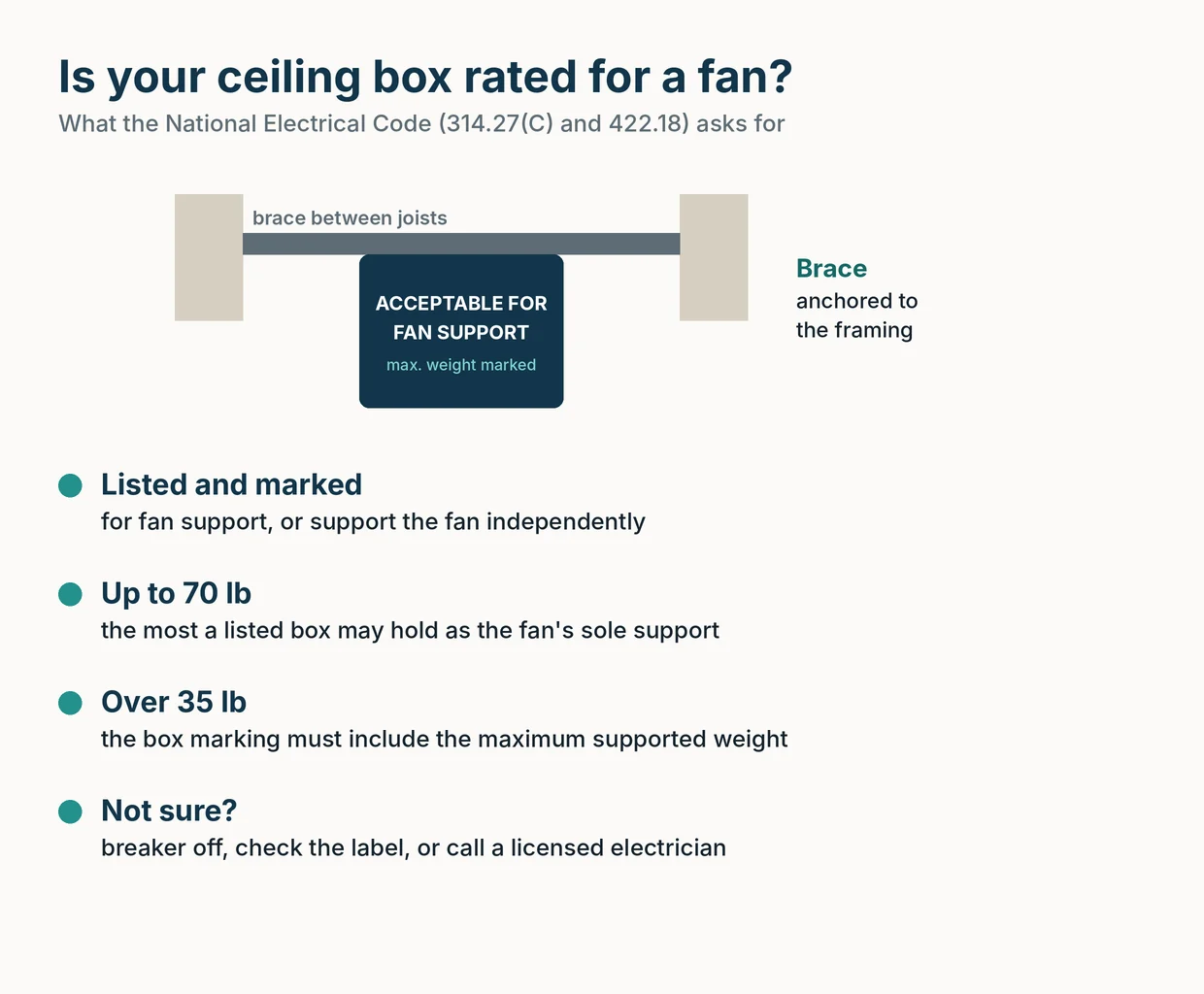
Important: Replacing a wall switch is electrical work. Turn off power at the breaker, make sure the fan hangs from a fan-rated box, follow the control’s manual and local code, and hire a licensed electrician if you’re unsure.
Frequently asked questions
What speed should a ceiling fan be on in summer?
Use the lowest speed that keeps you comfortable, with the fan spinning counterclockwise. UC Berkeley's Center for the Built Environment says the low speed of a typical 3-speed fan often gives about 150 fpm under the fan, which feels more than 5°F cooler. Go to medium or high on hot days or in big rooms.
What speed should a ceiling fan be on in winter?
Low, with the fan turning clockwise. ENERGY STAR and the DOE both say this gently pushes warm air from the ceiling back down into the room without creating a chilly breeze.
Does a ceiling fan use more electricity on high?
Yes, much more. The median ENERGY STAR certified 52 in fan draws 3.4 W on low and 28.6 W on high, so high uses more than eight times the power of low.
How many speeds does a ceiling fan have?
Most standard AC-motor fans have three fixed speeds: low, medium and high. DC-motor fans usually have more, commonly six, and some have seven or more. Check the spec sheet of the model you're looking at.
What is the best ceiling fan speed for sleeping?
Usually the lowest speed that keeps you cool. Low uses the least power and creates the least draft, which matters because a strong breeze all night can dry your eyes, nose and skin. A DC fan with a very low first speed gives you finer control.
Can I add more speeds to a 3-speed ceiling fan?
Only with a control made for that fan. Some wall controls, such as the Lutron Caseta fan control, offer four speeds for compatible AC fans, but they don't work with DC motors. Never use a light dimmer to control a fan motor.
Related guides
How-To
Ceiling Fan Direction: Which Way Should It Spin in Summer and Winter?
Counterclockwise in summer, clockwise on low in winter. How to check which way your fan spins, how to switch it on any fan, and how much it really helps.
8 min read
Buying Guides
AC vs DC Ceiling Fans: Which Should You Buy?
DC fans use far less power, have more speeds and run quieter; AC fans cost less and keep things simple. Here's how to choose.
7 min read
How-To
Ceiling Fan Wobble: Why It Happens and How to Fix It
Most wobbly fans need tightened screws and a balancing kit, not a new fan. Here's the fix in order, and the signs that wobble is a safety problem.
7 min read
How-To
Fan Rated Box: How to Tell If Your Ceiling Box Can Hold a Fan
A ceiling fan needs a box listed and marked for fan support, or its own support from the framing. Here's what the code says and how to check your box.
8 min read