How Much Electricity Does a Ceiling Fan Use? Watts and Running Cost
A typical ENERGY STAR ceiling fan uses about 3 W on low and 29 W on high, roughly half a cent an hour. Here's the math, a cost table and how to cut it.
By Cool Ceiling Ideas editorial teamUpdated 8 min read
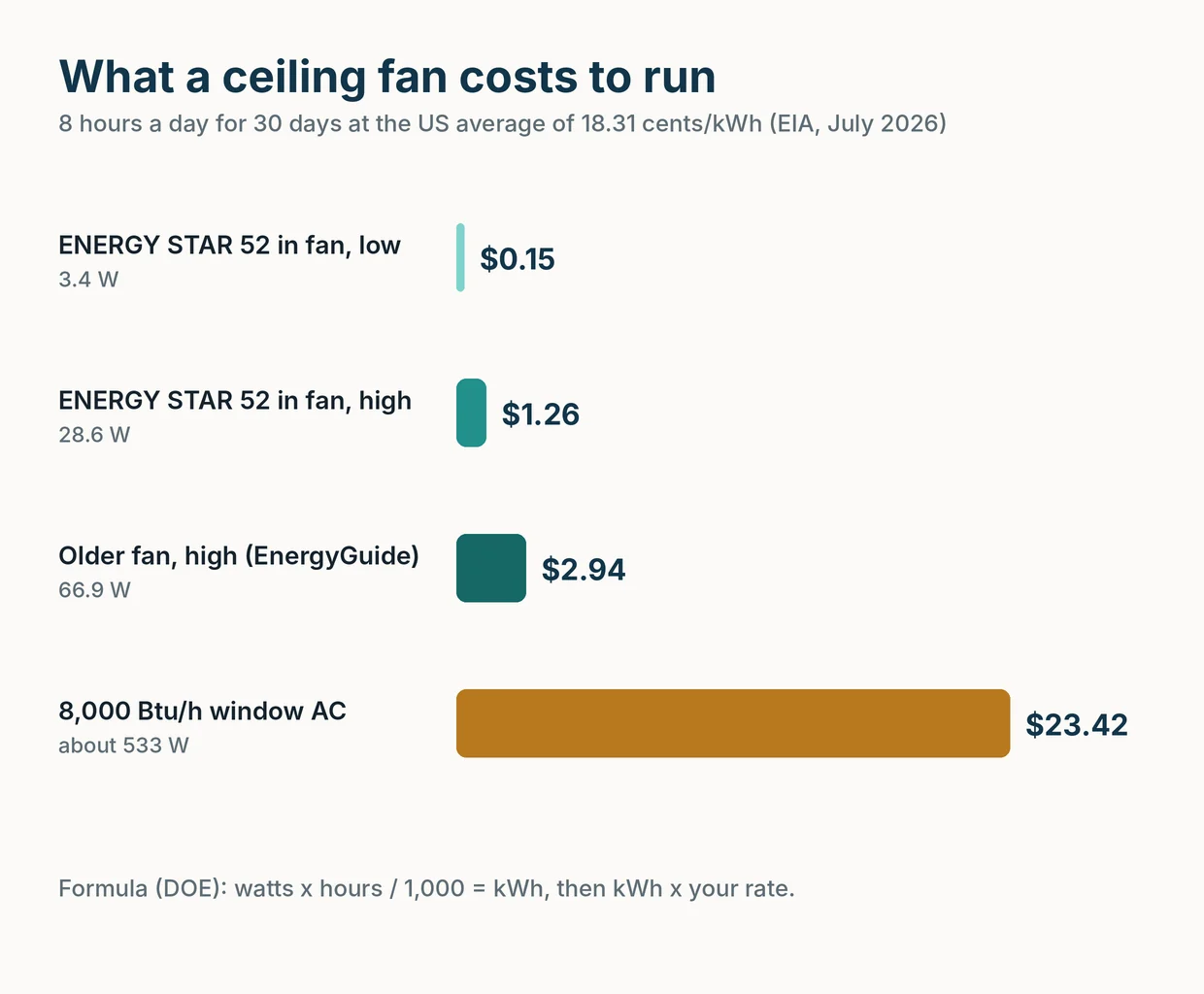
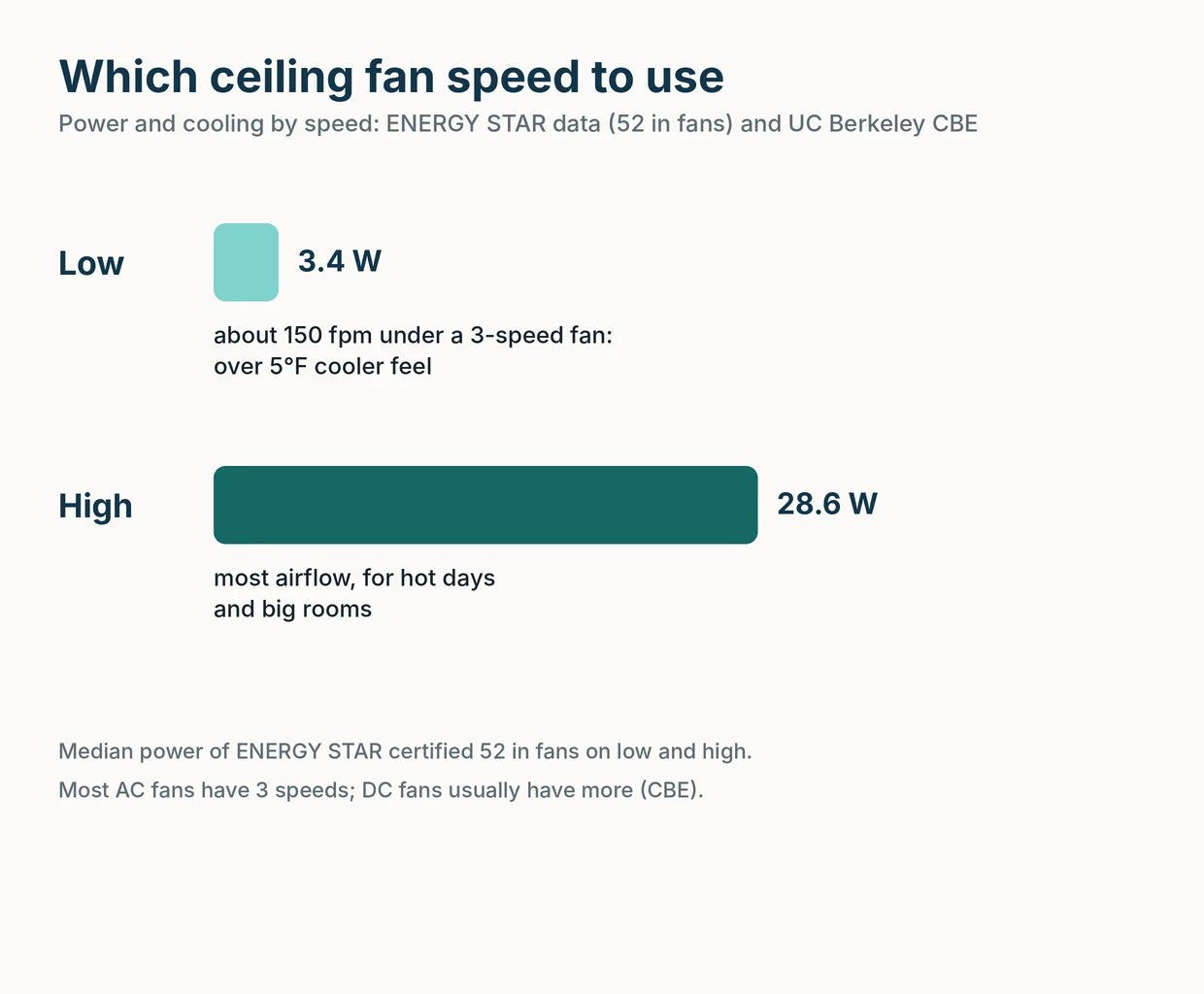
The short answer: not much. The median ENERGY STAR certified 52-inch ceiling fan uses 3.4 W on low and 28.6 W on high. At the July 2026 US average electricity price of 18.31 cents per kWh, that’s about half a cent an hour on high and $1.26 a month if you run it 8 hours a day. Older fans use more, and a window air conditioner uses roughly 19 times as much as an efficient fan on high.
How many watts a ceiling fan uses, by speed
Ceiling fans don’t have one wattage. Power climbs steeply with speed, and the DOE notes that a fan on a higher setting uses more electricity than on a lower one.
We pulled the medians from ENERGY STAR’s official dataset of certified fans (626 fans with a 52-inch blade span, the most common size):
| Setting | Median watts (ENERGY STAR 52 in) | Middle half of fans | Cost per hour at 18.31¢/kWh |
|---|---|---|---|
| Low | 3.4 W | 2.6–5.1 W | about 0.06¢ |
| High | 28.6 W | 23.4–35.8 W | about 0.5¢ |
| Standby (remote/receiver) | 0.6 W | – | about 0.01¢ |
Across all 1,389 certified fans with data, the medians are almost the same: 3.4 W on low and 29.6 W on high. The dataset doesn’t report medium speed, so we can’t give you a verified middle figure; it falls somewhere between the two.
Note: these are medians for certified fans, which lean toward efficient DC-motor models. A basic AC-motor fan can draw noticeably more. One EnergyGuide label for a fan sold at Lowe’s shows 66.9 W on high, excluding lights. That’s one example, not an average, but it shows the range.
Why the gap? Motor type is the big factor. UC Berkeley’s Center for the Built Environment says a brushless DC motor often uses about 70% less energy than an AC motor on home-size fans. Our AC vs DC ceiling fans comparison covers the trade-offs, and ceiling fan motor types explains how each motor works.
How to calculate what your fan costs
The DOE’s formula works for any appliance, including your fan:
- Watts × hours per day ÷ 1,000 = kWh per day
- kWh per day × days of use = kWh for the period
- kWh × your price per kWh = cost
For the price, we use 18.31 cents per kWh, the US average residential rate for July 2026, the latest month the EIA had published (it was 17.45 cents in July 2025). Summer prices run higher than the yearly average, so check your own bill for your actual rate and swap it in.
Here’s the median ENERGY STAR fan on high, 8 hours a day for 30 days:
- 28.6 W × 8 h × 30 days ÷ 1,000 = 6.86 kWh
- 6.86 kWh × $0.1831 = $1.26 a month
And the same fan on low:
- 3.4 W × 8 h × 30 days ÷ 1,000 = 0.82 kWh
- 0.82 kWh × $0.1831 = $0.15 a month
Tip: find your fan’s wattage on its EnergyGuide label, the spec sheet or the manual. If it has a light kit, add the wattage printed on the bulbs while the light is on. The label’s fan figure leaves lights out.
Monthly and yearly running cost
All figures use 18.31 cents per kWh. “Month” is 8 hours a day for 30 days; “year” is 8 hours a day for 365 days.
| Device (watts) | Cost per hour | Per month (8 h/day) | Per year (8 h/day) |
|---|---|---|---|
| ENERGY STAR 52 in fan, low (3.4 W) | 0.06¢ | $0.15 | $1.82 |
| ENERGY STAR 52 in fan, high (28.6 W) | 0.5¢ | $1.26 | $15.29 |
| Older fan, high (66.9 W) | 1.2¢ | $2.94 | $35.77 |
| 8,000 Btu/h window AC (about 533 W) | 9.8¢ | $23.42 | $284.97 |
The yearly window AC line is only for comparison; nobody runs one 365 days a year. The year figures are our own math with the same DOE formula, for example 28.6 W × 8 h × 365 days ÷ 1,000 = 83.51 kWh × $0.1831 = $15.29.
Worst case for a fan: the median ENERGY STAR fan on high, never switched off, uses 250.54 kWh a year (28.6 W × 24 h × 365 days ÷ 1,000), which comes to $45.87. Even then it’s a small line on your bill. In our view, the bigger waste is cooling an empty room, not the fan itself.
Ceiling fan vs air conditioner
This is where the numbers get interesting. ENERGY STAR certified 8,000 Btu/h window units have a median efficiency (CEER) of 15, which works out to about 533 W while the compressor runs. A 12,000 Btu/h unit works out to about 800 W. Those wattages are our estimates derived from ENERGY STAR data, not published figures.
Take a 4-month summer (120 days) at 8 hours a day:
- Fan on high: 28.6 W × 8 h × 120 days ÷ 1,000 = 27.46 kWh = about $5.03
- 8,000 Btu/h window AC: 533 W × 8 h × 120 days ÷ 1,000 = 511.68 kWh = about $93.69
The AC figure assumes the compressor runs nonstop. In real use it cycles on and off, so the true cost is usually lower.
Central air uses much more again. We couldn’t find a current government wattage figure; Hunter, a fan maker, puts central AC at 2,000 to 5,000 W while running, so treat that as a rough range. The EIA says air conditioning used about 19% of all US home electricity in 2020.
The catch: a fan doesn’t lower the temperature, it makes you feel cooler with a breeze. That’s why the money is in using both together.
Standby power: does a fan use electricity when it’s off?
Fans with electronics draw a trickle even when the blades are still. That includes every DC-motor fan (the drive electronics are always powered) and AC fans sold with a remote receiver.
ENERGY STAR’s data puts the median standby draw of certified 52-inch fans at 0.6 W:
- 0.6 W × 24 h × 365 days ÷ 1,000 = 5.26 kWh
- 5.26 kWh × $0.1831 = about $0.96 a year
A plain pull-chain AC fan with no receiver, switched off at the wall, draws nothing. For most homes, standby power isn’t worth worrying about.
How to read the EnergyGuide label
Most new ceiling fans sold in the US carry a yellow FTC EnergyGuide label (large-diameter and high-speed small-diameter fans are exempt). By federal rule it shows:
- Estimated yearly energy cost
- Airflow in cubic feet per minute (CFM)
- Energy use in watts, excluding lights
- Airflow efficiency in CFM per watt
- The cost range of similar models
The cost on the label assumes 6.4 hours a day at 12 cents per kWh, which is well below today’s average price. For fans 19 to 84 inches, the label’s cost range for similar models is $3 to $34 a year.
To get a more realistic number, rerun the label’s math at your own rate. For the 66.9 W fan on that Lowe’s label: 66.9 W × 6.4 h × 365 days ÷ 1,000 = 156.28 kWh. That’s $18.75 a year at 12 cents, but $28.61 at 18.31 cents. The median ENERGY STAR fan on high, on the same basis, comes to about $12.23 a year at 18.31 cents.
Note: a higher CFM per watt means more air for each watt. That same Lowe’s label shows 4,777 CFM and 71.4 CFM/W, and says 49 to 60 inch fans range from about 51 to 176 CFM/W on high. If you want strong airflow without the higher bill, compare CFM/W, not just CFM.
Ways to cut the cost
The fan is already cheap to run, so the real savings come from how it lets you use less air conditioning.
- Raise the thermostat about 4°F. The DOE says a ceiling fan lets you set the thermostat about 4°F higher without losing comfort, and in moderate climates a fan can sometimes replace AC altogether. This is by far the biggest saving.
- Turn it off when you leave. ENERGY STAR puts it simply: ceiling fans cool people, not rooms. A fan spinning over an empty room does nothing useful.
- Use low when it’s enough. On the median ENERGY STAR fan, low uses about one-eighth the power of high.
- Set the right direction. Counterclockwise in summer for a cooling breeze; clockwise on low in winter to push warm air down from the ceiling. Our ceiling fan direction guide shows how to check and switch it.
- Pick the right size. A fan sized for the room moves enough air on a lower setting. The ceiling fan size calculator gives you a blade span for your room.
- Choose ENERGY STAR when you replace a fan. ENERGY STAR says certified fans are up to 44% more efficient than conventional ones. We’d look for a DC motor in any room where the fan runs for hours a day. See our picks of energy efficient ceiling fans.
Important: if you’re swapping out an old fan, turn off power at the breaker first, make sure the ceiling box is a fan-rated box, and follow the manual and local code. If you’re unsure about the wiring, hire a licensed electrician.
Our take: unless your fan is an old, power-hungry model running around the clock, its electricity cost is a rounding error. We’d spend your attention on turning it off in empty rooms and nudging the thermostat up instead.
Frequently asked questions
How many watts does a ceiling fan use?
The median ENERGY STAR certified 52-inch fan draws 3.4 W on low and 28.6 W on high, plus about 0.6 W on standby. Older or less efficient fans use more: one EnergyGuide label for a fan sold at Lowe's shows 66.9 W on high.
How much does it cost to run a ceiling fan for 8 hours?
At the July 2026 US average of 18.31 cents per kWh, a median ENERGY STAR 52-inch fan on high uses 0.23 kWh in 8 hours, about 4 cents. On low it's about half a cent.
Is it expensive to leave a ceiling fan on all day?
Not in dollars. A median ENERGY STAR fan on high running 24 hours a day all year costs about $45.87 at 18.31 cents per kWh. But ENERGY STAR notes fans cool people, not rooms, so a fan in an empty room is money spent for nothing.
Does a ceiling fan use more electricity than an air conditioner?
No, far less. An 8,000 Btu/h ENERGY STAR window AC draws about 533 W while its compressor runs, around 19 times a median ENERGY STAR fan on high. Central AC draws a few thousand watts while running.
Do ceiling fans use electricity when they're turned off?
Fans with a remote receiver or a DC motor draw a little standby power. The median for ENERGY STAR certified 52-inch fans is 0.6 W, which costs about $1 a year. A fan without electronics, switched off at the wall, draws nothing.
Does a ceiling fan use more electricity on high?
Yes. The DOE notes a fan on higher speed uses more power. For ENERGY STAR 52-inch fans the median is 3.4 W on low and 28.6 W on high, so high uses about eight times as much.
Related guides
Ceiling Fans
Best Low Profile Ceiling Fans in 2026 for Low Ceilings
Hugger fans for ceilings under 8 ft: how low each one sits, how much air it moves, and which to pick for small, standard and large rooms.
11 min read
Ceiling Fans
Best Smart Ceiling Fans in 2026: App, Voice & Matter Picks
Smart ceiling fans compared by app, voice assistant and Matter support, plus three ways to make the fan you already have smart.
11 min read
Ceiling Fans
Best Outdoor Ceiling Fans in 2026: Damp vs Wet Rated Picks
Damp-rated fans belong under a solid roof; wet-rated fans can take rain. Six picks for porches, pergolas and the coast, plus the warranty fine print.
11 min read
How-To
Ceiling Fan Speeds: Which Setting to Use for Summer, Winter and Sleep
What low, medium and high really do, which ceiling fan speed to use in summer, winter and at night, and how speed changes watts, cost and noise.
8 min read