High CFM Ceiling Fans: What the Airflow Numbers Mean and 6 Strong Picks
How CFM is measured and labeled, how much airflow a fan of your size should move, why CFM per watt matters too, and six high-airflow fans with verified numbers.
By Cool Ceiling Ideas editorial teamUpdated 10 min read
Our picks at a glance
- Check price on Amazon
Most airflow with a light
11,879 CFM on its EnergyGuide label, an integrated LED and HunterSMART app control.
- 84 in. blades
- 11,879 CFM
- Damp-rated
- Check price on Amazon
Most airflow, fan only
11,694 CFM from a 72 in. DC fan with no light kit, for covered patios and great rooms.
- 72 in. blades
- 11,694 CFM
- Damp-rated
- Check price on Amazon
Best with standard bulbs
11,319 CFM and two E26 sockets, so you can choose your own bulbs.
- 70 in. blades
- 11,319 CFM
- DC motor
- Check price on Amazon
Most efficient big fan
Over 10,000 CFM with a 373 CFM/W EnergyGuide efficiency figure.
- 72 in. blades
- 10,242 CFM
- 373 CFM/W label
- Check price on Amazon
Brightest light
8,725 CFM from 12 blades plus a 40 W integrated LED.
- 65 in. blades
- 8,725 CFM
- ENERGY STAR
- Check price on Amazon
Premium smart pick
Up to 17,369 CFM for the line, a published sound claim and Matter support.
- 52, 60 or 84 in.
- DC motor
- Matter
Prices change often; Amazon shows the current price. As an Amazon Associate, Cool Ceiling Ideas earns from qualifying purchases.
The short answer: CFM (cubic feet per minute) is how much air a ceiling fan moves on its top speed, and you’ll find it on the yellow EnergyGuide label on the box. A “high CFM” fan is one that moves clearly more air than other fans of the same size. For a 52 in. fan, anything well above about 3,700 CFM is strong. For big rooms, the 70 to 84 in. fans below move 8,700 to almost 12,000 CFM.
Don’t shop on CFM alone, though. A fan has to suit the room, and how much power it burns to move that air (CFM per watt) matters as much as the headline number.
What CFM means and how it’s measured
CFM is a volume of air per minute. For ceiling fans it isn’t a number the maker can pick freely. The US Department of Energy’s test procedure measures airflow with air-velocity sensors 43 in. below the blades. Ordinary fans are tested at low speed and then high speed, and the standby power drawn by the remote receiver or electronics is measured too.
The airflow figure you see on the box is the high-speed airflow. On low, the same fan moves far less.
How to read the EnergyGuide label
The FTC requires an EnergyGuide label on the main display panel of the box for most ceiling fans. It shows four things:
- Airflow in CFM
- Energy use in watts, not counting the lights
- Airflow efficiency in CFM per watt
- Estimated yearly energy cost, assuming 6.4 hours a day at 12 cents per kWh, with a bar showing the range for similar fans ($3 to $34 a year for fans 19 to 84 in.). Our guide to how much electricity a ceiling fan uses shows how to work out the cost at your own electricity rate.
Two details trip people up. A fan that can be mounted both flush and on a downrod has to show its lowest-efficiency configuration. And the efficiency figure is a weighted average across speeds plus standby, so it isn’t simply airflow divided by watts.
Note: Large-diameter fans (over 7 ft) and high-speed small-diameter fans don’t need an EnergyGuide label, so for those you’ll rely on the maker’s spec sheet.
How much CFM should a fan move? The ENERGY STAR benchmark
There’s no reputable chart of “CFM per square foot of room”. The best yardstick is ENERGY STAR’s minimum airflow: a certified standard fan has to move at least this much on high speed.
| Blade span | ENERGY STAR minimum airflow (high speed) |
|---|---|
| 36 in. or smaller | 1,767 CFM |
| 44 in. | 2,640 CFM |
| 52 in. | 3,687 CFM |
| 54 in. | 3,976 CFM |
| 60 in. | 4,909 CFM |
| 72 in. | 7,069 CFM |
| 78 in. or larger | 8,296 CFM |
Between 36 and 78 in., the floor is 250 × π × (blade span ÷ 24)², which works out to about 250 CFM for every square foot the blades sweep. Hugger (flush) fans get a lower floor: about 2,950 CFM at 52 in., because blades close to the ceiling move less air.
We’d treat a fan well above the floor for its size as high-airflow, and one close to it as average. Our ceiling fan size calculator shows this benchmark for the blade span it recommends.
Why CFM alone isn’t everything
Efficiency: CFM per watt
Two fans can move the same air for very different amounts of power. UC Berkeley’s Center for the Built Environment (CBE) found the median fan manages 165 CFM/W at its lowest speed but only 79 CFM/W at its highest, because power rises with the cube of the speed while airflow rises only in step with it. That’s why the fastest setting is the least efficient one.
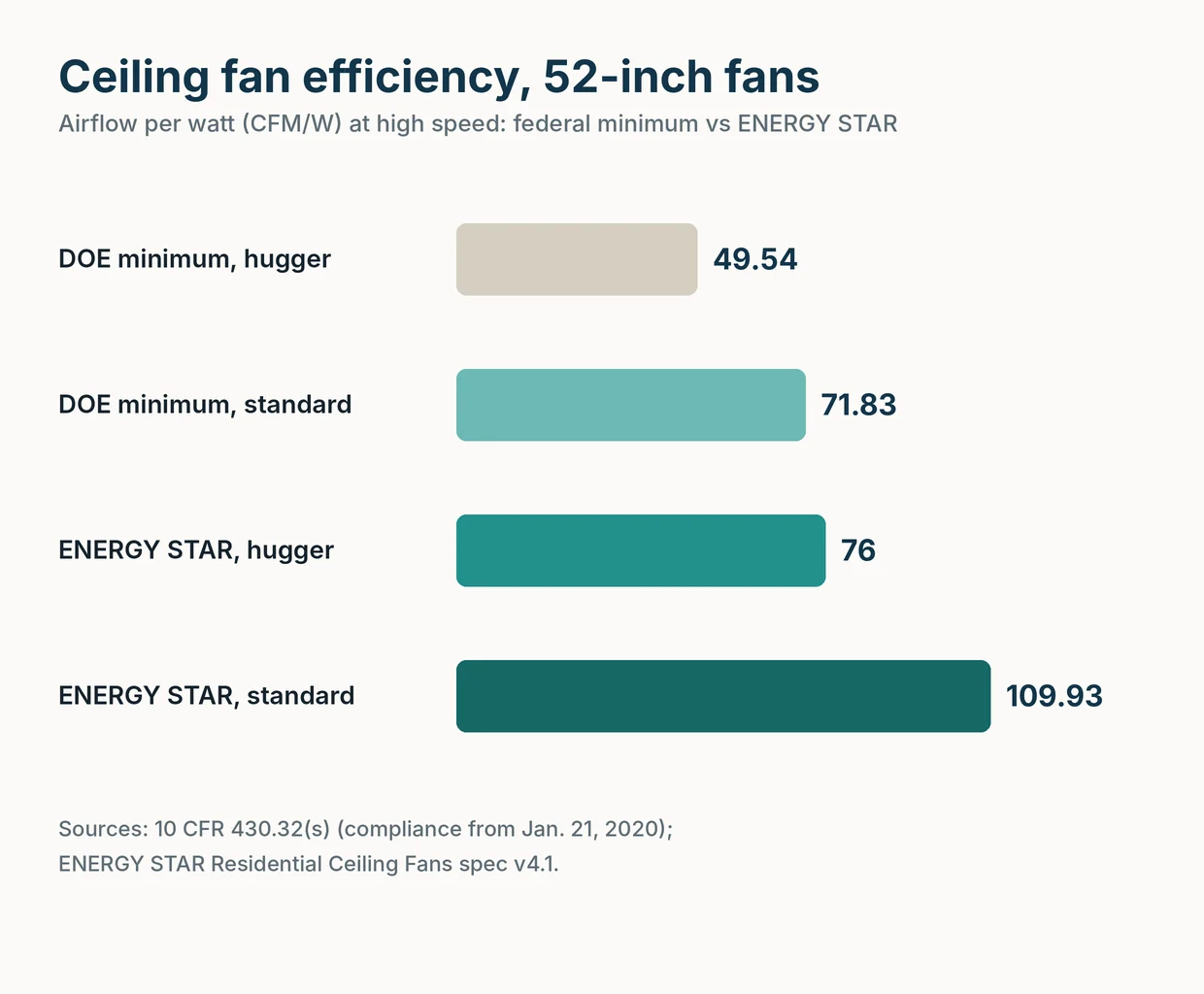
The legal floor is low. A 52 in. standard fan only has to reach about 72 CFM/W under DOE rules, while ENERGY STAR asks for about 110 CFM/W at the same size. The large DC fans below are rated 238 to 387 CFM/W. CBE says brushless DC motors often use 70% less energy than AC motors on small fans; see our AC vs DC ceiling fans guide for the trade-offs.
One catch from CBE: the weighted efficiency figure ignores how much air a fan moves at its top and bottom speeds, so a fan with a weak top speed can still rate well. Compare CFM and CFM per watt together. Our guide to energy efficient ceiling fans goes deeper into the ENERGY STAR and DOE efficiency levels.
Blade span and pitch
A bigger blade span sweeps more area, which is the main reason the fans below move so much air. Blade pitch matters too: CBE notes that steeper blade angles raise airflow at the cost of efficiency, and that more blades add airflow but also weight and drag.
Room size
More CFM than the room needs just means a draft. Size the fan first with our ceiling fan size guide, then compare airflow between fans of that size.
A quick checklist for comparing high-CFM fans
- Fix the blade span first, from the room size.
- Check the CFM on the EnergyGuide label against the ENERGY STAR floor for that span in the table above.
- Compare CFM per watt between fans of the same size, not across sizes.
- Look at watts on high if you’ll run the fan at top speed for long periods.
- Confirm the location rating (dry, damp or wet) and the mounting options for your ceiling.
Tip: If two fans of the same size are close on CFM, pick the one with more speed settings. A strong fan with a gentle low speed covers both hot afternoons and quiet nights.
How we chose
We don’t test fans. From the high-airflow fans in our research shortlist, we kept current DC models with a published airflow figure (EnergyGuide label or maker’s high-speed spec), and we flag where ENERGY STAR’s records disagree. Prices are from the makers’ sites in October 2026.
| Fan | Blade span | Airflow | Efficiency | ENERGY STAR floor for the size |
|---|---|---|---|---|
| Hunter Airvault | 84 in. | 11,879 CFM | 345 CFM/W (label) | 8,296 CFM |
| Hunter Downtown | 72 in. | 11,694 CFM | 290 CFM/W (label) | 7,069 CFM |
| Hunter Phenomenon | 70 in. | 11,319 CFM | 307 CFM/W (label) | 6,681 CFM |
| Hunter Gravity | 72 in. | 10,242 CFM | 373 CFM/W (label) | 7,069 CFM |
| Minka-Aire Windmolen | 65 in. | 8,725 CFM | 244 CFM/W (ENERGY STAR) | 5,761 CFM |
The picks
Hunter Airvault 84 in.
For: great rooms and covered patios where you also want a light. Its EnergyGuide label lists 11,879 CFM, the highest verified airflow in our shortlist, and 345 CFM/W. It has a 6-speed DC motor, a damp rating, a 1,900-lumen dimmable LED (3000K), a wall control and HunterSMART control with Alexa, Google and Apple Home.
Trade-off: Hunter tags it ENERGY STAR, but we couldn’t find its model numbers in ENERGY STAR’s database in October 2026. It’s also the priciest Hunter here, around $800.
Check the Hunter Airvault on Amazon
Hunter Downtown 72 in.
For: people who want maximum air and no light kit. This seven-blade DC fan lists 11,694 CFM on its EnergyGuide label, is damp-rated for covered outdoor spaces and comes with a wall control and 6 speeds.
Trade-off: the efficiency figures conflict. Hunter’s label says 290 CFM/W, while ENERGY STAR’s record gives 237.5 CFM/W and 55.4 W on high, the highest draw in this group. There’s no app control.
Check the Hunter Downtown on Amazon
Hunter Phenomenon 70 in.
For: large living rooms or open kitchens where you want to pick your own bulbs. It lists 11,319 CFM and 307 CFM/W on the EnergyGuide label, uses a 6-speed DC motor and has two standard E26 sockets with 800-lumen, 3000K dimmable LED bulbs included (1,600 lumens in total). It comes with a wall control and HunterSMART app and voice control.
Trade-off: the ENERGY STAR record that lists its model numbers describes a 60 in. fan with different figures (193.4 CFM/W), so we rely on Hunter’s label here.
Check the Hunter Phenomenon on Amazon
Hunter Gravity 72 in.
For: buyers who want big airflow at the lowest running cost. It’s our pick if the fan will run for long hours. It moves 10,242 CFM with a 373 CFM/W label efficiency, the best among our picks, and its EnergyGuide energy-use figure is 18 W. You get a 6-speed DC motor, a 2,000-lumen dimmable integrated LED (3000K), a handheld remote and HunterSMART control.
Trade-off: slightly less air than the other big Hunters. ENERGY STAR files this model under the 60 in. Gravity’s record, so there’s no size-specific high-speed wattage.
Check the Hunter Gravity on Amazon
Minka-Aire Windmolen 65 in.
For: a design-led 12-blade fan with a very bright light. Minka lists 8,725 CFM on high at 40.6 W; some retailers list 8,848 CFM. ENERGY STAR rates it 244 CFM/W. The 40 W integrated LED is rated 2,800 lumens in its ENERGY STAR record (3000K), and it comes with a remote, Wi-Fi control that works with Alexa and Google, and a 10 in. downrod.
Trade-off: less airflow than the Hunters above. Retailers list it as wet-rated, but we couldn’t confirm that on Minka’s own spec page, and we couldn’t verify a US price.
Check the Minka-Aire Windmolen on Amazon
Big Ass Fans Haiku
For: a premium smart fan with sensors and Matter. Big Ass Fans quotes up to 17,369 CFM for the Haiku line (52, 60 and 84 in.). ENERGY STAR rates Haiku models 247 to 387 CFM/W, the 84 in. at the top (about 42 W on high). It has 7 speeds, a stated sound level under 35 dBA at full speed, temperature and motion sensors, and Alexa, Google and Apple Home (via Matter) support.
Trade-off: the airflow figure isn’t tied to a size; only the 84 in. version is plausibly big enough to reach it, and we found no per-size EnergyGuide airflow. It’s also by far the most expensive option, from around $1,550.
Check the Big Ass Fans Haiku on Amazon
Also considered
- Minka-Aire Xtreme H2O 84 in. Minka lists 7,880 CFM on high, which is below ENERGY STAR’s 8,296 CFM floor for fans this size, yet it has a 2020 ENERGY STAR record (255 CFM/W). Its wattage also differs between sources (43 W vs 55.4 W). We left it out until the numbers line up.
- Harbor Breeze Cando 84 in. ENERGY STAR rates it 422 CFM/W, the highest in our research, but we couldn’t verify its airflow, motor or rating.
Large-diameter fans for big rooms
The DOE treats fans with a blade span over 7 ft (84 in.) as large-diameter fans. They’re rated on a different efficiency index, they’re excluded from ENERGY STAR and they don’t carry an EnergyGuide label. So an 84 in. fan is the largest “standard” residential fan you can compare label to label.
In our view, most homes never need more than an 84 in. fan. When does a bigger fan make sense? Hunter suggests 56 in. or more for rooms over 400 sq ft, and Big Ass Fans sizes its 84 in. fans for rooms up to 900 sq ft. CBE suggests considering fans over 7 ft for large spaces with ceilings of at least 11 ft. Most of those need their blades at least 10 ft above the floor and about 3 ft of clearance from obstructions. In a long room, CBE recommends splitting the space into roughly square zones with a fan in each, rather than one giant fan.
For regular big fans, the usual rules apply: blades at least 7 ft above the floor, ideally 8 to 9 ft, and at least 18 in. from walls. For covered patios, check the damp or wet rating in our outdoor ceiling fans guide.
Important: Big fans are heavy and move a lot of air. A ceiling box can only be the fan’s sole support if it’s a fan-rated box listed for fan support, and under the National Electrical Code that tops out at 70 lb. Turn off power at the breaker, follow the manual and local code, and hire a licensed electrician if you’re unsure about the box or the wiring.
Frequently asked questions
What is a good CFM for a ceiling fan?
It depends on the blade span. A good yardstick is ENERGY STAR's minimum airflow on high speed: about 3,687 CFM for a 52 in. fan, 4,909 CFM for a 60 in. fan and 8,296 CFM for fans 78 in. and larger. A fan well above that figure for its size is a strong mover.
Where do I find a ceiling fan's CFM?
On the yellow EnergyGuide label, which must be printed on or attached to the main panel of the box. It lists airflow in CFM, energy use in watts (without lights), airflow efficiency in CFM per watt and an estimated yearly energy cost.
Is a higher CFM always better?
No. A fan that's too powerful for a small room can feel drafty, and airflow costs power: on a fan's top speed, power rises much faster than airflow. Size the fan to the room first, then compare CFM and CFM per watt between fans of that size.
Is CFM per watt the same as CFM divided by watts?
Not on the label. The official airflow efficiency is a weighted average across the fan's speeds plus standby power, so it won't match the high-speed CFM divided by the high-speed watts.
Do DC ceiling fans have higher CFM?
Not necessarily. DC motors are mainly more efficient: UC Berkeley's Center for the Built Environment says they often use 70% less energy on small fans. Airflow depends more on blade span, blade pitch and speed.
What is the highest CFM ceiling fan for a home?
Among the residential fans in our research, the Hunter Airvault 84 in. has the highest verified label airflow at 11,879 CFM. Big Ass Fans quotes up to 17,369 CFM for its Haiku line, but doesn't tie that figure to a specific size.
Related guides
Buying Guides
Best Energy Efficient Ceiling Fans in 2026, Ranked by CFM per Watt
The most efficient ceiling fans we found in ENERGY STAR and EnergyGuide data, plus how CFM per watt, DOE minimums and DC motors work.
11 min read
Buying Guides
Best Ceiling Fans of 2026: Top Picks for Every Room
Seven research-based picks for every room and budget, from Consumer Reports' top-rated fan to efficient DC, smart and wet-rated models.
10 min read

Buying Guides
Ceiling Fan Size Guide: What Size Fan Does Your Room Need?
The right blade span for your room, how high to hang the fan, which downrod to buy, and how to read the airflow numbers on the box.
8 min read

Buying Guides
Best Hunter Ceiling Fans in 2026: 9 Models by Room and Budget
Nine Hunter ceiling fans picked by room and budget from Hunter's spec sheets, manuals and ENERGY STAR data, plus the warranty fine print and HunterSMART.
11 min read