How to Cool a Garage: What Lowers the Heat and What Only Feels Cooler
Keep the sun's heat out, swap hot air for cooler air when you can, then use a fan to cool yourself. Real air cooling takes an air conditioner.
By Cool Ceiling Ideas editorial teamUpdated 7 min read
In this article
The short answer: to cool a garage, keep heat out first, then swap the hot air for cooler outside air when you can. A fan makes you feel cooler while you work but won’t lower the temperature. To actually cool the air on a hot day, you need an air conditioner, such as a ductless mini-split.
Most garages need a mix of all three. Here’s which fixes lower the air temperature, which only cool you, and the safety rules for a space full of fuel and tools.
Why garages get so hot
Hunter points to four sources of heat:
- Sun on the door. A garage door can absorb heat, especially on the afternoon side. Hunter says metal or insulated doors can act like heat collectors.
- Thin insulation. Garages often have less insulation than the living areas of a home, so outdoor heat has an easier path in.
- Your car. The engine keeps releasing heat after you park, and a closed door traps it.
- The concrete floor. Concrete absorbs heat during the day and releases it slowly into the evening.
Hunter adds that most garages have few windows or airflow paths. Warm air rises, gathers near the ceiling and stays there.
Cooling the air vs cooling yourself
Every fix either lowers the air temperature or only cools the people in the room.
| What you do | Lowers the air temperature? | What it does |
|---|---|---|
| Shade the door, insulate, use a lighter door finish | Reduces heat gain | Less heat gets in to begin with |
| Open the door or vents when outside air is cooler | Yes, if outside air is cooler | Replaces hot inside air with cooler air |
| Ceiling, wall or portable fan | No | Cools the people in the breeze |
| Mini-split or room air conditioner | Yes | Removes heat from the space |
ENERGY STAR sums up the fan side in one line: ceiling fans cool people, not rooms. Hunter says the same about garages: if it’s 95°F, the thermometer will probably still read 95°F with the fan running.
That doesn’t make a fan useless if you spend hours at a workbench. Our roundup of ceiling fans rated and sized for garages and workshops compares five models by rating, airflow and size. In our view, a fan is the second step, after you’ve dealt with the heat itself.
Should you open the garage door to cool it down?
Yes, when the air outside is cooler than the air inside. Hunter notes that on a blazing afternoon, opening the door may give little relief. Cooler morning or evening air helps flush out the heat built up during the day.
Ways to make that air exchange work harder:
- Time it. Open the door or windows in the morning or evening, not at 3 p.m.
- Push hot air out. Hunter suggests a tilting fan mounted high on a side wall, aimed at the open door. It pushes hot air out and draws fresh air in.
- Break up the ceiling layer. A fan centered on the ceiling and angled slightly down mixes the hot air that collects up high.
- Cross the room. In a two- or three-car garage, Hunter suggests placing a fan on one side and angling it across the space.
- Add openings where you can. Hunter lists improving ventilation openings as one of the longer-term fixes.
Tip: If the garage feels damp as well as hot, Hunter says fresh air or a dehumidifier may help, and moving air helps wet floors dry faster.
Keep the heat out: door, shade and insulation
Ventilation only helps when the air outside is cooler. Blocking heat helps all day. Hunter lists these measures for a sun-baked garage:
- Insulate the garage door. It’s the biggest surface facing the sun on most garages.
- Choose a reflective or lighter door finish if you’re repainting or replacing the door.
- Add a shade structure outside the door.
We’d start with the door, since it takes the afternoon sun. On the worst days, we’d also let a hot car cool outside before you shut it in.
Using a ceiling fan in a garage
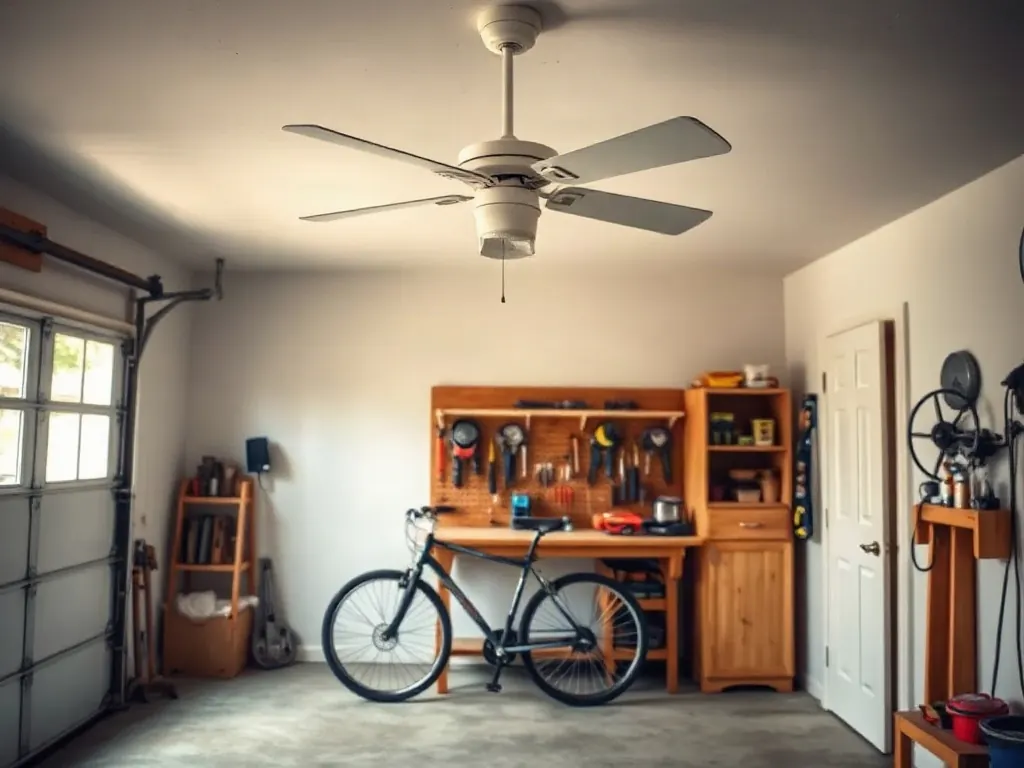
A ceiling fan keeps the floor clear and gives broad overhead airflow. In a garage, check four things.
Rating. Hunter recommends a damp-rated fan for any garage exposed to humidity, moisture or temperature swings, and a motor built for heat, dust and long run times. If rain or snow can blow in through an open door or carport side, choose a wet-rated fan. Our outdoor ceiling fan picks include wet-rated models.
Airflow. Hunter suggests about 3,000 to 5,500 CFM for a 1-2 car garage (200 to 500 sq ft). For a 3-car garage or large workshop, it suggests 10,000 CFM or more. Higher ceilings may need more. Compare fans by the CFM on the spec sheet or EnergyGuide label; our list of high CFM ceiling fans explains how to read it.
Clearance from the door, tracks and opener. ENERGY STAR says to mount fans at least 7 ft above the floor and 18 in. from walls, with 8 to 9 ft ideal for airflow. We found no maker’s figure for clearance from a door track or opener. We’d treat the opener rail, the tracks and the open door as obstructions, and check every door position before you pick a spot.
Direction and habits. Run the fan counterclockwise in summer so it blows down on you, as ENERGY STAR advises; our page on ceiling fan direction shows how to check it. Turn it off when you leave. Hunter adds that heavy protective clothing may limit how much moving air reaches your skin.
Important: Turn off power at the breaker before you work on any fan or ceiling box. Hang the fan from a fan-rated box listed for its weight, or mount it to the structure as the manual directs. Follow the manual and local code, and hire a licensed electrician if you’re unsure or need a new circuit.
Wall-mounted and portable fans
Not every garage has a ceiling spot clear of the door. Portable fans can move with you from task to task. Mounted garage fans keep the floor clear and aim at one spot. Hunter’s DualMount fan, for example, mounts on a wall or ceiling and tilts toward where you want the breeze.
Hunter notes that large garages may need more than one fan. For more options, our guide to cooling alternatives to a ceiling fan compares floor fans, tower fans, window units and portable air conditioners.
Air conditioning: mini-splits and room units
Only an air conditioner removes heat from the garage itself. Two routes are common.
Ductless mini-split. ENERGY STAR lists additions and outbuildings, including garages, among the spaces mini-splits suit. A head unit inside connects to a unit outside. ENERGY STAR says a mini-split should be professionally installed, and an HVAC contractor can help size it. Many also heat, which helps if you use the garage year-round.
Room air conditioner. ENERGY STAR sizes room units by floor area, and its chart assumes an 8 ft ceiling. For example, it lists 10,000 Btu per hour for 400 to 450 sq ft and 12,000 Btu for 450 to 550 sq ft. ENERGY STAR also says to add 10% for a very sunny room, and that an oversized unit costs more, wastes energy and doesn’t cool better.
We’d do the insulation and shading work before buying any AC.
Garage cooling safety
A hot garage often holds fuel, chemicals and engines, so cooling it is also a safety job.
- Never run an engine or generator inside. The EPA lists car exhaust from attached garages as a carbon monoxide source and says not to idle the car in the garage. Never use a generator in a home or garage, even with doors and windows open.
- Move fuel and chemicals out. The US Fire Administration (USFA) says to store oil, gasoline, paints, propane and varnishes in a shed away from your home.
- Keep the house door self-closing. USFA describes a 20-minute fire-rated door that is self-closing and self-latching between the garage and the house. We’d skip propping it open to share the house’s air conditioning.
- Use a heat alarm. USFA recommends a heat alarm, not a smoke alarm, in the garage.
- Go easy on outlets. USFA says to plug only one charging appliance into an outlet and not to use an extension cord when charging an appliance.
USFA adds that garage fires tend to spread farther and cause more injuries and dollar loss than fires elsewhere in the home.
Important: A fan doesn’t lower the air temperature, and Hunter warns that heat illness can still be a serious risk. On extreme days, take breaks somewhere cool and pay attention to how you feel.
Frequently asked questions
What is the cheapest way to cool a garage?
Block heat first and move air second. Open the door when the outside air is cooler, in the morning or evening as Hunter suggests, and run a fan while you're in the garage. Only an air conditioner lowers the air temperature on a hot afternoon.
Will a ceiling fan cool down a hot garage?
It cools you, not the garage. Hunter says a ceiling fan cools people, not the garage itself, so the thermometer reading stays about the same while the breeze makes you feel cooler. Turn it off when you leave.
Should I open the garage door to cool it down?
Yes, when the outside air is cooler than the air inside. Hunter notes that during extreme outdoor heat the incoming air may give little relief, while cooler morning or evening air helps release built-up heat.
Can you put a mini-split in a garage?
Yes. ENERGY STAR lists additions and outbuildings, including garages, among the places ductless mini-splits suit. They need a professional installer, and an HVAC contractor can help size the system.
Is it safe to run a generator in the garage with the door open?
No. The EPA says never to use a generator inside a home or garage, even if doors and windows are open, because of carbon monoxide. Use it outside and far away from windows, doors and vents.
Related guides
How-To
Ceiling Fan Direction: Which Way Should It Spin in Summer and Winter?
Counterclockwise in summer, clockwise on low in winter. How to check which way your fan spins, how to switch it on any fan, and how much it really helps.
8 min read
How-To
Ceiling Fan Speeds: Which Setting to Use for Summer, Winter and Sleep
What low, medium and high really do, which ceiling fan speed to use in summer, winter and at night, and how speed changes watts, cost and noise.
8 min read
How-To
Ceiling Fan Wiring: What Each Wire Does, With One or Two Switches
What the black, white, blue, red and green wires do, how one-switch and two-switch setups differ, and when to stop and call an electrician.
8 min read
How-To
How to Install a Ceiling Fan Light Kit, Step by Step
Check that your fan can take a kit, cut the power at the breaker, open the switch housing, connect the light lead, mount the kit and fit bulbs within the limit.
7 min read