Garage Ceiling Fans: Ratings, Airflow and Sizing (With 5 Picks)
A garage ceiling fan needs a damp or wet rating, plenty of airflow and room to clear the door. How to size one, plus five picks from 52 to 96 in.
By Cool Ceiling Ideas editorial teamUpdated 8 min read
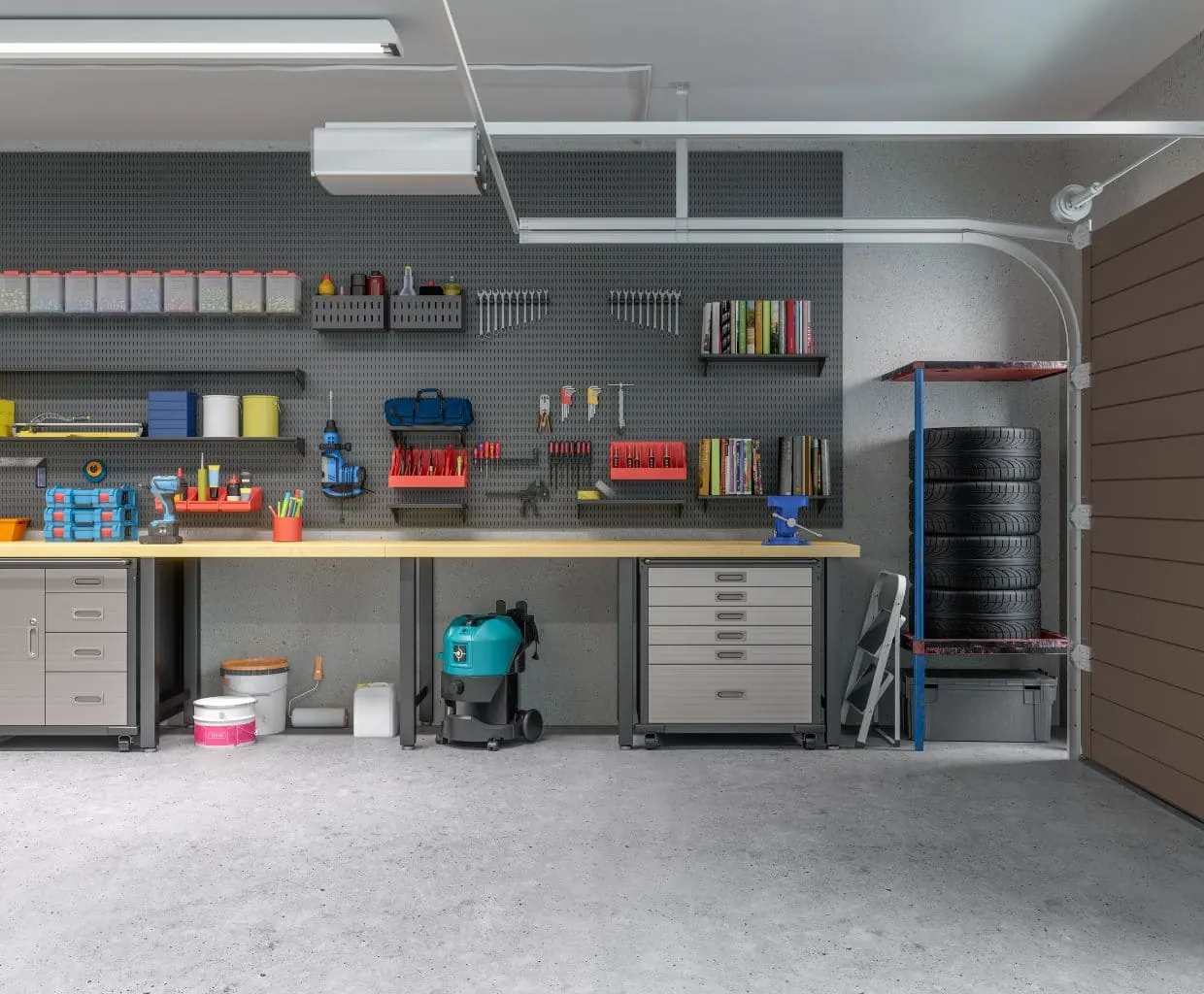
Our picks at a glance
- Top pickCheck price
Best budget fan for a 1-2 car garage
Hunter Builder Elite Outdoor 52 in.
A damp-rated fan under $200 whose airflow sits inside Hunter's own range for 1-2 car garages.
- 52 in. blades
- 4,416 CFM
- Damp-rated
- Check price
Best for garages open to the weather
A wet-rated, ENERGY STAR DC fan with a wall control and a light, for carports and doors left open.
- 60 in. blades
- 7,167 CFM
- Wet-rated, ENERGY STAR
- Check price
Best high-airflow mid-size fan
Wet-rated, ENERGY STAR and over 9,000 CFM on high from an 8-blade DC fan.
- 65 in. blades
- 9,036 CFM (high)
- Wet-rated DC
- Check price
Best for big garages and workshops
Hunter's largest garage fan, with aluminum blades and a wall control.
- 96 in. blades
- 8,992 CFM
- Damp-rated
- Check price
Best smart garage fan
Big Ass Fans Mammoth Outdoor 72 in.
Wet-rated and ENERGY STAR, with app and voice control and coverage up to 625 sq ft per Big Ass Fans.
- 72 in. blades
- Wet-rated
- ENERGY STAR, smart
Prices change often; Amazon shows the current price. As an Amazon Associate, Cool Ceiling Ideas earns from qualifying purchases.
In this article
- Why garages get so hot, and what a fan can do
- Damp or wet rated?
- How much airflow a garage needs
- Clearance: doors, openers and the floor
- Five garage ceiling fans worth a look
- Hunter Builder Elite Outdoor 52 in.
- Hunter Skysail Outdoor 60 in.
- Minka Aire Xtreme H2O 65 in.
- Hunter HFC-96 Outdoor 96 in.
- Big Ass Fans Mammoth Outdoor 72 in.
- Keeping a garage fan running
The short answer: a garage ceiling fan should be at least damp-rated, move a lot of air for its size, and hang well clear of the garage door and opener. For a typical 1-2 car garage, our budget pick is the Hunter Builder Elite Outdoor 52 in. If your door stays open to rain and snow, step up to a wet-rated fan like the Hunter Skysail 60 in. For a 3-car garage or workshop, plan on a very large fan or two smaller ones.
Why garages get so hot, and what a fan can do
Garages rarely have air conditioning and many aren’t insulated, so they tend to follow the weather outside rather than the temperature in the house. Hunter notes that a fan’s performance in an uninsulated garage can vary at extreme temperatures.
Set your expectations accordingly. ENERGY STAR’s point that ceiling fans cool people, not rooms, matters more here than anywhere: the fan won’t bring the temperature down, but the moving air makes you feel cooler while you work. UC Berkeley’s Center for the Built Environment puts an air speed of about 100 ft per minute at roughly a 4°F cooling effect. Turn the fan off when you leave. To bring the air temperature itself down, see how to cool a garage with ventilation, shade and AC.
Damp or wet rated?
A garage isn’t a living room. Hunter recommends a damp-rated fan for any garage exposed to humidity, moisture or temperature swings, and a motor built for heat, dust and long run times.
Use the spot where the fan will hang to decide:
- Closed garage, door shut in bad weather: damp-rated is enough. Hunter describes its damp-rated fans as made for covered areas not directly exposed to rain, snow or water.
- Door often open in rain or snow: choose a wet-rated fan.
- Carport or a garage with an open side: wet-rated, since the fan can be reached by blowing rain.
- Dry-rated (indoor-only) fans: we’d skip them in any garage, given Hunter’s advice above.
Our guide to outdoor ceiling fans explains the difference in detail.
How much airflow a garage needs
Hunter gives the clearest garage-specific numbers we found. For airflow, it suggests about 3,000 to 5,500 CFM for a 1-2 car garage (200 to 500 sq ft) and 10,000 CFM or more for a 3-car garage or large workshop (over 500 sq ft). For blade span, its garage chart reads:
| Garage floor area | Blade span (Hunter) |
|---|---|
| Up to 144 sq ft | 42-48 in. |
| 144-225 sq ft (standard garage) | 52-60 in. |
| Over 225 sq ft | 60 in. or larger; several fans for oversized spaces |
Hunter adds that higher ceilings may need more airflow, and Big Ass Fans suggests going up one fan size for unusually shaped or very tall spaces. These garage sizes run larger than the room chart in our ceiling fan size calculator, which is built for living spaces. Compare fans by the airflow (CFM) on the EnergyGuide label or spec sheet; our guide to high CFM ceiling fans explains how to read it.
Clearance: doors, openers and the floor
None of the manufacturer guides we read give a specific distance from a garage door track or opener. The general rules still apply:
- At least 7 ft from the floor to the blades. ENERGY STAR and the manufacturer manuals in our research all set this minimum, and ENERGY STAR calls 8 to 9 ft ideal. Our ceiling fan height guide covers the full set of clearance rules.
- Keep blades clear of anything that moves. Hunter’s install guide asks for 30 in. from the blade tips to the nearest wall or obstruction. We’d treat the opener rail, the tracks and the door in its open position as obstructions.
- Big fans need more room. CBE says most fans over 7 ft in diameter need their blades at least 10 ft above the floor and about 3 ft of clearance from obstructions. Check the manual for the exact figure.
If your garage ceiling is high, Hunter’s downrod chart gives 12 to 18 in. for a 10 ft ceiling and 36 in. for 12 ft. See our ceiling fan downrod length guide.
Important: Turn off power at the breaker before you start. Big garage fans are heavy: the National Electrical Code limits fan-rated boxes to 70 lb, and a box holding a fan over 35 lb must be marked with its maximum weight. Use a fan-rated box listed for the fan’s weight or mount to the structure, follow the manual and local code, and hire a licensed electrician if you’re unsure. Our ceiling fan wiring guide covers the basics.
No ceiling box? Hunter says its universal mounting systems let a ceiling fan plug into a standard outlet.
Five garage ceiling fans worth a look
We don’t test fans. These picks are still listed by their makers, and every spec comes from the manufacturer’s spec sheet or ENERGY STAR data.
| Fan | Blade span | Rating | Motor | High speed (maker or ENERGY STAR) |
|---|---|---|---|---|
| Hunter Builder Elite Outdoor | 52 in. | Damp | AC, 3 speeds | 4,416 CFM, 38 W |
| Hunter Skysail Outdoor | 60 in. | Wet | DC, 6 speeds | 7,167 CFM; 28.9 W |
| Minka Aire Xtreme H2O | 65 in. | Wet | DC | 9,036 CFM, 57.36 W |
| Hunter HFC-96 Outdoor | 96 in. | Damp | AC, 3 speeds | 8,992 CFM, 62 W |
| Big Ass Fans Mammoth Outdoor | 72 in. | Wet | Direct drive | CFM not published; 38.9 W |
Hunter Builder Elite Outdoor 52 in.
For: a 1-2 car garage on a budget.
Hunter lists 4,416 CFM and 38 W, which puts it inside Hunter’s own 3,000 to 5,500 CFM range for a 1-2 car garage. It’s damp-rated, with a 3-speed AC motor, a pull chain and reversible matte black and stained oak blades. It mounts flush, on the included 3 in. downrod or on an angled ceiling, and costs under $200.
Trade-off: no light, no remote, and damp-rated only.
Our pick: Best budget fan for a 1-2 car garageHunter Builder EliteSee today's price, ratings and delivery options
Check priceHunter Skysail Outdoor 60 in.
For: a garage whose door stays open in all weather, or a carport.
The Skysail is wet-rated and part of Hunter’s WeatherMax line, with a 3-year finish warranty on top of the lifetime motor warranty. Hunter lists 7,167 CFM; ENERGY STAR measures 28.9 W on high and rates it at 293.4 CFM/W. It has a 6-speed DC motor, a wall control, an LED light and a three-position mount (standard, low-profile or angled).
Trade-off: it costs around $500, more than double the Builder Elite. For any garage that sees rain or snow, we’d still choose it over a damp-rated fan.
Our pick: Best for garages open to the weatherHunter SkysailSee today's price, ratings and delivery options
Check priceMinka Aire Xtreme H2O 65 in.
For: a 2-car garage or shop where you want lots of air without a giant fan.
Minka’s spec sheet lists 9,036 CFM and 57.36 W on high from eight ABS blades and a DC motor. It’s wet-rated, ETL listed and ENERGY STAR certified. A remote and a 6 in. downrod are included, and a light kit and wall control are optional.
Trade-off: around $600, smart control only with an optional Bond add-on, and Minka sells through dealers, so check stock.
Our pick: Best high-airflow mid-size fanMinka Aire Xtreme H2OSee today's price, ratings and delivery options
Check priceHunter HFC-96 Outdoor 96 in.
For: a 3-car garage or large workshop with a high ceiling.
This is the biggest fan in Hunter’s garage collection. Hunter lists 8,992 CFM and 62 W. It has aluminum blades that can be installed as a 3- or 6-blade fan, a 3-speed AC motor, a wall control, an 11 in. downrod and an angled mount.
Trade-off: it weighs 54.95 lb, so the box must be marked for that weight or the fan mounted to the structure. It’s damp-rated only and costs about $1,200. At 8 ft across, check its manual for blade height and clearance.
Our pick: Best for big garages and workshopsHunter HFC-96See today's price, ratings and delivery options
Check priceBig Ass Fans Mammoth Outdoor 72 in.
For: a big garage or shop where you want app or voice control.
Big Ass Fans states a UL wet rating, a direct-drive motor, under 35 dBA, and support for Apple HomeKit, Google, Alexa and Matter. It’s ENERGY STAR certified at 38.9 W on high (257 CFM/W). Big Ass Fans rates the 72 in. for up to 625 sq ft, with 60 and 84 in. sizes for 400 and 900 sq ft.
Trade-off: Big Ass Fans doesn’t publish its CFM, and it costs about $1,550 to $1,950 across its three sizes. We’d only pay that if smart control matters to you. Its small overhead fan warranty excludes failures caused by adverse site conditions such as excessive heat, dust or humidity.
Our pick: Best smart garage fanBig Ass Fans MammothSee today's price, ratings and delivery options
Check priceKeeping a garage fan running
Dust is the main enemy. A simple routine:
- Turn the fan off at the wall control and wait for the blades to stop.
- Wipe the blades with light pressure, spraying cleaner onto the cloth, not the fan, as Hunter advises.
- Avoid bleach or harsh chemicals on the finish.
- Check that blade screws are snug if the fan starts to click or wobble.
Tip: Hunter recommends dusting every 1 to 3 months, and more often in dusty conditions such as kitchens and homes with pets. In our view, a garage workshop belongs in that group.
In our view, a wall control or remote is worth paying for in a garage, because a pull chain is awkward to reach over a car or workbench.
Frequently asked questions
Is a ceiling fan in a garage worth it?
Yes, if you spend time working in the garage. A fan won't lower the air temperature, but the breeze makes you feel cooler while you're there. Turn it off when you leave, as ENERGY STAR advises for any fan.
Do I need a damp-rated fan in my garage?
Hunter recommends a damp-rated fan for any garage exposed to humidity, moisture or temperature swings. If rain or snow can blow in through an open door or carport side, choose a wet-rated fan.
How many CFM do I need for a garage?
Hunter suggests about 3,000 to 5,500 CFM for a 1-2 car garage (200 to 500 sq ft) and 10,000 CFM or more for a 3-car garage or large workshop. Higher ceilings may need more.
What size ceiling fan is best for a 2-car garage?
Hunter's garage chart gives 52 to 60 in. for 144 to 225 sq ft and 60 in. or larger above 225 sq ft. Hunter puts 1-2 car garages at 200 to 500 sq ft, so many land in the larger tier; very large spaces may need two fans.
How high should a garage ceiling fan be?
Keep the blades at least 7 ft above the floor and clear of the garage door, its tracks and the opener in every position. Hunter's install guide also asks for 30 in. between blade tips and the nearest wall or obstruction.
Can I put a ceiling fan in a garage without wiring?
Hunter says its universal mounting systems let a ceiling fan plug into a standard outlet. Otherwise, a new ceiling box and circuit is a job for a licensed electrician.
Related guides
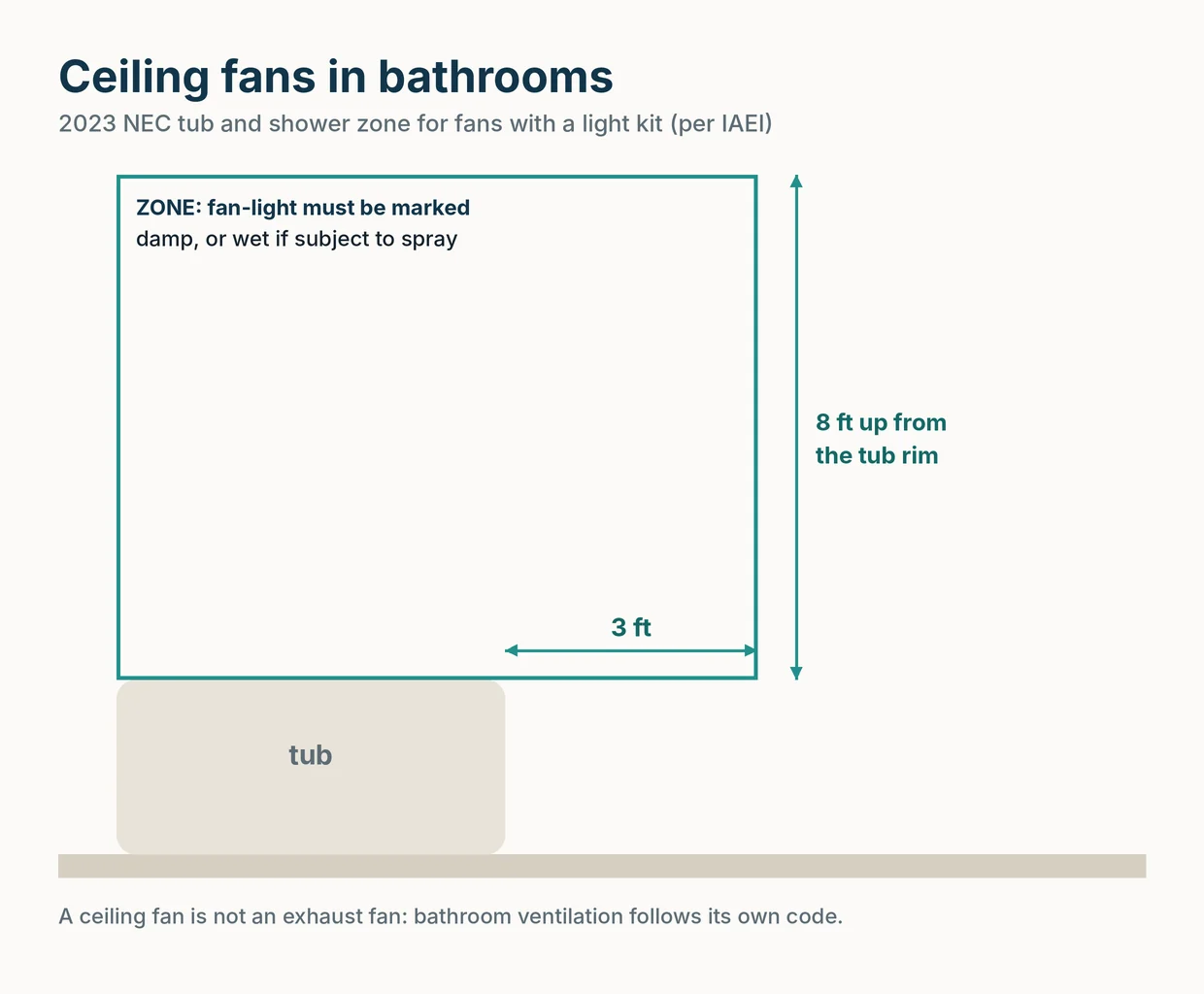
Room Ideas
Bathroom Ceiling Fans: Ratings, Sizing and Safe Placement
A bathroom ceiling fan needs the right damp or wet rating, a small blade span and room to clear walls and heads. What the 2023 NEC zone means, plus four picks.
9 min read

Room Ideas
Best Ceiling Fans for Bedrooms in 2026: Quiet, Dimmable Picks
Seven bedroom ceiling fans picked by need: quiet DC motors, dimmable lights, low ceilings, control from bed and budget. Plus sizing, placement and sleep tips.
11 min read
Room Ideas
Kitchen Ceiling Fans with Lights: Brightness, Bulbs, Placement and Picks
How bright a kitchen fan light should be, integrated LED vs standard E26 bulbs, where to hang it over an island, keeping grease off, and four picks with stated lumens.
8 min read

Room Ideas
Best Nursery Ceiling Fans in 2026: Quiet, Safe Picks
Quiet DC and low-profile fans with dimmable lights and remotes for a baby's room, plus safe mounting, crib placement and what the AAP says about overheating.
10 min read