Best Ceiling Fans of 2026: Top Picks for Every Room
Seven research-based picks for every room and budget, from Consumer Reports' top-rated fan to efficient DC, smart and wet-rated models.
By Cool Ceiling Ideas editorial teamUpdated 10 min read
Our picks at a glance
- Check price on Amazon
Best overall
Consumer Reports' top-rated 52-inch fan, with high marks for quiet running even at higher speeds.
- 52 in. (also 44, 65 in.)
- Dimmable integrated LED
- Remote included
- Check price on Amazon
Best budget
Consumer Reports' runner-up at around $160, with a 1,135-lumen dimmable LED.
- 52 in., downrod or flush
- 1,135 lm, 3000K LED
- Pull chain
- Check price on Amazon
Best smart
An ENERGY STAR Most Efficient DC fan with a 2,000-lumen light, a remote and HunterSMART Wi-Fi.
- 60 in., DC, 6 speeds
- 2,000 lm LED
- Alexa, Google, HomeKit
- Check price on Amazon
Best for quiet bedrooms
A 6-speed DC fan under $200 that draws just 1.7 W on low and has no light to glare over the bed.
- 52 in., DC, 6 speeds
- 1.7 W on low
- ENERGY STAR Most Efficient
- Check price on Amazon
Best outdoor
A wet-rated, ENERGY STAR DC fan for open patios, with a wall control in the box.
- Wet rated
- 60 in., DC, 6 speeds
- Wall control
- Check price on Amazon
Best for large rooms
Over 10,000 CFM on its EnergyGuide label from a DC motor, with smart control and a bright light.
- 72 in., DC
- 10,242 CFM (EnergyGuide)
- Remote + app
- Check price on Amazon
Best for small rooms
A compact damp-rated DC smart fan Hunter sizes for rooms up to about 100 sq ft.
- 44 in., DC
- Damp rated
- 2,000 lm, 3000-5000K
Prices change often; Amazon shows the current price. As an Amazon Associate, Cool Ceiling Ideas earns from qualifying purchases.
The short answer: the best ceiling fan for most people who want a proven performer is the Minka-Aire Light Wave, Consumer Reports’ top-rated 52-inch fan. On a budget, the Westinghouse Comet ranked second in the same tests at around $160. If efficiency and smart control matter more, we’d pick the Hunter Gravity 60, a DC fan on ENERGY STAR’s Most Efficient list.
The right fan still depends on the room. Below are seven picks by role, a comparison table, links to our specialized guides, and a buying guide covering size, motors, lights, controls, damp and wet ratings and warranties.
How we chose
We don’t test fans ourselves. Every pick here comes from published sources:
- Independent lab results. Consumer Reports tested 52-inch fans from nine brands, measuring airflow, the gap between the lowest and highest speeds, and motor and air noise separately. We use Hunker’s August 2026 summary, since CR’s scores are paywalled.
- Manufacturer spec sheets and manuals for blade span, airflow, watts, motor, mounting, light and controls.
- ENERGY STAR’s certified ceiling fan data for high- and low-speed power and efficiency.
- Warranty terms from manuals and brand warranty pages.
We only list current models, and we say “not published” when a maker doesn’t give a figure. More on our process is on the how we research page.
Note: fan airflow figures come in two kinds. The EnergyGuide label shows a weighted average across speeds, while spec sheets often give airflow on high. The Westinghouse Comet, for example, lists 3,210 CFM on its label but 4,460 CFM on high. We say which one each number is, and you shouldn’t compare one kind with the other.
The best ceiling fans by room and need
Minka-Aire Light Wave 52 in.
Best for: anyone who wants the fan that did best in independent lab tests, especially in a bedroom or living room.
Consumer Reports rated the Light Wave (model F844) top of its 52-inch group, with high marks for quiet running even at higher speeds, per Hunker. Minka-Aire lists 4,453 CFM on high at 67.49 W. It has a dimmable 20 W integrated LED (lumens not published), a handheld remote and a 6-inch downrod. It also comes in 44-inch (F845) and 65-inch (F848) sizes.
- Trade-off: it’s an AC fan with 3 speeds, so it draws far more power than the DC picks below. You reverse it with a switch on the motor, not the remote. It’s for dry indoor spaces only, the F844 manual lists a 1-year warranty, and the list price is around $400.
Check the Minka-Aire Light Wave on Amazon
Westinghouse Comet 52 in.
Best for: a budget pick with lab results behind it.
The Comet (model 7224200) came second in Consumer Reports’ tests at around $160, roughly 40% of the Light Wave’s price. Westinghouse’s spec sheet gives 4,460 CFM on high with the downrod, or 3,589 CFM when mounted close to the ceiling, at 63 W on high. It’s an AC fan that can go on the included 4-inch downrod or flush, so it also works under lower ceilings. The integrated 16 W LED puts out 1,135 lumens at 3000K and dims. The motor has a lifetime warranty, with 2 years on other parts.
- Trade-off: it comes with a pull chain, not a remote (Westinghouse says it’s remote-adaptable). The number of speeds isn’t published, it isn’t ENERGY STAR certified, and its EnergyGuide efficiency is a modest 82 CFM per watt on a downrod (64 flush-mounted). We’d pick it for a guest room or a lower ceiling more than for a fan that runs all night.
Check the Westinghouse Comet on Amazon
Want a remote at a lower price? The third fan in CR’s ranking was the Honeywell Carnegie (CR lists model 50614). Prominence Home sells a 52-inch Carnegie (51855-98) for around $120 with a remote, a cage around three dimmable E26 Edison LED bulbs and 4,500 CFM listed. We couldn’t confirm it’s the same model CR tested.
Check the Honeywell Carnegie on Amazon
Hunter Gravity 60 in.
Best for: a smart, efficient fan for a living room or primary bedroom.
The Gravity is on ENERGY STAR’s Most Efficient list at 311.7 CFM per watt. ENERGY STAR measured 20 W on high and 1.7 W on low, and Hunter’s EnergyGuide figure is 6,468 CFM. It has a 6-speed DC motor, a dimmable 24 W LED rated at 2,000 lumens and 3000K, a handheld remote and HunterSMART Wi-Fi that works with Alexa, Google Home and Apple HomeKit without a hub. A 3-inch downrod is included, and it can go on an angled ceiling. The installation manual gives a limited lifetime motor warranty, 1 year on other parts and 3 years on the LED.
- Trade-off: it costs around $500, and Hunter’s product page contradicts itself on the motor warranty (the manual says lifetime). Hunter doesn’t say whether the remote reverses the fan.
Check the Hunter Gravity 60 on Amazon
Hunter Embrook 52 in.
Best for: quiet, cheap-to-run bedroom cooling.
At around $180, the Embrook is the least expensive DC fan here and it’s on ENERGY STAR’s Most Efficient list at 312.3 CFM per watt. ENERGY STAR measured 17.1 W on high and just 1.7 W on low; Hunter’s EnergyGuide figure is 4,966 CFM. You get 6 speeds and a remote that reverses direction. It has no light, which many people prefer over a bed. In our view, it’s the best value here if you don’t need a light. A 3.5-inch downrod is included and the motor carries a limited lifetime warranty.
- Trade-off: Hunter publishes no noise data, so this is a quiet pick based on the DC motor and very low minimum speed, not a sound test. There’s no light, and it’s for dry indoor spaces.
Check the Hunter Embrook on Amazon
Hunter Skysail 60 in.
Best for: open patios, pergolas and carports that get rain.
The Skysail is part of Hunter’s wet-rated WeatherMax line, so it can go where rain reaches it. It’s ENERGY STAR certified at 293.4 CFM per watt, with 28.9 W on high per ENERGY STAR. Hunter lists 7,167 CFM. The 6-speed DC motor comes with a wall control, an 800-lumen LED light, a 3-inch downrod and a three-position mount (standard, angled or low-profile). Hunter backs the motor for life and the finish for 3 years.
- Trade-off: around $500, no remote or app in the box, and Amazon pages give conflicting airflow figures. Hunter’s spec table also lists 16 W “total energy use,” which doesn’t match ENERGY STAR’s high-speed figure.
Check the Hunter Skysail on Amazon
Hunter Gravity 72 in.
Best for: great rooms, open-plan spaces and rooms over 400 sq ft.
The 72-inch Gravity lists 10,242 CFM on its EnergyGuide label with 18 W energy use and 373 CFM per watt. ENERGY STAR files the 72-inch models under the Gravity 60 record, so there’s no size-specific high-speed wattage. Otherwise it matches the 60: a 6-speed DC motor, a dimmable 2,000-lumen 3000K LED, a remote, HunterSMART Wi-Fi with Alexa, Google Home and HomeKit, and a 3-inch downrod.
- Trade-off: around $600, and a 72-inch fan needs the room and ceiling height to match. Taller ceilings will need a longer downrod, sold separately.
Check the Hunter Gravity 72 on Amazon
Hunter ZenTech 44 in.
Best for: small bedrooms, offices and guest rooms.
Hunter rates the 44-inch ZenTech for rooms up to about 100 sq ft. It’s a damp-rated DC fan with 6 speeds, 21.3 W on high per ENERGY STAR (207 CFM per watt), and 4,493 CFM on Hunter’s EnergyGuide figure. The integrated 2,000-lumen LED is tunable from 3000K to 5000K, and HunterSMART Wi-Fi works with Alexa, Google Home and HomeKit. The remote reverses the fan, and a 6-inch downrod is included.
- Trade-off: around $380 is a lot for a small fan, and we’d skip it for rooms much bigger than 100 sq ft. Hunter tags it “Most Efficient,” but ENERGY STAR’s record says it isn’t.
Check the Hunter ZenTech 44 on Amazon
Tip: Hunter’s warranty covers fans bought new from authorized dealers only and excludes refurbished units. Many Hunter listings on Amazon are “Renewed,” so check the seller before you buy.
The best ceiling fans compared
| Fan | Size and motor | Light | Controls | Rating / ENERGY STAR |
|---|---|---|---|---|
| Minka-Aire Light Wave | 52 in., AC, 3 speeds | 20 W LED, dimmable | Remote | Dry / no record found |
| Westinghouse Comet | 52 in., AC | 1,135 lm, 3000K, dimmable | Pull chain | Dry / no |
| Hunter Gravity 60 | 60 in., DC, 6 speeds | 2,000 lm, 3000K, dimmable | Remote + app | Dry / Most Efficient |
| Hunter Embrook | 52 in., DC, 6 speeds | None | Remote | Dry / Most Efficient |
| Hunter Skysail | 60 in., DC, 6 speeds | 800 lm | Wall control | Wet / yes |
| Hunter Gravity 72 | 72 in., DC, 6 speeds | 2,000 lm, 3000K, dimmable | Remote + app | Dry / yes |
| Hunter ZenTech 44 | 44 in., DC, 6 speeds | 2,000 lm, 3000-5000K | Remote + app | Damp / yes |
Find the right roundup for your room
This page covers the best all-rounders. Our specialized guides go deeper, with more picks for each need:
- By feature: smart ceiling fans, quiet ceiling fans, low profile ceiling fans for ceilings under 8 ft, high CFM ceiling fans and energy efficient ceiling fans.
- Lights and controls: ceiling fans with lights, ceiling fans with a light and remote and ceiling fans without lights.
- By room:
- By brand: the best Hunter ceiling fans, the best ceiling fan brands compared, and our Big Ass Fans Haiku review.
Ceiling fan buying guide
Size: match the blades to the room
Blade span matters more than almost anything else. ENERGY STAR’s chart, which cites the American Lighting Association, suggests:
| Room size | Blade span |
|---|---|
| Up to 75 sq ft | 29-36 in. |
| 76-144 sq ft | 36-42 in. |
| 144-225 sq ft | 44 in. |
| 225-400 sq ft | 50-54 in. |
| Over 400 sq ft | 56 in. or more (Hunter) |
Height matters too. Every source we checked says the blades should be at least 7 ft off the floor, and ENERGY STAR calls 8 to 9 ft ideal. For long rooms, UC Berkeley’s Center for the Built Environment (CBE) suggests splitting the space into squarer zones with a fan each once one side is more than 1.5 times the other. Our ceiling fan size calculator does the math, including downrod length, and the ceiling fan size guide explains each rule.
AC vs DC motors
CBE describes brushless DC motors as the most efficient and quietest type, and says they often use 70% less energy than AC motors on small fans. Every DC pick above has 6 speeds, against 3 on the Light Wave. AC fans cost less and give steady airflow. The DOE has noted that DC fans are newer and carry extra electronics, so long-term reliability is less proven. Our AC vs DC ceiling fans guide covers the trade-offs.
ENERGY STAR says certified fans are up to 44% more efficient than conventional ones. To earn the label, a fan must also let you switch airflow direction and carry at least a 3-year warranty.
Lights
You can choose an integrated LED, standard bulbs, or no light at all. Integrated LEDs are slim and efficient but can’t be swapped for brighter bulbs. Bulb-based fixtures let you pick brightness and color. Compare the lumens each maker states; our picks range from 800 to 2,000 lumens. If you have recessed lighting, a fan without a light is simpler and often cheaper.
Controls
Pull chains are cheapest. Remotes let you change speed and dim the light from bed, and on many DC fans they also reverse the fan. Smart fans add an app and voice control. If you want a wall control, use one made for fans: Hunter warns that a standard light dimmer or incompatible speed control on the fan circuit often causes humming.
Damp and wet ratings
Indoor fans are dry-rated. Hunter says damp-rated fans suit covered patios and porches, while wet-rated fans are for spaces that may get heavy rain or snow. Bathrooms count too: under the 2023 National Electrical Code, a fan with a light kit near a tub or shower (within 3 ft horizontally and 8 ft vertically) must be marked for damp locations, or wet if spray can reach it.
Warranty
Motor warranties range widely. Hunter gives a limited lifetime motor warranty with shorter terms on other parts, and only for the original buyer from an authorized dealer. Westinghouse gives lifetime on the Comet’s motor and 2 years on parts. Big Ass Fans gives 5 years on indoor Haiku fans. The Light Wave’s manual lists just 1 year. We’d read the full terms before buying, not just the headline “lifetime,” including coverage for LED modules and controls.
Important: turn off power at the breaker before installing or replacing a fan, and hang it only from a fan-rated box. Follow the manual and local code, and hire a licensed electrician if you’re unsure.
Frequently asked questions
What ceiling fan did Consumer Reports rate best?
In Consumer Reports' tests of 52-inch fans, the Minka-Aire Light Wave came first, the Westinghouse Comet second and the Honeywell Carnegie third, according to Hunker's August 2026 summary. CR's full scores are behind its paywall.
What size ceiling fan do I need?
ENERGY STAR's chart suggests 29 to 36 inches for rooms up to 75 sq ft, 36 to 42 inches up to 144 sq ft, 44 inches up to 225 sq ft and 50 to 54 inches up to 400 sq ft. Hunter suggests 56 inches or more for bigger rooms.
Are DC ceiling fans worth the extra money?
Usually, if you run the fan a lot. UC Berkeley's Center for the Built Environment says brushless DC motors are the most efficient and quietest type, and often use 70% less energy than AC motors on small fans. DC fans also tend to have more speeds.
Can I use an indoor ceiling fan on a porch?
No. Covered porches need at least a damp-rated fan, and spots exposed to rain need a wet-rated fan. Indoor (dry-rated) fans aren't built for moisture.
How long is a typical ceiling fan warranty?
It varies a lot. Hunter gives a limited lifetime motor warranty and shorter terms on other parts, Big Ass Fans gives 5 years on indoor Haiku fans, and the Minka-Aire Light Wave manual lists 1 year. ENERGY STAR fans must carry at least a 3-year warranty.
Related guides
Buying Guides
Best Hunter Ceiling Fans in 2026: 9 Models by Room and Budget
Nine Hunter ceiling fans picked by room and budget from Hunter's spec sheets, manuals and ENERGY STAR data, plus the warranty fine print and HunterSMART.
11 min read
Buying Guides
Best Energy Efficient Ceiling Fans in 2026, Ranked by CFM per Watt
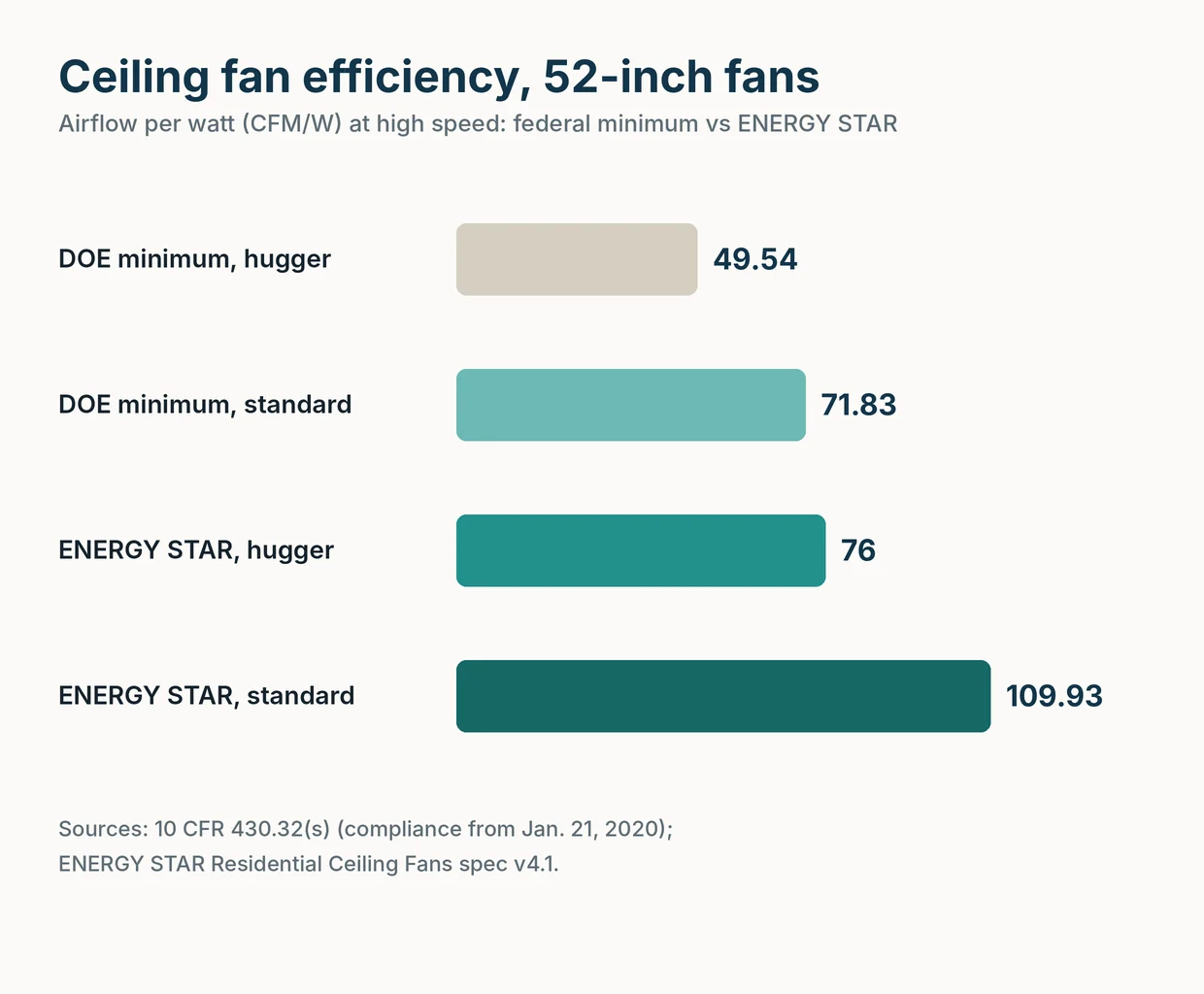
The most efficient ceiling fans we found in ENERGY STAR and EnergyGuide data, plus how CFM per watt, DOE minimums and DC motors work.
11 min read
Buying Guides
High CFM Ceiling Fans: What the Airflow Numbers Mean and 6 Strong Picks
How CFM is measured and labeled, how much airflow a fan of your size should move, why CFM per watt matters too, and six high-airflow fans with verified numbers.
10 min read
Buying Guides
Best Ceiling Fan Brands in 2026: 16 Brands Compared
16 ceiling fan brands compared on motor warranty, DC and smart options, price and who owns them now, plus the warning signs of brands to avoid.
15 min read