Best Energy Efficient Ceiling Fans in 2026, Ranked by CFM per Watt
The most efficient ceiling fans we found in ENERGY STAR and EnergyGuide data, plus how CFM per watt, DOE minimums and DC motors work.
By Cool Ceiling Ideas editorial teamUpdated 11 min read
Our picks at a glance
- Check price on Amazon
Best overall
ENERGY STAR Most Efficient at 312 CFM/W for under $200, with a 6-speed DC motor and remote.
- 52 in. blades
- 312 CFM/W
- 17.1 W on high
- Check price on Amazon
Best smart
Same 312 CFM/W rating plus Wi-Fi control with Alexa, Google and HomeKit and a bright LED.
- 60 in. blades
- 312 CFM/W
- 6,468 CFM
- Check price on Amazon
Best for large rooms
Over 10,000 CFM on the EnergyGuide label at 373 CFM/W, the best label figure among the big fans we checked.
- 72 in. blades
- 373 CFM/W (label)
- 10,242 CFM
- Check price on Amazon
Best for sloped ceilings
ENERGY STAR Most Efficient at 301 CFM/W, only 2.0 W on low, and rated for slopes up to 18 degrees.
- 56 in. blades
- 301 CFM/W
- 2.0 W on low
- Check price on Amazon
Best wet-rated
A wet-rated WeatherMax fan for open patios and carports at 293.4 CFM/W.
- 60 in. blades
- Wet rated
- 293.4 CFM/W
- Check price on Amazon
Best for covered patios
A damp-rated 72 in DC fan with 11,694 CFM on its EnergyGuide label.
- 72 in. blades
- Damp rated
- 11,694 CFM
- Check price on Amazon
Best hugger
A wet-rated DC hugger at 173 CFM/W on ENERGY STAR, far above the hugger minimum.
- 36 in. blades
- Flush mount
- 15.38 W on high
Prices change often; Amazon shows the current price. As an Amazon Associate, Cool Ceiling Ideas earns from qualifying purchases.
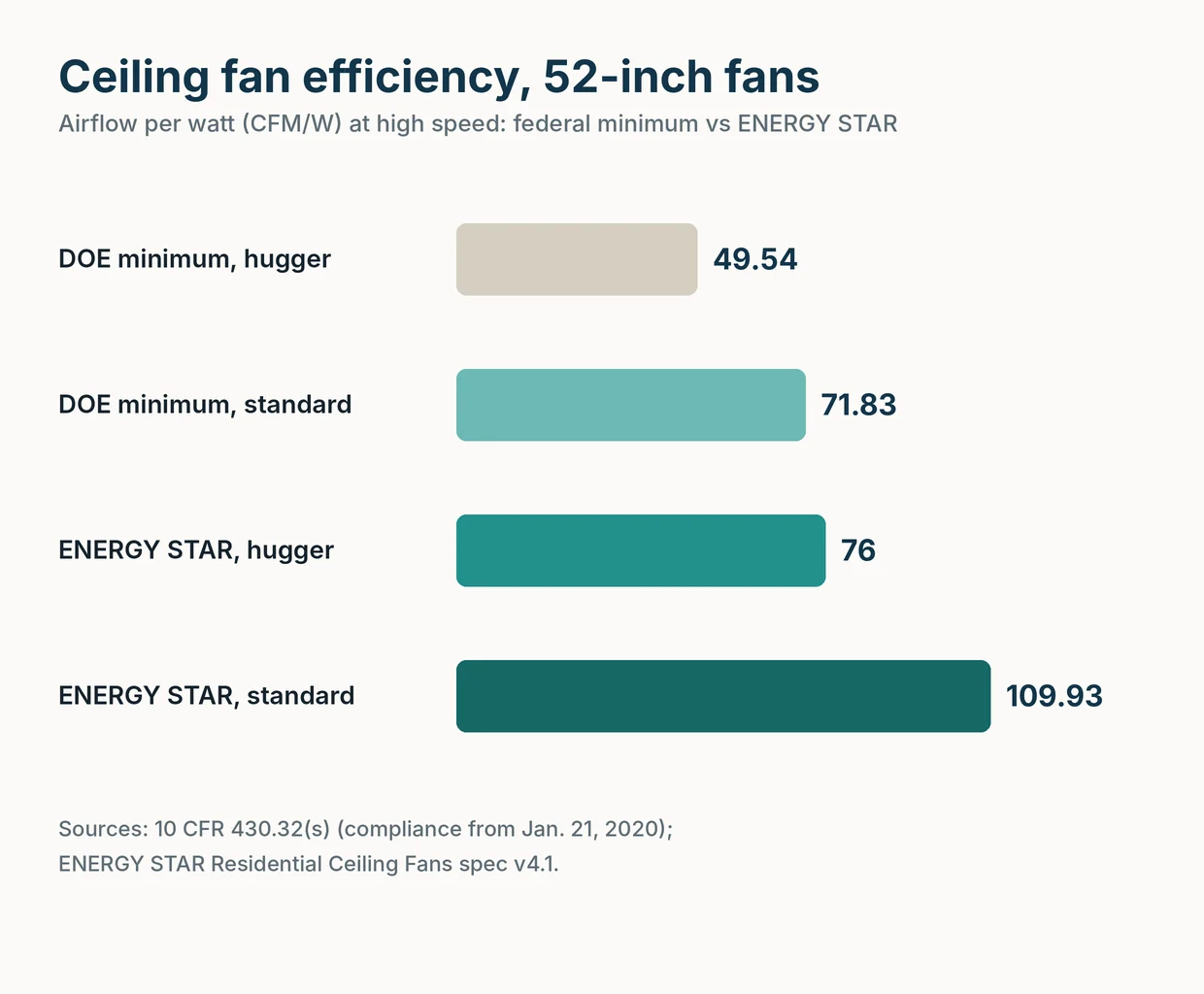
The short answer: the most energy efficient ceiling fans move a lot of air per watt, and the number to compare is CFM per watt (CFM/W). A 52 in fan only has to reach 71.83 CFM/W to be sold in the US, and 109.93 CFM/W to earn ENERGY STAR. Our pick is the Hunter Embrook 52 in.: ENERGY STAR rates it at 312 CFM/W and lists it as Most Efficient, and it costs under $200. For big rooms, the Hunter Gravity 72 in. tops the large fans we checked, and for patios the wet-rated Hunter Skysail 60 in. is the efficient choice.
Every pick below uses a DC motor. That’s not a coincidence, as the section on motors explains.
What CFM per watt means
CFM is cubic feet of air a fan moves per minute. Watts is the power it draws. Divide one by the other and you get airflow efficiency: how much breeze you get for each watt you pay for.
There’s a catch that trips up a lot of shoppers. The official figure on the EnergyGuide label and in the ENERGY STAR database is not simply high-speed CFM divided by high-speed watts. It’s a weighted average across the fan’s speeds plus its standby power. UC Berkeley’s Center for the Built Environment (CBE) points out that this method ignores differences in maximum airflow, so a fan with a weaker top speed can still rate well.
So the CFM and watts in our table won’t always divide to the CFM/W shown. Some brands also publish their own ratio: Minka-Aire lists 268.8 for the Sandfell at high speed, while ENERGY STAR’s weighted figure is 301.
Note: Compare fans on the same basis. The ENERGY STAR record is the most consistent source; we mark label or maker figures where no ENERGY STAR record exists.
For context, CBE’s data puts the median fan at 79 CFM/W at top speed and 165 CFM/W at its lowest speed.
Federal minimums vs ENERGY STAR
Since January 21, 2020, every ceiling fan manufactured for the US has to meet a Department of Energy (DOE) minimum. ENERGY STAR’s Version 4.1 spec sets a higher bar. Both scale with blade span (D, in inches), and huggers get their own, lower line.
| Fan type | DOE minimum (CFM/W) | 52 in. DOE | ENERGY STAR v4.1 (36–78 in.) | 52 in. ENERGY STAR |
|---|---|---|---|---|
| Standard (blades more than 10 in. below ceiling) | 0.65 × D + 38.03 | 71.83 | 2.63 × D − 26.83 | 109.93 |
| Hugger (blades 10 in. or less below ceiling) | 0.29 × D + 34.46 | 49.54 | 1.75 × D − 15 | 76 |
ENERGY STAR also sets a minimum airflow on high: about 3,687 CFM for a 52 in standard fan and about 2,950 CFM for a 52 in hugger. On top of that, certified fans must carry at least a 3-year warranty, report standby power and let you reverse the airflow. ENERGY STAR says certified fans are up to 44% more efficient than conventional ones.
A few things fall outside these rules:
- Large-diameter fans (blades over 7 ft) use a different DOE metric and are excluded from ENERGY STAR. Our largest picks are 72 in, so they stay in the normal classes.
- Very small, highly decorative and belt-driven fans are excluded from ENERGY STAR too.
- Fans over 78 in are still certifiable, but their airflow minimum is capped at 8,296 CFM (standard) or 6,637 CFM (hugger).
The hugger penalty
Look at the table again: a 52 in hugger can legally be about 31% less efficient than a standard 52 in fan (49.54 vs 71.83 CFM/W). ENERGY STAR says huggers move less air because the blades are close to the ceiling, and CBE describes them as standard fans mounted too close to the ceiling, which typically hurts energy performance.
If your ceiling is 8 ft or higher, a short downrod usually gets you more air per watt. Under 8 ft, a hugger is the safe option, and you still have efficient choices. Our low profile ceiling fan guide covers flush-mount models by ceiling height.
AC vs DC motors
The motor is the biggest single factor in efficiency. Here’s what DOE and CBE say:
| Factor | AC induction | Brushless DC |
|---|---|---|
| Efficiency | Baseline; meets the 2020 DOE minimum | Often 70% less energy on small fans (CBE); most efficient type |
| Speeds | Usually 3 fixed speeds | Tend to have more speed levels |
| Noise | Louder (CBE) | Quietest of the motor types |
| Cost | Cheaper; basic fans under $100 | More expensive |
| Standby power | Only if sold with a remote | Always (DOE assumed 0.7 W) |
DOE also assumed DC fans need repair more often (9% vs 2.5%) because of the added electronics, though efficiency advocates disputed that estimate for lack of data. CBE adds that the efficiency gain from DC is much smaller on large-diameter fans. For the full trade-off, see AC vs DC ceiling fans and our overview of ceiling fan motor types.
How we chose
We pulled every current fan in our research files that has a verified efficiency figure, from the ENERGY STAR certified-fan dataset (downloaded October 21, 2026) or the maker’s EnergyGuide label, and kept the highest scorers. Then we covered different needs: a standard 52 in bedroom fan, smart control, large rooms, sloped ceilings, wet and damp locations, and a hugger. We don’t test fans ourselves; every number comes from ENERGY STAR or the manufacturer. Prices are from maker stores in October 2026, and the Amazon links are searches, so check that the listing matches the model number.
Two Lowe’s house-brand fans rated even higher: ENERGY STAR lists the Harbor Breeze Cando 84 in. at 422.2 CFM/W and the Cando 72 in. at 340.6 CFM/W. We left them out of the picks because we couldn’t verify the 84 in model’s airflow, and the 72 in model’s specs came only from retailer search snippets.
Energy efficient ceiling fans compared
| Fan | Blade span | Airflow (high) | Watts (high) | CFM/W |
|---|---|---|---|---|
| Hunter Embrook | 52 in. | 4,966 CFM | 17.1 W | 312 (ENERGY STAR) |
| Hunter Gravity | 60 in. | 6,468 CFM | 20 W | 312 (ENERGY STAR) |
| Hunter Gravity | 72 in. | 10,242 CFM | not published | 373 (label) |
| Minka-Aire Sandfell | 56 in. | 6,118 CFM | 22.76 W | 301 (ENERGY STAR) |
| Hunter Skysail | 60 in. | 7,167 CFM | 28.9 W | 293.4 (ENERGY STAR) |
| Hunter Downtown | 72 in. | 11,694 CFM | 55.4 W | 290 (label); 237.5 (ENERGY STAR) |
| Minka-Aire Ventiara (hugger) | 36 in. | 2,860 CFM | 15.38 W | 173 (ENERGY STAR); 186 (Minka) |
Not sure which span you need? The ceiling fan size calculator matches blade span to your room.
The best energy efficient ceiling fans
Hunter Embrook 52 in.
Who it’s for: bedrooms and living rooms up to about 400 sq ft, and anyone who wants top efficiency without paying for smart features.
ENERGY STAR rates the Embrook at 312.3 CFM/W and puts it on its Most Efficient list. It draws 17.1 W on high and just 1.7 W on low, and Hunter’s EnergyGuide label shows 4,966 CFM. The DC motor has six speeds, the handheld remote reverses direction, and Hunter includes a 3.5 in downrod and a limited lifetime motor warranty. It’s around $180 at hunterfan.com.
The trade-off: no light kit and no app. One oddity: Hunter sells it as a downrod fan, but ENERGY STAR files the record as a hugger. In our view, it’s the best value in this list.
Check the Hunter Embrook on Amazon
Hunter Gravity 60 in.
Who it’s for: larger living rooms and kitchens where you want voice control and a bright light.
The Gravity matches the Embrook’s efficiency (311.7 CFM/W, ENERGY STAR Most Efficient) with a bigger 60 in span and 6,468 CFM. It draws 20 W on high and 1.7 W on low. It works with the HunterSMART app over Wi-Fi plus Alexa, Google and Siri/HomeKit, without a hub, and has a dimmable 24 W LED that Hunter rates at 2,000 lumens (ENERGY STAR’s test record shows 1,593). It runs around $500.
The trade-off: the price, and Hunter’s page lists conflicting warranty terms (limited lifetime motor in the spec table, 3 years in the description). We’d confirm before buying. Our best smart ceiling fans guide compares other app-controlled options.
Check the Hunter Gravity 60 in. on Amazon
Hunter Gravity 72 in.
Who it’s for: great rooms and open-plan spaces where one 52 in fan isn’t enough.
Hunter’s EnergyGuide label shows 10,242 CFM and 373 CFM/W, the highest label figure among the large fans in our research. It shares the 60 in model’s DC motor setup, six speeds, smart platform and 2,000-lumen light, with a limited lifetime motor warranty and a 3-year light kit warranty.
The trade-off: ENERGY STAR lists the 72 in model numbers under the 60 in Gravity’s record, so there’s no size-specific high-speed wattage. The label’s “Energy Use” figure is 18 W. It’s around $600.
Check the Hunter Gravity 72 in. on Amazon
Minka-Aire Sandfell 56 in.
Who it’s for: bedrooms and vaulted rooms that need a smart fan with a soft light.
ENERGY STAR rates the Sandfell at 301 CFM/W (Most Efficient) with 22.8 W on high and a very low 2.0 W on low. Minka-Aire lists 6,118 CFM on high. It’s slope compatible up to 18 degrees, includes a 6 in downrod, and has separate LED uplight and downlight with five color temperatures. ENERGY STAR lists a 3-year warranty.
The trade-off: Minka-Aire doesn’t publish the app or voice assistants on its spec block, the speed count isn’t listed, and it’s new (on the market since April 2026).
Check the Minka-Aire Sandfell on Amazon
Hunter Skysail 60 in.
Who it’s for: open patios, pergolas and carports where rain can reach the fan.
The Skysail is wet rated (Hunter’s WeatherMax line, tagged “Wet + Salt-Resistant”) and ENERGY STAR certified at 293.4 CFM/W. It moves 7,167 CFM on high at 28.9 W, has a six-speed DC motor, a wall control and a 3-position mount (downrod, angled or low profile). Hunter backs the motor with a limited lifetime warranty and the finish for 3 years. It’s around $500.
The trade-off: Hunter’s spec table lists 16 W “total energy use,” which doesn’t match ENERGY STAR’s 28.9 W high-speed figure; we use ENERGY STAR’s. For more patio choices, see our outdoor ceiling fans guide.
Check the Hunter Skysail on Amazon
Hunter Downtown 72 in.
Who it’s for: large covered porches and great rooms that need a lot of air.
This seven-blade DC fan is damp rated and shows 11,694 CFM on its EnergyGuide label, the most airflow in this list. Hunter’s label rates it at 290 CFM/W, though ENERGY STAR’s weighted figure for the family is 237.5 CFM/W, with 55.4 W on high and 2.5 W on low. It has six speeds, a wall control, a 3 in downrod and a limited lifetime motor warranty.
The trade-off: fan only, no light, and damp rated means covered areas only. Hunter’s page has shown it out of stock, so check availability. It’s around $550.
Check the Hunter Downtown on Amazon
Minka-Aire Ventiara 36 in.
Who it’s for: small rooms with low ceilings, covered or open outdoor nooks, and anyone who needs a flush mount.
The Ventiara is a wet-rated DC hugger with a dimmable 20 W LED and a remote. Minka-Aire lists 2,860 CFM at 15.38 W on high (186 CFM/W by its math), and ENERGY STAR’s weighted rating is 173 CFM/W. For a 36 in hugger, the ENERGY STAR minimum works out to about 48 CFM/W, so it clears the bar several times over.
The trade-off: it costs around $420, and the warranty is unclear: Minka’s page says 1 year, ENERGY STAR’s record says 3. We’d ask before buying.
Check the Minka-Aire Ventiara on Amazon
How to read the EnergyGuide label
Since the FTC requires a yellow EnergyGuide label on ceiling fan packaging, you can compare efficiency in the store. It shows:
- Estimated yearly energy cost, assuming 6.4 hours a day at 12 cents per kWh, not counting lights.
- Airflow in CFM.
- Energy use in watts, excluding lights.
- Airflow efficiency in CFM per watt.
- A cost range for similar models: $3 to $34 a year for fans 19 to 84 in.
Multi-mount fans must show the figures for their least efficient setup, which is often the hugger position. Large-diameter and high-speed small-diameter fans don’t carry the label.
Tip: Your real cost depends on your electric rate and hours. Our guide to how much electricity a ceiling fan uses walks through the DOE formula with current prices.
Getting the most from an efficient fan
- Raise the thermostat. DOE says a ceiling fan lets you set it about 4°F higher without feeling warmer, and in moderate climates a fan can sometimes replace AC.
- Turn it off when you leave. ENERGY STAR’s rule: fans cool people, not rooms.
- Use the right direction. Counterclockwise in summer for a breeze; clockwise on low in winter to push warm air down.
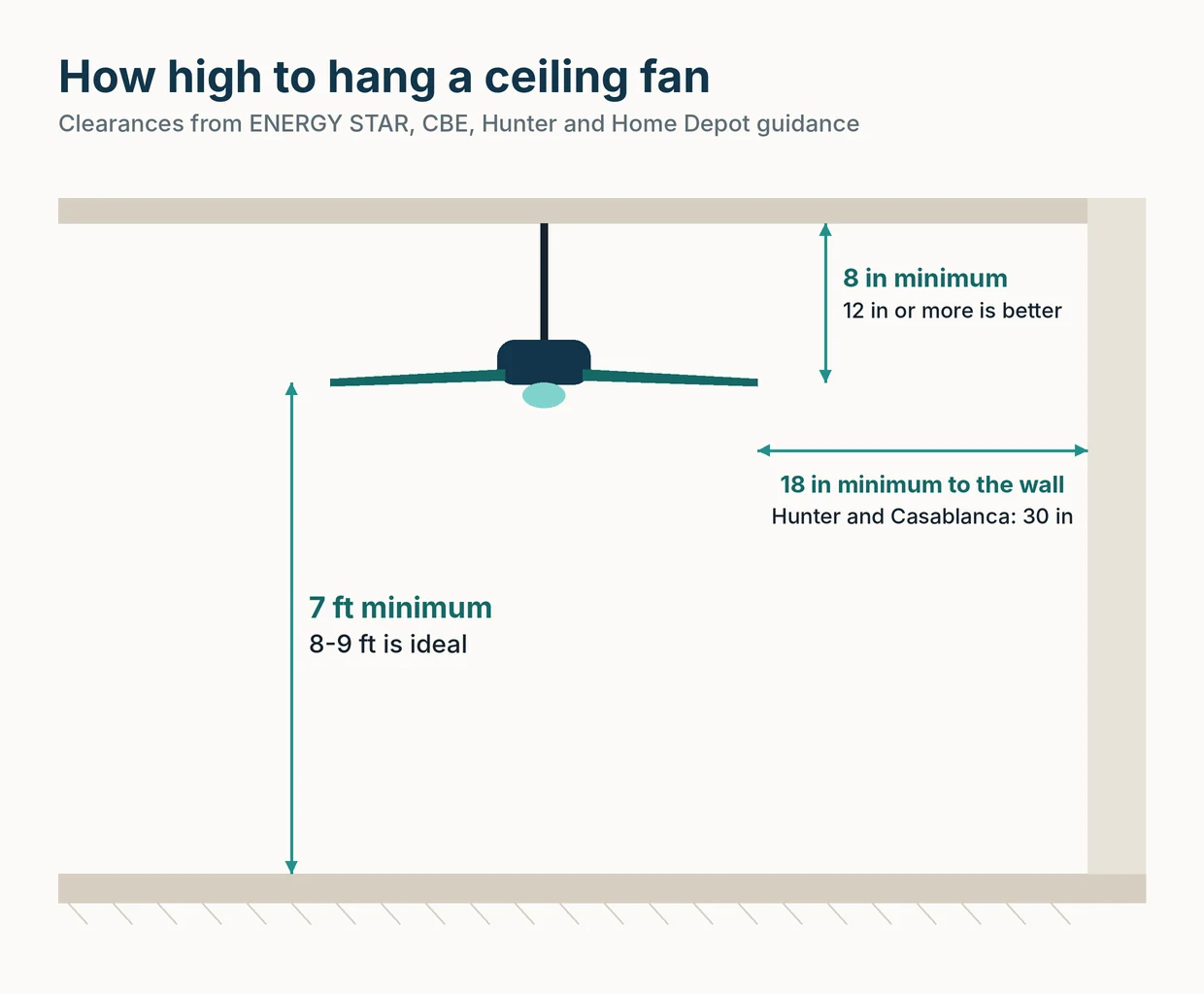
- Mount it right. Blades at least 7 ft above the floor and 8 to 9 ft for best airflow, per ENERGY STAR.
- Pick the right size. ENERGY STAR suggests 50 to 54 in blades for rooms of 225 to 400 sq ft and 44 in for 144 to 225 sq ft.
Important: Swapping in a new fan means working on household wiring. Turn off power at the breaker, mount the fan to a fan-rated box, follow the manual and local code, and hire a licensed electrician if you’re unsure.
Frequently asked questions
What is a good CFM per watt for a ceiling fan?
For a 52 in standard fan, the federal minimum is 71.83 CFM/W and ENERGY STAR's minimum is 109.93 CFM/W. Most of the DC fans picked here are rated around 290 to 373 CFM/W on their ENERGY STAR record or EnergyGuide label.
Are DC ceiling fans more energy efficient?
Usually, yes. UC Berkeley's Center for the Built Environment says a brushless DC motor often uses about 70% less energy than an AC motor on smaller fans, and every pick in this guide uses a DC motor. The gain is smaller on very large fans.
Do ENERGY STAR ceiling fans save money?
ENERGY STAR says certified fans are up to 44% more efficient than conventional ones. The Department of Energy adds that running a ceiling fan lets you raise the thermostat about 4°F without losing comfort, which is where most of the savings come from.
Is a hugger ceiling fan less efficient?
Yes, typically. The blades sit close to the ceiling and get less air, so federal rules let a 52 in hugger be about 31% less efficient than a standard 52 in fan (49.54 vs 71.83 CFM/W).
Where do I find a fan's CFM per watt?
On the yellow FTC EnergyGuide label on the box or product page, which shows airflow, watts, CFM per watt and estimated yearly cost. ENERGY STAR's product finder lists the weighted efficiency for certified models.
Can I compare CFM per watt across brands?
Only loosely. The official figure is a weighted average across speeds plus standby power, and brands sometimes publish a different high-speed ratio. Compare fans using the same source, ideally the ENERGY STAR record.
Related guides
Buying Guides
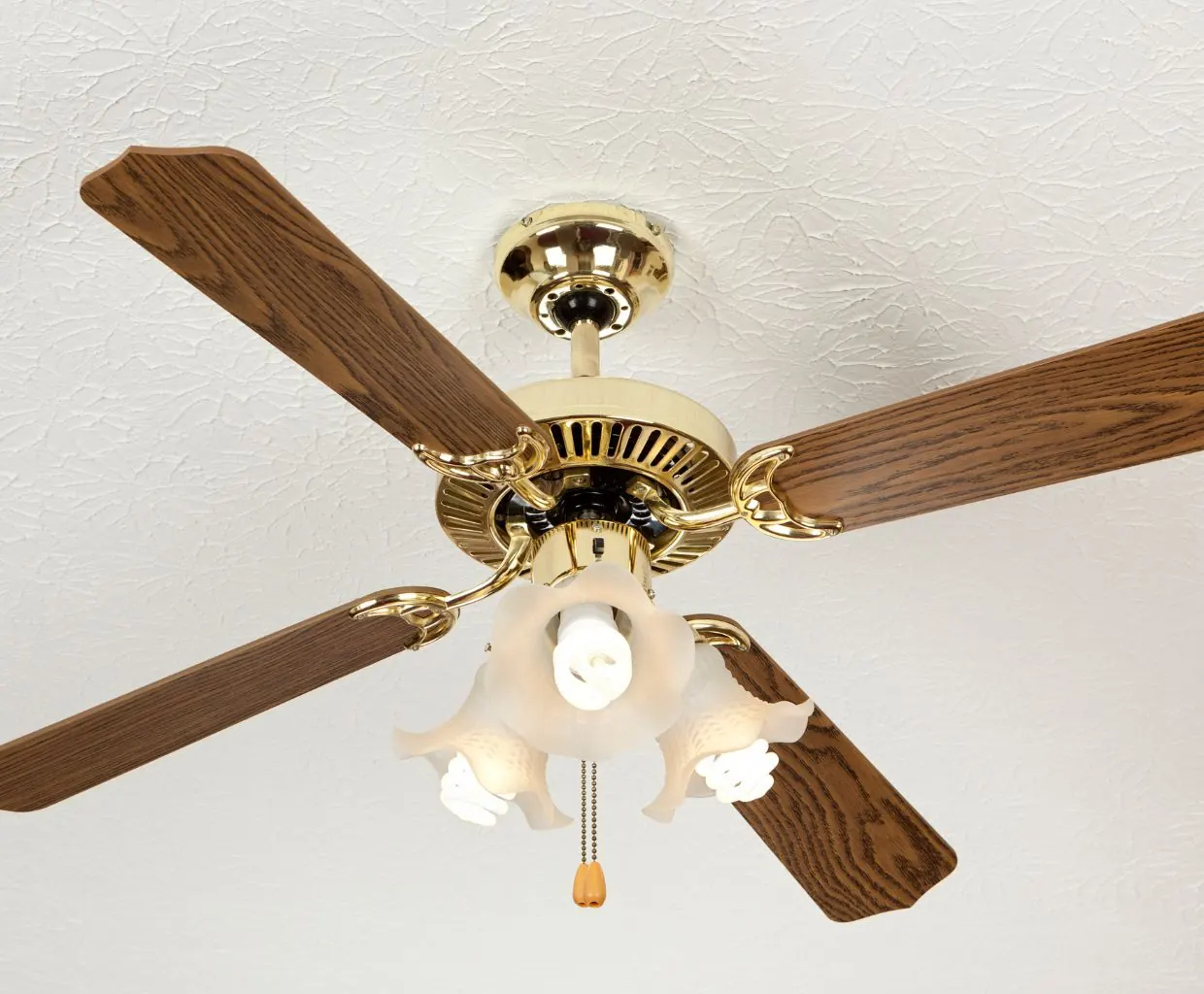
Ceiling Fan Motor Types: AC Induction vs Brushless DC Explained
Which motor is in a ceiling fan, how AC induction and brushless DC motors differ, and how efficiency, speeds, noise and standby power compare.
7 min read
Buying Guides
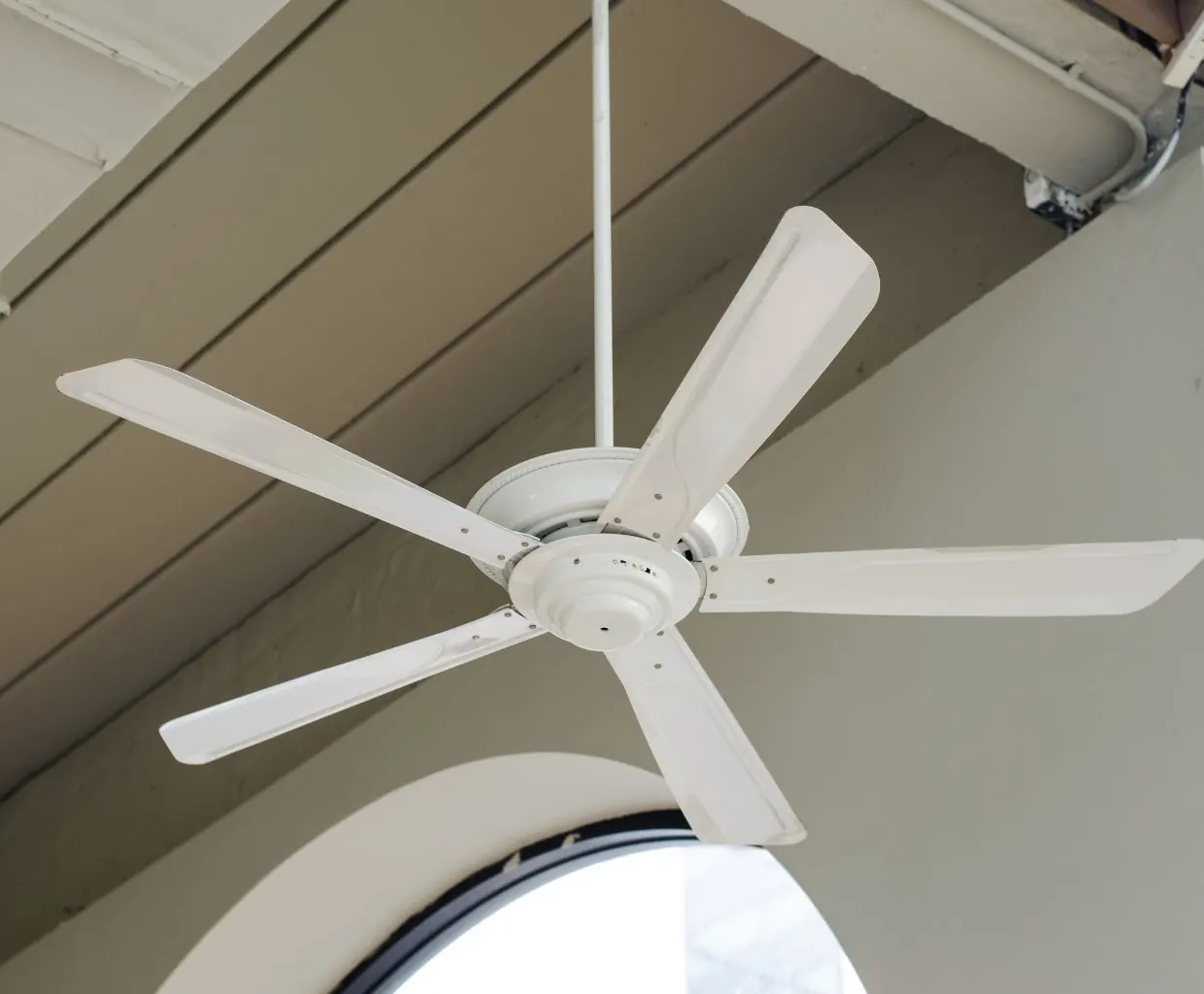
AC vs DC Ceiling Fans: Which Should You Buy?
DC fans use far less power, have more speeds and run quieter; AC fans cost less and keep things simple. Here's how to choose.
7 min read
Buying Guides
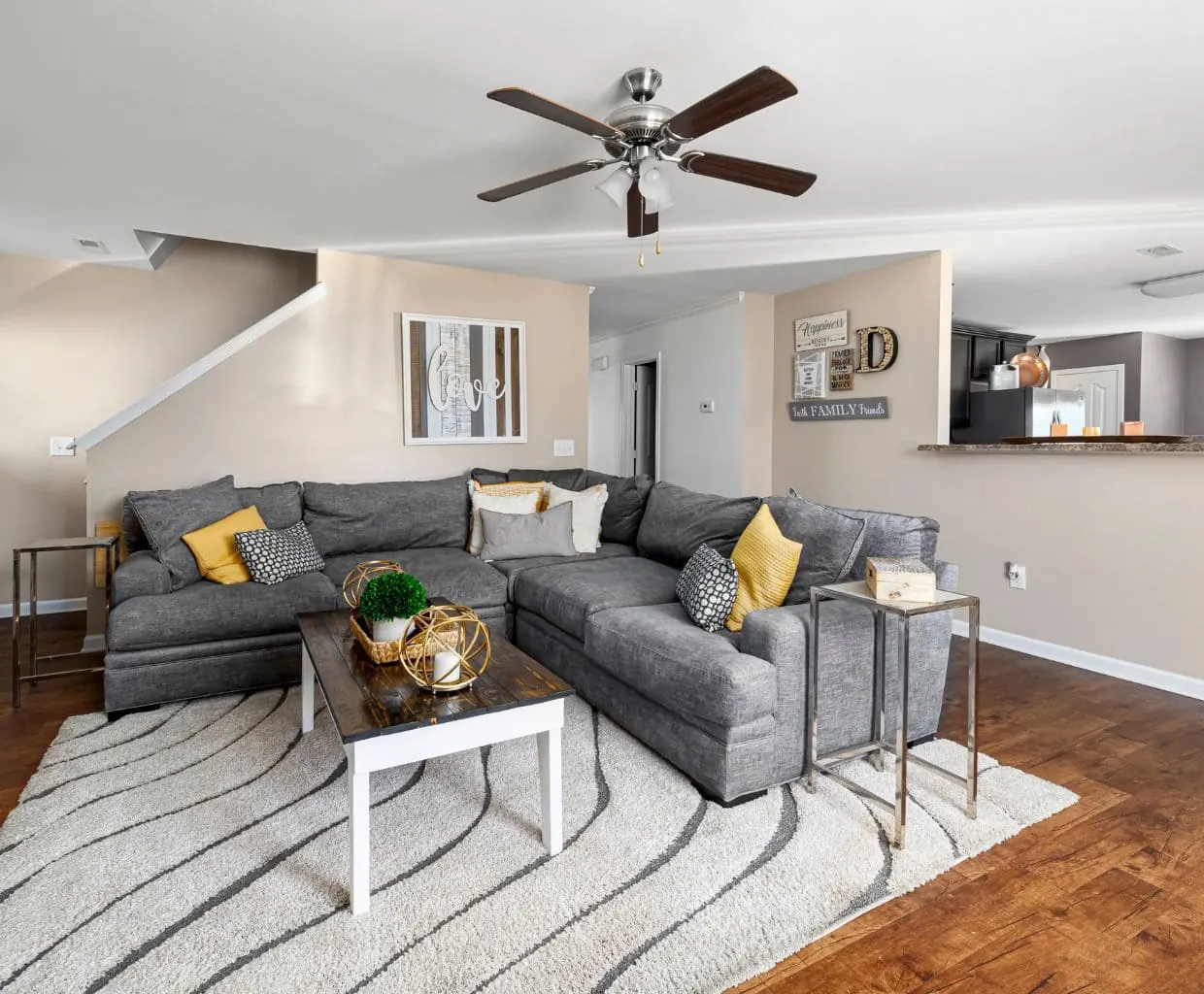
Ceiling Fan Size Guide: What Size Fan Does Your Room Need?
The right blade span for your room, how high to hang the fan, which downrod to buy, and how to read the airflow numbers on the box.
8 min read
Buying Guides
Ceiling Fan Height: How High to Hang a Ceiling Fan
The 7 ft minimum, the 8 to 9 ft sweet spot, ceiling and wall clearances by source, and which mount and downrod fit your ceiling height.
8 min read
Buying Guides
Ceiling Fan Statistics 2026: Ownership, Energy Use, Safety and Market Data
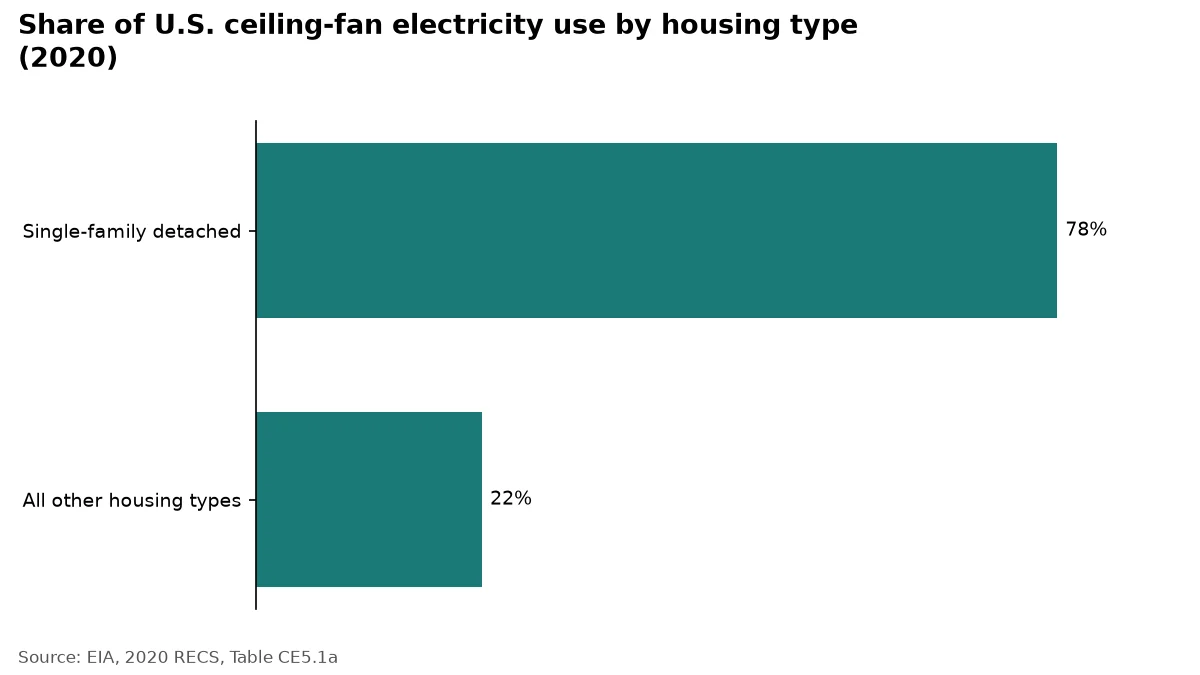
39 primary-sourced statistics on ceiling fan ownership, energy use, federal efficiency rules, safety recalls and market size, each checked against its original source: EIA, DOE, CPSC, NFPA, NAHB, Consumer Reports and more.
12 min read