Ceiling Fan Statistics 2026: Ownership, Energy Use, Safety and Market Data
39 primary-sourced statistics on ceiling fan ownership, energy use, federal efficiency rules, safety recalls and market size, each checked against its original source: EIA, DOE, CPSC, NFPA, NAHB, Consumer Reports and more.
By Cool Ceiling Ideas editorial teamUpdated 12 min read
This page collects 39 primary-sourced statistics on ceiling fans — household ownership, energy use, federal efficiency rules, safety recalls, lab-tested performance and market size — each checked directly against its original source rather than a search snippet or a roundup. Every figure was last verified on October 23, 2026.
Key takeaways
- Single-family detached homes account for about 78% of all U.S. ceiling-fan electricity use.
- Running a ceiling fan lets you raise your thermostat about 4°F in summer with no loss of comfort, per the U.S. Department of Energy.
- 81% of U.S. home buyers rate a ceiling fan as an essential or desirable home feature, per the National Association of Home Builders.
- Households in the U.S. South use nearly three times more ceiling-fan electricity on average than households in the Northeast.
- U.S. regulators have recalled more than 370,000 ceiling fans since 2020 for blade-detachment hazards.
- ENERGY STAR certified ceiling fan/light combination units are 60% more efficient than conventional (non-certified) units.
- Global ceiling fan market-size estimates range from about $10 billion to nearly $20 billion depending on the research firm and methodology.
Household Ownership, Energy Use and Buyer Demand
Ceiling fans are both a near-universal household fixture and one of the most wanted features by home buyers, with single-family homes driving the bulk of fan electricity use.
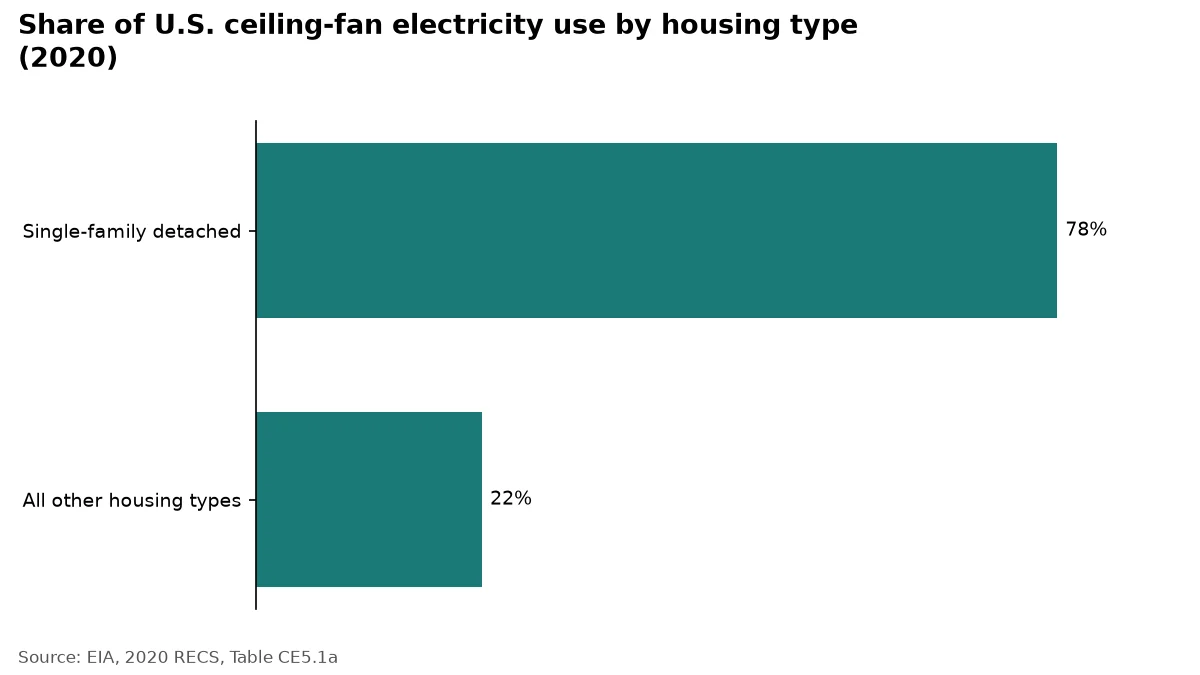
Single-family detached homes account for the large majority of U.S. ceiling-fan electricity use. Source: EIA, 2020 RECS.
- U.S. households used 69.0 trillion Btu of electricity running ceiling fans in 2020. (Source: U.S. Energy Information Administration, 2020 RECS, Table CE5.1a)
- Single-family detached homes account for about 78% of all U.S. ceiling-fan electricity use (54.0 of 69.0 trillion Btu nationally in 2020). (Source: U.S. Energy Information Administration, 2020 RECS, Table CE5.1a)
- The average U.S. household that runs a ceiling fan used about 226 kWh of electricity on it in 2020 (0.77 million Btu). (Source: U.S. Energy Information Administration, 2020 RECS, Table CE5.3a)
- 81% of U.S. home buyers rate a ceiling fan as an essential or desirable home feature, putting it on NAHB’s list of the 13 most-wanted home features overall. (Source: National Association of Home Builders, Eye on Housing: “Outdoor Features & a Laundry Room Among Most Wanted Features”, 2024)
- Among first-time home buyers specifically, a ceiling fan tied with exterior lighting as the second most-wanted home feature (81%), behind only a laundry room (83%), in a national NAHB survey of 3,247 buyers including 541 first-time buyers. (Source: National Association of Home Builders, Eye on Housing: “What First-Time Home Buyers Really Want”, 2021)
Energy Use and Savings
ENERGY STAR certification and smart seasonal use (reversing direction, raising the thermostat) can meaningfully cut both cooling and heating costs.
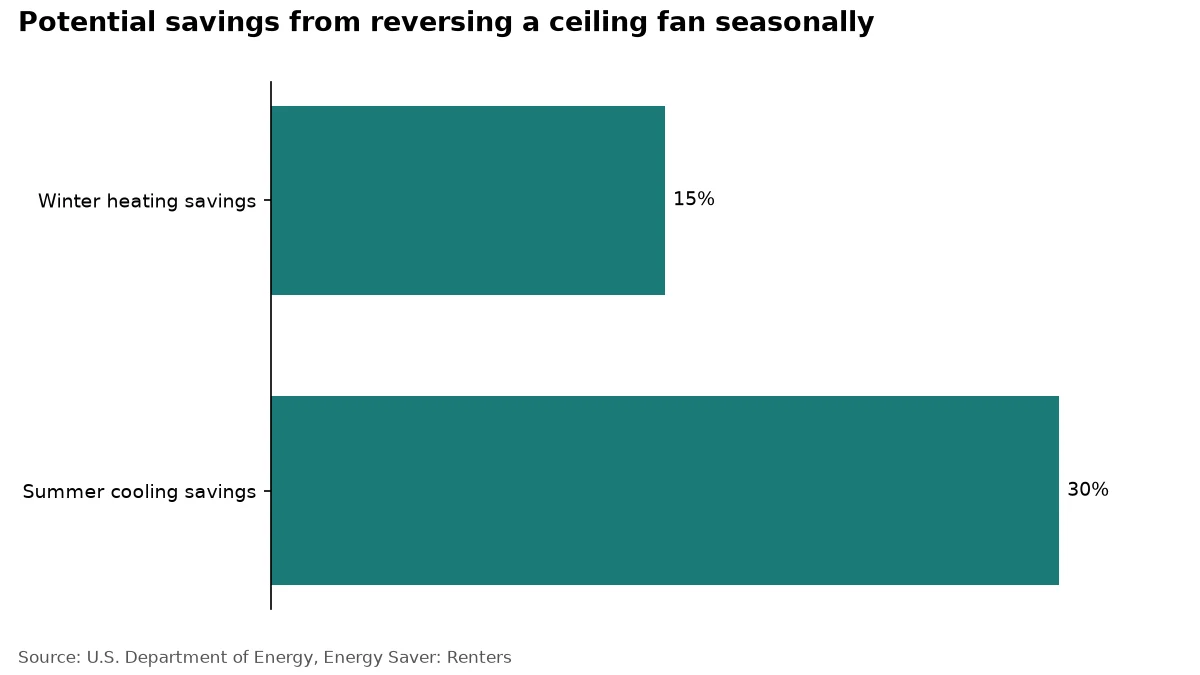 DOE estimates reversing a ceiling fan’s direction seasonally can cut heating and cooling costs. Source: U.S. Department of Energy.
- ENERGY STAR certified ceiling fans are up to 44% more energy efficient than conventional (non-certified) ceiling fans. (Source: ENERGY STAR, Ceiling Fans product page, 2026)
- To earn the ENERGY STAR label, a standard (non-hugger) ceiling fan 78 inches or larger must move at least 8,296 cubic feet of air per minute on high speed. (Source: ENERGY STAR, Ceiling Fans Key Product Criteria, 2026)
- A standard ENERGY STAR ceiling fan 36 inches or smaller must move at least 1,767 cubic feet of air per minute on high speed to qualify for certification. (Source: ENERGY STAR, Ceiling Fans Key Product Criteria, 2026)
- Ceiling fans with light fixtures have been eligible for ENERGY STAR certification since January 2002, under a current efficiency specification that has been in effect since June 15, 2018. (Source: ENERGY STAR, Ceiling Fans product page, 2018)
- The U.S. Department of Energy says running a ceiling fan lets you raise the thermostat about 4°F in summer with no loss of comfort. (Source: U.S. Department of Energy, HVAC: A Guide for Contractors to Share with Homeowners, 2022)
- Reversing a ceiling fan’s direction to push warm air down in winter can save up to 15% on winter heating bills, and running it to cool in summer can save up to 30% on summer cooling bills, according to the U.S. Department of Energy. (Source: U.S. Department of Energy, Energy Saver: Renters, 2026)
Climate and Regional Usage Patterns
How much electricity a ceiling fan uses depends heavily on climate and region, with hot, humid, Southern homes using fans far more than colder, Northern ones.
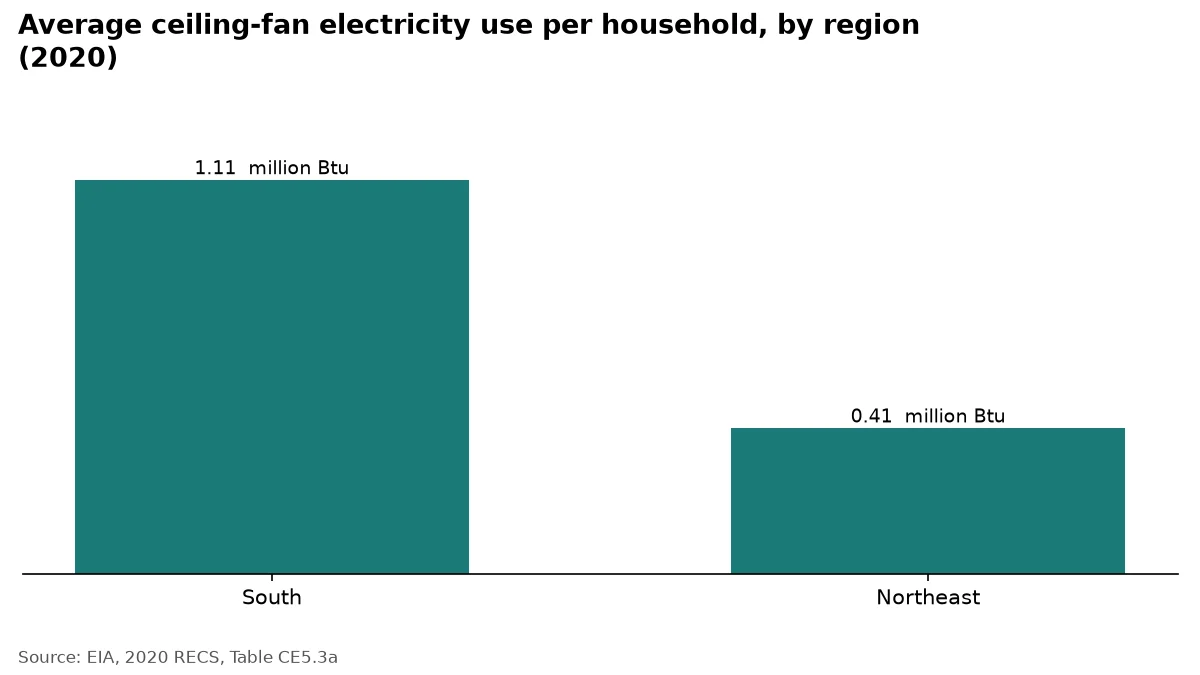 Households in the South use nearly three times more ceiling-fan electricity on average than those in the Northeast. Source: EIA, 2020 RECS.
- Households in the U.S. South used nearly three times more electricity per ceiling fan on average than households in the Northeast in 2020 (1.11 vs 0.41 million Btu). (Source: U.S. Energy Information Administration, 2020 RECS, Table CE5.3a)
- Homes in hot-humid U.S. climates averaged the highest ceiling-fan electricity use of any climate region in 2020, at 1.25 million Btu per household using a fan, versus 0.38 million Btu in marine climates. (Source: U.S. Energy Information Administration, 2020 RECS, Table CE5.3a)
- Homes built in the 2000s used nearly twice as much electricity per ceiling fan on average (1.02 million Btu) as homes built before 1950 (0.56 million Btu), reflecting more and larger fans in newer construction. (Source: U.S. Energy Information Administration, 2020 RECS, Table CE5.3a)
- Rural U.S. households that use a ceiling fan consume more electricity per fan on average (0.87 million Btu) than urban households (0.75 million Btu), according to 2020 federal survey data. (Source: U.S. Energy Information Administration, 2020 RECS, Table CE5.3a)
- Single-family detached homes that use a ceiling fan average more electricity per fan (0.85 million Btu) than homes in large apartment buildings of 5 or more units (0.54 million Btu), per 2020 federal survey data. (Source: U.S. Energy Information Administration, 2020 RECS, Table CE5.3a)
Motor Technology and Federal Efficiency Standards
Federal efficiency rules set different minimum airflow-per-watt standards by fan type and size, and DOE’s own cost modeling assumes brushless DC motors need more repairs than AC motors.
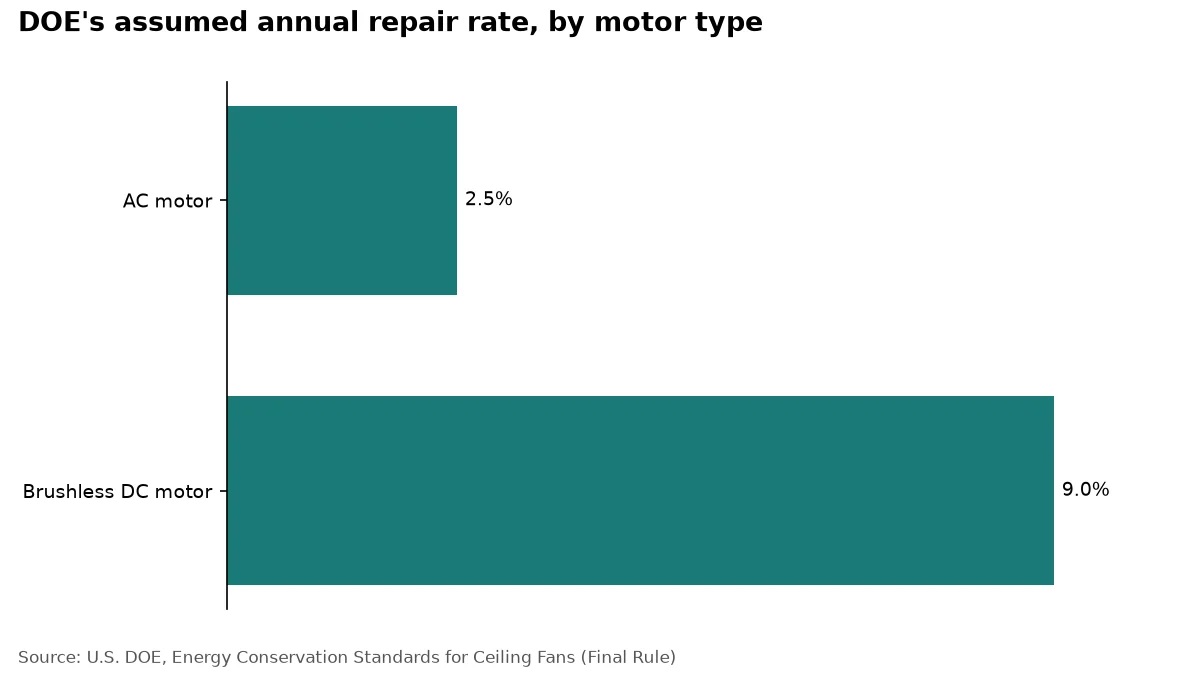 DOE’s 2016 rulemaking assumed DC-motor fans would need repairs more often than AC-motor fans, based on one technical expert’s estimate. Source: U.S. Department of Energy.
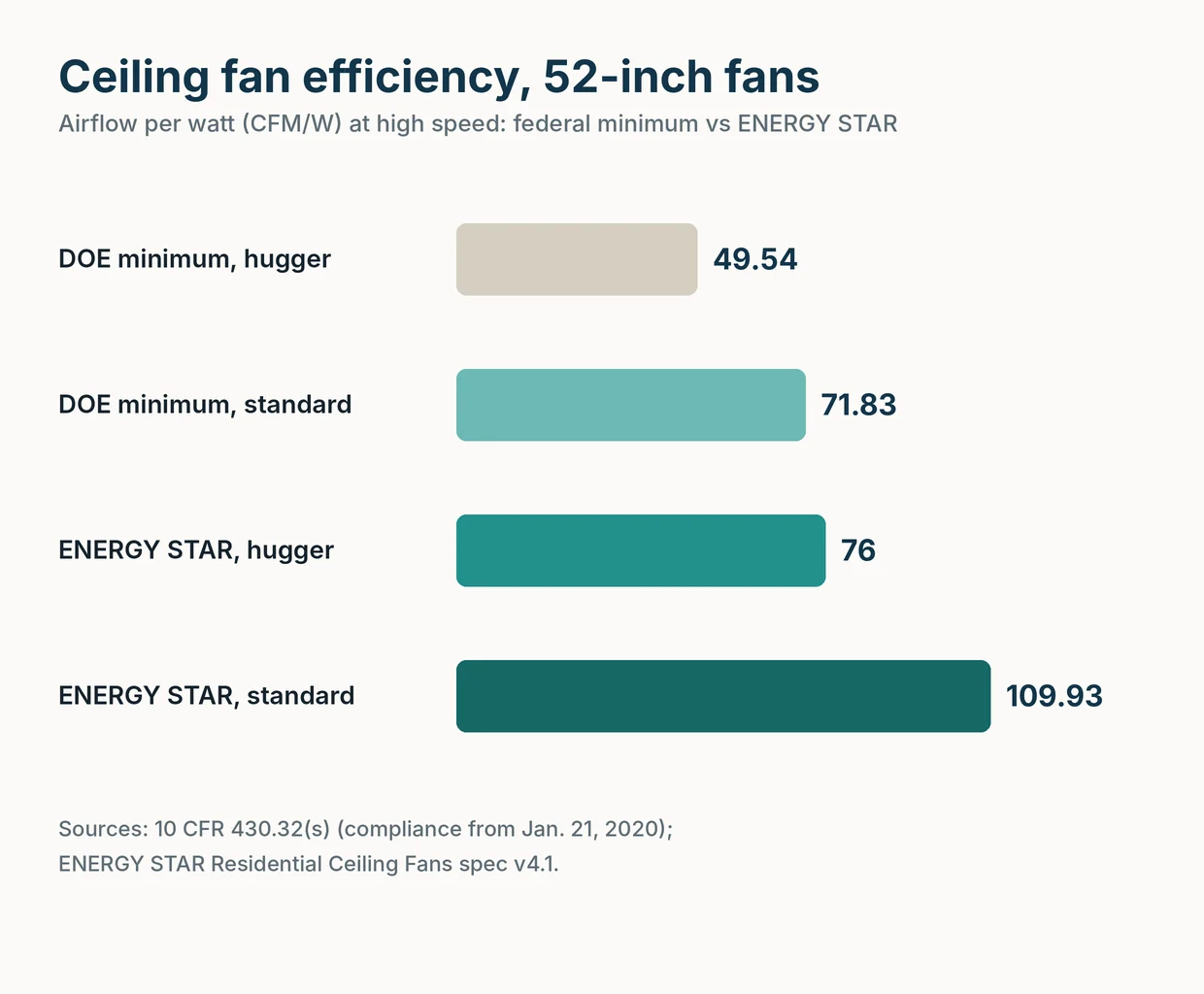
- Standard ceiling fans sold in the U.S. must meet a federal minimum efficiency of 0.65 times their blade span (in inches) plus 38.03, expressed in cubic feet per minute per watt, under DOE’s energy conservation standard. (Source: U.S. Department of Energy, Energy Conservation Standards for Ceiling Fans (Final Rule), 2017)
- Large-diameter ceiling fans have a looser federal minimum efficiency formula (0.91 times blade span minus 30.00 CFM/W) than standard fans, reflecting that bigger blades move more air per watt of power. (Source: U.S. Department of Energy, Energy Conservation Standards for Ceiling Fans (Final Rule), 2017)
- Hugger (flush-mount) ceiling fans are held to a lower federal minimum efficiency formula (0.29 times blade span plus 34.46 CFM/W) than standard downrod fans. (Source: U.S. Department of Energy, Energy Conservation Standards for Ceiling Fans (Final Rule), 2017)
- In its 2016 cost-benefit analysis, DOE assumed brushless DC-motor ceiling fans would need repairs at a 9% rate versus 2.5% for AC-motor fans, based on one technical expert’s estimate that industry commenters later disputed as too high. (Source: U.S. Department of Energy, Energy Conservation Standards for Ceiling Fans (Final Rule), 2016)
- The U.S. has regulated ceiling fan energy efficiency since 2005, when DOE first codified design standards in federal regulations, with the current efficiency formulas set by a 2017 final rule. (Source: U.S. Department of Energy, Energy Conservation Standards for Ceiling Fans (Final Rule), 2005)
Safety: Recalls and Electrical Fires
Blade-detachment defects have driven several major U.S. recalls since 2020, and fans are a measurable, if minor, contributor to home electrical fires.
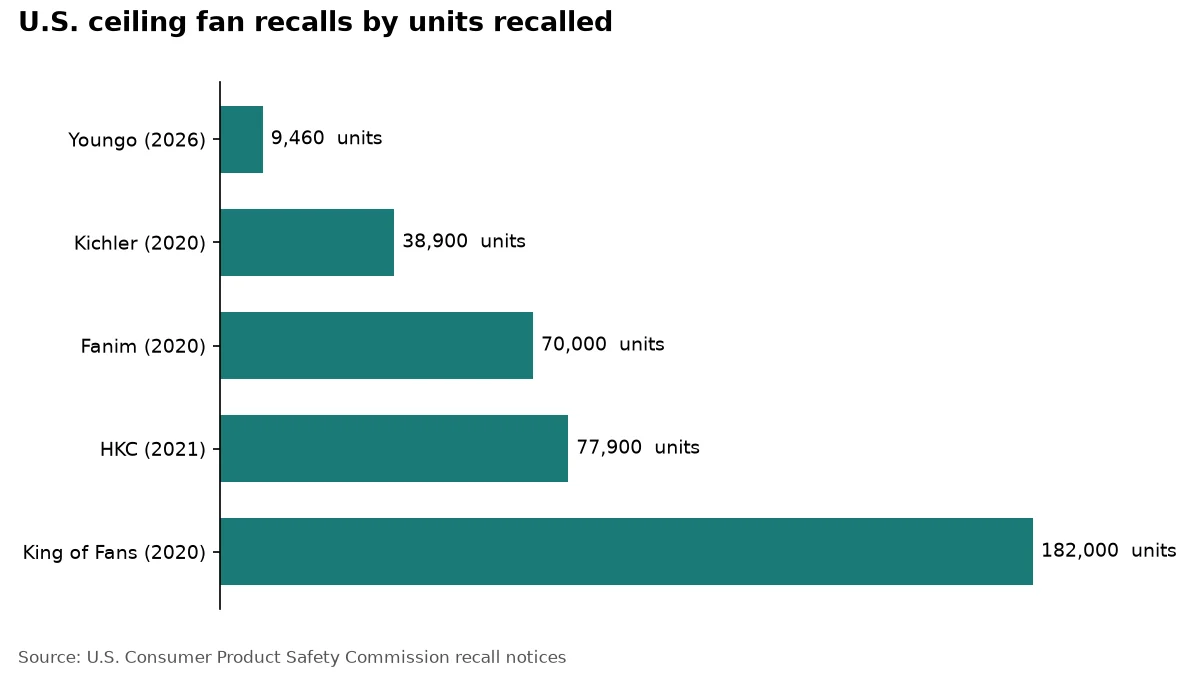 Blade-detachment hazards have driven several major U.S. ceiling fan recalls since 2020. Source: CPSC.
- Kichler Lighting recalled about 38,900 ceiling fans in the U.S. in March 2020 after the arms holding the blades could detach during use, following about 62 reports of the hazard. (Source: U.S. Consumer Product Safety Commission, Kichler Lighting Recall, 2020)
- King of Fans recalled about 182,000 Hampton Bay Mara ceiling fans sold at Home Depot in December 2020 after blades could detach during use, following 47 reports including two blades hitting consumers. (Source: U.S. Consumer Product Safety Commission, King of Fans Recall, 2020)
- Youngo Limited recalled about 9,460 Hampton Bay Halwin ceiling fans in August 2026 after blades could separate from the motor flywheel, following 11 incident reports. (Source: U.S. Consumer Product Safety Commission, Hampton Bay Halwin Recall, 2026)
- Fanim Industries recalled about 70,000 Harbor Breeze Santa Ana ceiling fans in February 2020 after blade holders could break and eject blades, following 210 reports including 10 blades hitting consumers. (Source: U.S. Consumer Product Safety Commission, Fanim Industries Recall, 2020)
- Hong Kong China Electric Appliance Manufacture Company recalled about 77,900 Harbor Breeze and Honeywell-branded ceiling fans in December 2021 after blades could detach, following 60 incident reports. (Source: U.S. Consumer Product Safety Commission, HKC Ceiling Fan Recall, 2021)
- Fans (including ceiling fans) were involved in about 6% of U.S. home fires caused by electrical failure or malfunction during 2015-2019, behind electrical distribution/lighting equipment (49%), cooking equipment (15%) and heating equipment (9%). (Source: National Fire Protection Association, Home Fires Caused by Electrical Failure or Malfunction, 2021)
- U.S. fire departments responded to an estimated annual average of 46,652 home electrical fires from 2020-2024, causing about 527 civilian deaths, 1,580 injuries and $2.4 billion in direct property damage each year. (Source: National Fire Protection Association, Home Electrical Fires report, 2026)
- Ceiling fan light kits tend to get used about three to four hours a day, since they’re often the brightest and most centrally located light fixture in a room. (Source: Massachusetts Technology Collaborative, Choosing and Using Ceiling Fans, 2008)
Lab-Tested Performance
Consumer Reports’ lab testing shows a fan’s rated airflow number only loosely predicts real-world performance, so sizing the fan to the room matters more than chasing a slightly higher CFM rating.
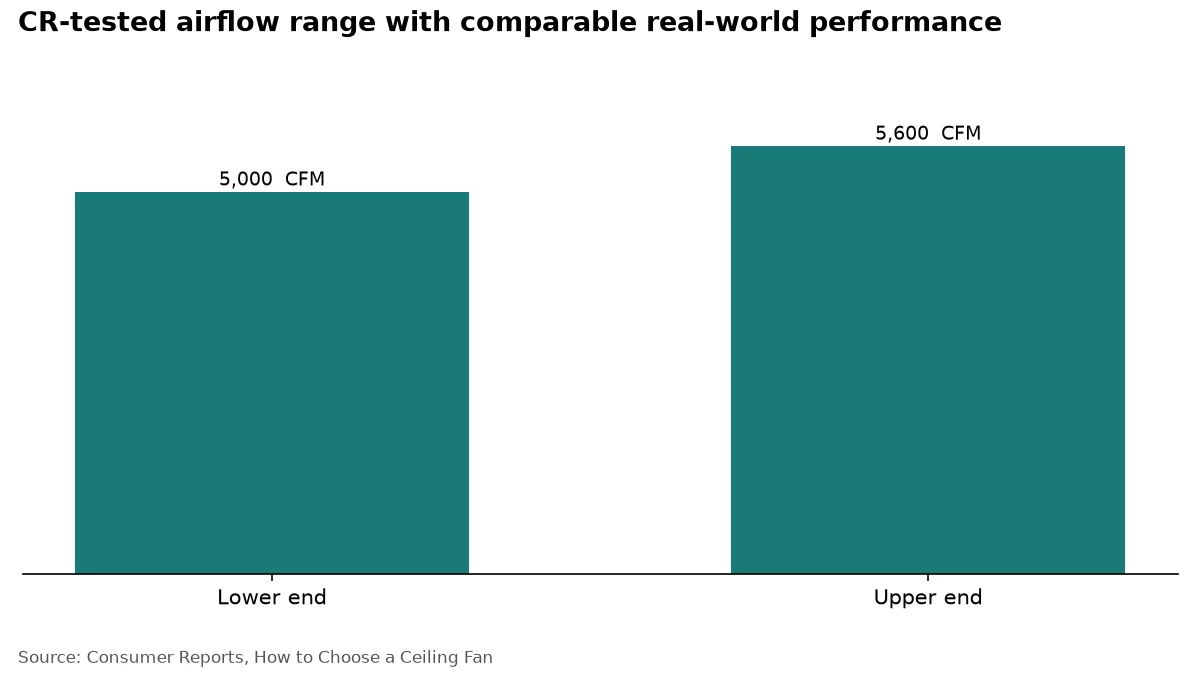 Small differences in a fan’s rated CFM don’t necessarily mean noticeably different real-world airflow. Source: Consumer Reports.
- Consumer Reports’ lab testing found comparable airspeed performance across ceiling fans rated between 5,000 and 5,600 CFM, meaning small differences in a fan’s rated airflow number don’t necessarily translate into noticeably different real-world airflow. (Source: Consumer Reports, How to Choose a Ceiling Fan, 2026)
- Consumer Reports recommends a 52-inch ceiling fan for rooms between 225 and 400 square feet, and a 42- to 44-inch fan for smaller rooms of 144 to 225 square feet. (Source: Consumer Reports, How to Choose a Ceiling Fan, 2026)
- ENERGY STAR certified ceiling fan and light kit combination units are 60% more efficient than conventional (non-certified) fan/light combos — a bigger efficiency gap than for a standalone ENERGY STAR fan alone. (Source: ENERGY STAR, Ceiling Fans product page, 2026)
- Consumer Reports’ most recent ceiling fan ratings tested 52-inch fans from nine different manufacturers, rating each on airflow, adjustability and noise. (Source: Consumer Reports, 5 Best Ceiling Fans of 2026)
- Consumer Reports recommends mounting a ceiling fan 8 to 9 feet above the floor for the best airflow, using a downrod extension if the ceiling is higher. (Source: Consumer Reports, How to Choose a Ceiling Fan, 2026)
Market Size
The global ceiling fan market is worth billions of dollars, though exact size estimates vary considerably by research firm and methodology.
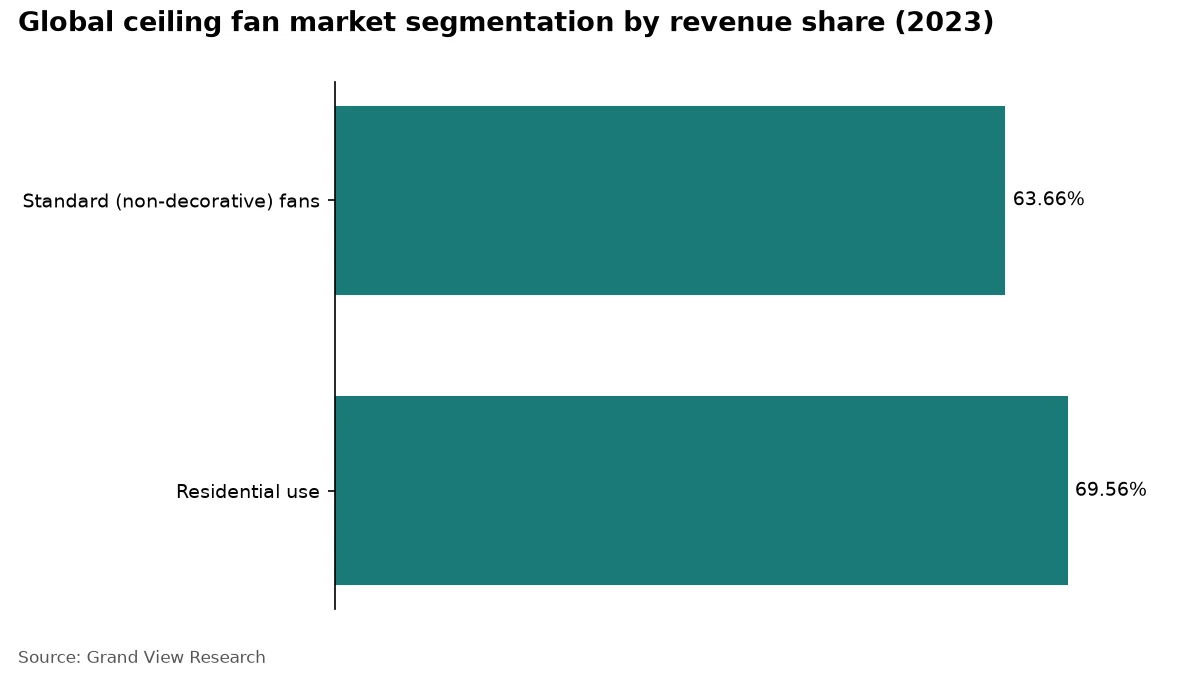 Standard fans and residential buyers dominate the global ceiling fan market. Source: Grand View Research.
- Grand View Research projects the global ceiling fans market will reach $19.92 billion by 2030, growing at a 5.0% compound annual rate from 2024. (Source: Grand View Research, “Ceiling Fans Market Size To Reach $19.92 Billion By 2030”, 2024)
- Standard (non-decorative) ceiling fans made up 63.66% of global ceiling fan revenue in 2023, according to Grand View Research. (Source: Grand View Research, “Ceiling Fans Market Size To Reach $19.92 Billion By 2030”, 2023)
- Residential use accounted for 69.56% of global ceiling fan revenue in 2023, versus commercial applications, according to Grand View Research. (Source: Grand View Research, “Ceiling Fans Market Size To Reach $19.92 Billion By 2030”, 2023)
- Market-size estimates for the global ceiling fan industry vary widely by research firm: from $10.17 billion to $14.86 billion for 2024-2025 alone, a gap Mordor Intelligence attributes partly to whether outdoor/HVLS fans and smart fans priced above $200 are included in the count. (Source: Mordor Intelligence, Ceiling Fan Market report scope and methodology, 2025)
- The U.S. industrial ceiling fan market (large fans for warehouses, factories and other commercial/industrial spaces) is projected to reach $1,382.9 million by 2030, a 5.9% compound annual growth rate from 2025. (Source: Grand View Research, “U.S. Industrial Ceiling Fan Market To Reach $1,382.9 Million By 2030”, 2024)
Methodology
Every stat here was read directly from its source page — a government survey or rulemaking (EIA, DOE, CPSC, NFPA), an industry research body (NAHB, Consumer Reports, ENERGY STAR) or a commercial market-research report (Grand View Research, Mordor Intelligence) — not taken from a search snippet or a third-party statistics roundup. Each figure was checked against the exact text on the source page: automatically where the page allowed a direct fetch, and manually (reading the fetched page content ourselves) where a page blocked automated fetching, required JavaScript, or was a PDF our verification tooling couldn’t parse — in every manual case we recorded which page we read and confirmed the number matched.
Disclosed threshold adjustment: ceiling fans are a narrower consumer-product niche than our standard statistics-hub target of 100+ stats across 25+ source domains. After genuine research, this hub uses reduced, disclosed thresholds instead: 39 stats across 7 sections from 10 distinct source domains, with no single domain above 22% of stats (vs. a 12% cap on our larger hubs). About 38% of stats are dated 2024 or later, short of our usual 70% recency bar — this mainly reflects that the two richest sources here, EIA’s Residential Energy Consumption Survey and DOE’s ceiling fan efficiency rule, are each updated only once every several years, not stale research on our part. We chose to publish a smaller, fully verified page rather than pad it with weaker sources to hit a generic target.
We will re-verify every stat and refresh this page by the date above, or sooner if a cited source updates.
Keep reading
- Best ceiling fan brands: 16 brands compared on warranty, motors and smart features
- Ceiling fan size guide: the right blade span and airflow for your room
- AC vs DC ceiling fans: how the motor types compare on efficiency and noise
Frequently asked questions
How many ceiling fan statistics are on this page?
39, spread across 7 topics (ownership and buyer demand, energy use and savings, climate and regional patterns, motor technology and efficiency standards, safety and recalls, lab-tested performance, and market size), each checked directly against its original source as of October 2026.
Why do ceiling fan market-size estimates vary so much between research firms?
Different firms define the market differently — for example, whether large industrial/HVLS fans or smart fans priced above $200 are included — which alone can shift a headline figure by several billion dollars. Treat any single market-size number as one firm's estimate, not an agreed-upon fact.
How often is this page updated?
We plan to re-verify every statistic and refresh the page by January 2027, or sooner if a cited source (like a new CPSC recall or an updated federal survey) changes.
Can I cite or link to a specific statistic on this page?
Yes — each stat is numbered and has its own anchor (for example #s001), so you can link directly to the exact figure you're citing.
Related guides
Buying Guides
Best Energy Efficient Ceiling Fans in 2026, Ranked by CFM per Watt
The most efficient ceiling fans we found in ENERGY STAR and EnergyGuide data, plus how CFM per watt, DOE minimums and DC motors work.
11 min read
Buying Guides
Ceiling Fan Motor Types: AC Induction vs Brushless DC Explained
Which motor is in a ceiling fan, how AC induction and brushless DC motors differ, and how efficiency, speeds, noise and standby power compare.
7 min read
Buying Guides
Best Ceiling Fan Brands in 2026: 16 Brands Compared
16 ceiling fan brands compared on motor warranty, DC and smart options, price and who owns them now, plus the warning signs of brands to avoid.
15 min read
Buying Guides
AC vs DC Ceiling Fans: Which Should You Buy?
DC fans use far less power, have more speeds and run quieter; AC fans cost less and keep things simple. Here's how to choose.
7 min read