Ceiling Fans for Sloped Ceilings: Angle Limits, Adapters and Downrods
How steep a ceiling a standard fan mount handles, when you need an angle adapter, how to measure the pitch and which downrod keeps the blades clear.
By Cool Ceiling Ideas editorial teamUpdated 8 min read
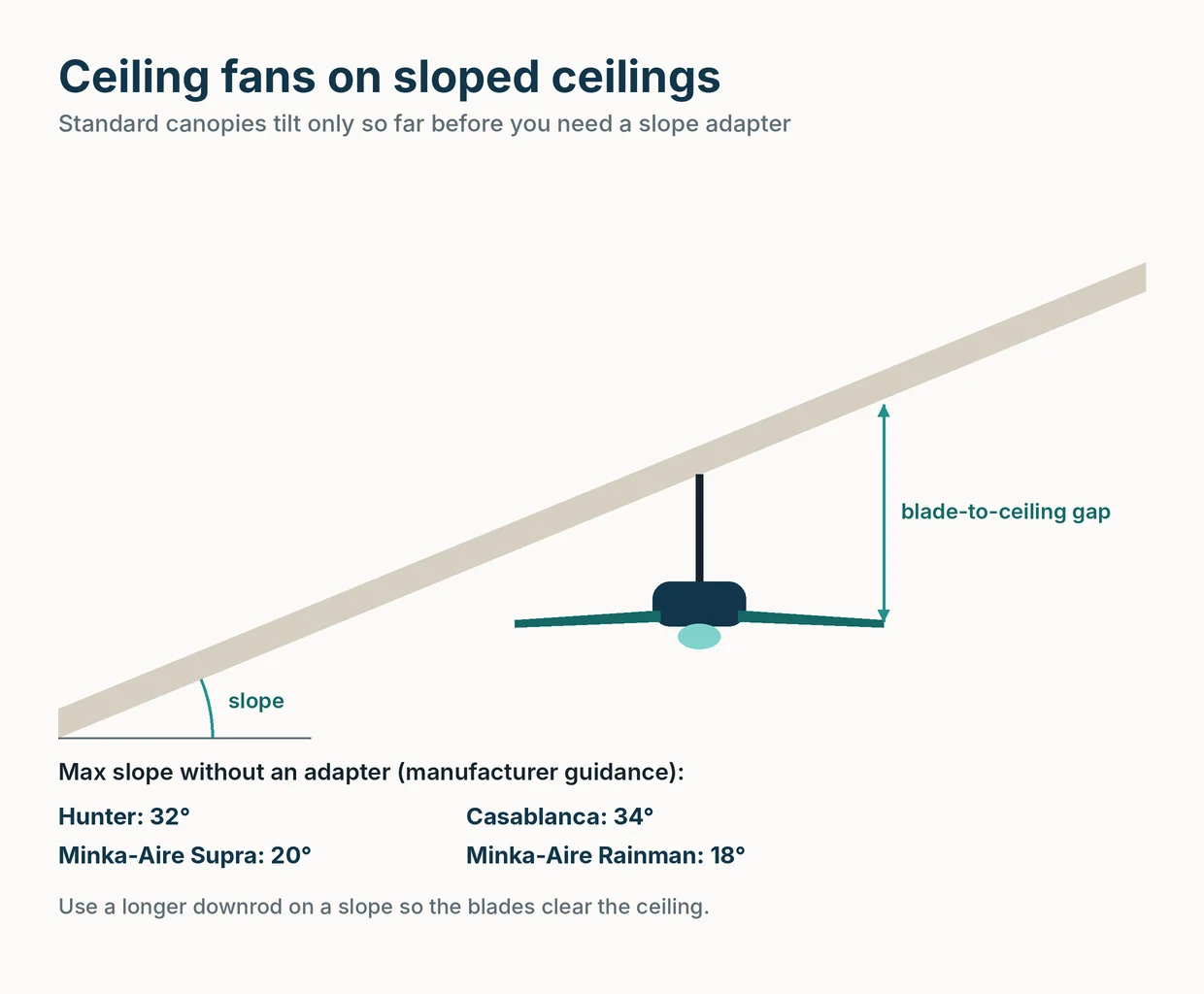
The short answer: most ceiling fans work on a sloped ceiling if they hang from a downrod and your ceiling’s angle is within the mount’s limit. Hunter’s included bracket handles slopes under 32°, Casablanca’s up to 34° and Minka-Aire’s Supra and Rainman only 20° and 18°. Steeper than that, you need the maker’s angled mounting kit, and on any real slope you need a longer downrod so the blades clear the low side of the ceiling.
How steep can the ceiling be without an adapter?
On a sloped ceiling, the fan hangs from a downrod whose mount lets the rod tilt so the fan hangs straight down. Each mount can only tilt so far (Kichler calls it the maximum stem tilt), and makers publish that limit in the manual.
| Brand or source | Standard mount works up to | Above that |
|---|---|---|
| Hunter | Under 32° | Angled ceiling mount adapter |
| Casablanca | 34° | Angled mounting kit, sold separately |
| Minka-Aire Supra (F568) | 20° | Longer downrod may be needed on steep slopes |
| Minka-Aire Rainman (F582L) | 18° | Longer downrod may be needed on steep slopes |
| Home Depot (general guide) | Not stated | 34–56° needs a slope-mount or angle-mount fan |
The limit is model-specific, not just brand-specific: Minka-Aire’s two manuals already differ by 2°, so check the manual of the fan you’re buying. Home Depot gives no rule above 56°; a ceiling that steep is a question for the manufacturer.
Note: The Department of Energy’s efficiency standards don’t apply to fans whose blades spin in a plane more than 45° from horizontal (10 CFR 430.32(s)). That rule is about tilted fans, not tilted ceilings. A fan hung correctly from a downrod keeps its blades level even under a steep ceiling.
Slope and angle adapters
When your ceiling is steeper than the standard mount allows, the fix is the manufacturer’s angled (sloped) ceiling mount kit. Hunter calls it an angled ceiling mount adapter; Casablanca an angled mounting kit, sold separately. Fanimation’s spec sheets show how much a kit can add: its Odyn Custom works on slopes up to 27° as shipped and up to 42° with the sloped-ceiling kit.
Before you buy one, check:
- Same brand, right model. Downrods and mounts aren’t universal. Hunter notes that its Original fans use a double-threaded downrod while many other Hunter fans use single-threaded ones.
- The kit’s maximum angle. It has to cover your measured pitch, with no rounding down.
- The downrod it expects. Kits change the mount, not the rod length. You’ll usually still need a longer rod (see below).
How to measure your ceiling pitch
Roof and ceiling slopes are usually given as a pitch: how many inches the surface rises over 12 in of level run. To find yours:
- Hold a level against the ceiling so one end touches it and the level reads level.
- Mark 12 in along the level from the touching end.
- Measure straight up from that mark to the ceiling. That’s the rise, so 6 in means a 6/12 pitch.
- Convert it to degrees with the table below and compare it with your fan’s limit.
| Pitch | Angle | Minimum downrod (Fanimation sheet) |
|---|---|---|
| 1/12 | 4.8° | Standard rod |
| 2/12 | 9.5° | 6 in |
| 3/12 | 14.0° | 12 in |
| 4/12 | 18.4° | 12 in |
| 5/12 | 22.6° | 18 in |
| 6/12 | 26.5° | 18 in |
| 7/12 | 30.3° | 24 in |
| 8/12 | 33.7° | 24 in |
| 9/12 to 12/12 | 36.9° to 45.0° | 36 in |
So a 4/12 ceiling (18.4°) is already past the 18° limit of the Minka-Aire Rainman, while an 8/12 ceiling (33.7°) is past Hunter’s 32° but inside Casablanca’s 34°.
Tip: Measure at the spot where the fan will hang, since some vaulted ceilings change pitch.
Downrod length on a slope
On a flat ceiling, the downrod is set by ceiling height. On a slope, there’s a second minimum set by the pitch. Use whichever is longer.
The height side comes from Hunter’s chart: the included rod at 9 ft, 12–18 in at 10 ft, 18–24 in at 11 ft and 36 in at 12 ft. Measure the height where the fan mounts, not at the peak.
The pitch side is the right-hand column of the table above. Example: a fan mounted where the ceiling is 10 ft high, on a 6/12 slope. The height chart says 12–18 in; the pitch table says at least 18 in. Buy the 18 in rod.
Then check the result against the floor. ENERGY STAR and every manufacturer in our research put the minimum at 7 ft from the floor to the blades, and ENERGY STAR suggests 8 to 9 ft for best airflow. Our guide to ceiling fan height explains how to measure it.
Blade clearance to the slope
The downhill blade tip is the one at risk. The ceiling above it is lower than at the mount, by (blade radius) × (rise ÷ 12). Our math for a 52 in fan, whose tips reach 26 in out from the center:
- 4/12 pitch: the ceiling above the low-side tip is about 8.7 in lower than at the mount.
- 6/12 pitch: about 13 in lower.
- 8/12 pitch: about 17.3 in lower.
Add the gap you want above the blades: CBE, Home Depot and Hunter put the minimum at 8 in, CBE says 12 in or more is better, and it also suggests at least 0.2 × the fan diameter. That’s why the downrod minimum climbs with the pitch, and why Minka-Aire’s manuals warn that steep slopes may need a longer rod for blade clearance.
Important: A fan hung too close to a vaulted ceiling can wobble. A Harbor Breeze manual lists it as a cause of excessive wobble and a longer downrod as the fix. If yours already shakes, start with our ceiling fan wobble guide.
Why flush-mount fans usually don’t work on slopes
A hugger fan bolts straight to the ceiling with no rod and no swivel, so there’s nothing to let it hang level. Hunter says it directly: low-profile fans cannot be used on angled ceilings. Multi-mount fans follow the same logic. Big Ass Fans’ Haiku low-profile mount is for flat 8–10 ft ceilings, while its universal (downrod) mount handles slopes up to 33°.
If your sloped room is low, look for a model that publishes a slope limit with its shortest rod rather than forcing a hugger onto the angle. Our low profile ceiling fans guide is for flat, low ceilings.
Fan support on a vaulted ceiling
The fan’s weight and its constant motion have to go into the structure, and a slope doesn’t change the rules:
- NEC 422.18 (2017) says a ceiling paddle fan must be supported independently of an outlet box, or by a listed box or box system identified for fan support.
- A box that is the sole support must be listed and marked for fan support, up to 70 lb. Fans over 35 lb need a box marked with the maximum weight it supports.
- Minka-Aire wants a UL-listed metal box rated for at least 50 lb, never plastic.
- ENERGY STAR says to anchor the fan to a joist, or use a ceiling-fan bracket between joists if the joist isn’t where the fan goes.
Our fan-rated box guide explains how to tell whether your box qualifies.
Important: Turn off power at the breaker before touching the box or wiring. Follow the fan’s manual and local code, and hire a licensed electrician if you’re unsure about the box, the brace or the wiring.
Where to place a fan under a sloped ceiling
- Center it over the space you use, like the seating area, not the peak by default. CBE says one centered fan can serve a rectangular room up to a 1.5:1 length-to-width ratio; longer rooms do better with two fans.
- Keep the blade tips away from walls and the sloping ceiling. ENERGY STAR and Minka-Aire want at least 18 in to walls; Hunter and Casablanca say 30 in.
- Size the fan to the floor area, not the ceiling surface. Our ceiling fan size guide and the ceiling fan size calculator give the blade span and downrod in one go.
Fans that publish a slope rating
Many fans list an “angled” mount without a number. These models in our research state an actual limit.
| Fan | Max slope (as shipped) | With kit | Rating | Downrod in box |
|---|---|---|---|---|
| Fanimation Odyn Custom 56 in | 27° (usually 24 in+ rod) | 42° | Wet | 12 in |
| Big Ass Fans Haiku (universal mount) | 33° | Not stated | Dry | 12 in |
| Quorum Monaco 52 in Patio | 25° | Not stated | Wet | Not confirmed |
| Kichler Breda 65 in | 22° (max stem tilt) | Not stated | Wet | Yes |
| Minka-Aire Sandfell 56 in | 18° | Not stated | Not stated | 6 in |
| Minka-Aire Norwynd 60 in | 18° | Not stated | Wet | 6 in |
| Westinghouse Comet 52 in | 15° | Not stated | Damp | 4 in |
Our pick for steep ceilings is the Fanimation Odyn Custom, the only model here with a published kit limit as high as 42°. It’s a DC, ENERGY STAR certified fan with 7,587 CFM on high (56 in); motor and blades are ordered separately.
Check the Fanimation Odyn Custom on Amazon
For a moderate indoor slope, we’d look at the Minka-Aire Sandfell 56 in: a DC smart fan, ENERGY STAR Most Efficient, rated to 18°. That covers up to about a 3/12 pitch (14°), but not 4/12 (18.4°).
Check the Minka-Aire Sandfell on Amazon
The premium Big Ass Fans Haiku handles 33° on its universal mount.
Check the Big Ass Fans Haiku on Amazon
Note: Treat a product page’s “angled mount” tag with care. Hunter tags its Outdoor Original with an angled mount, but the spec text doesn’t confirm it, and a Home Depot reviewer reports it doesn’t fit sloped ceilings out of the box. If the manual doesn’t state a degree limit, ask the maker before you buy.
Frequently asked questions
Can you put a ceiling fan on a sloped ceiling?
Yes, as long as it hangs from a downrod. Most standard mounts handle a moderate slope (Hunter under 32°, Casablanca 34°, Minka-Aire Supra 20°), and steeper ceilings need the maker's angled mounting kit.
What angle can a ceiling fan be mounted at?
It depends on the model. Hunter's included bracket works below 32°, Casablanca's up to 34° and Minka-Aire's Supra and Rainman to 20° and 18°. Fanimation's Odyn Custom goes to 27°, or 42° with its sloped-ceiling kit.
Do I need a special ceiling fan for a vaulted ceiling?
Usually not a special fan, but a fan with a downrod and a mount rated for your ceiling's angle. Hunter says low-profile fans can't go on angled ceilings, so skip flush-mount huggers.
How long should a downrod be on a sloped ceiling?
Use the longer of two numbers: the length for your ceiling height and the minimum for the pitch. A Fanimation sheet lists 12 in for a 4/12 pitch, 18 in for 6/12, 24 in for 8/12 and 36 in from 9/12 to 12/12.
How do I find the angle of my ceiling?
Measure the pitch: how many inches the ceiling rises over 12 in of level run. A 4/12 pitch is about 18.4°, 6/12 about 26.5° and 12/12 exactly 45°.
Does a fan on a sloped ceiling need a special electrical box?
It needs the same thing every ceiling fan needs: a box listed and marked for fan support, or support from the building structure. On a vaulted ceiling that often means a brace between rafters, so call a licensed electrician if you're unsure.
Related guides
Room Ideas
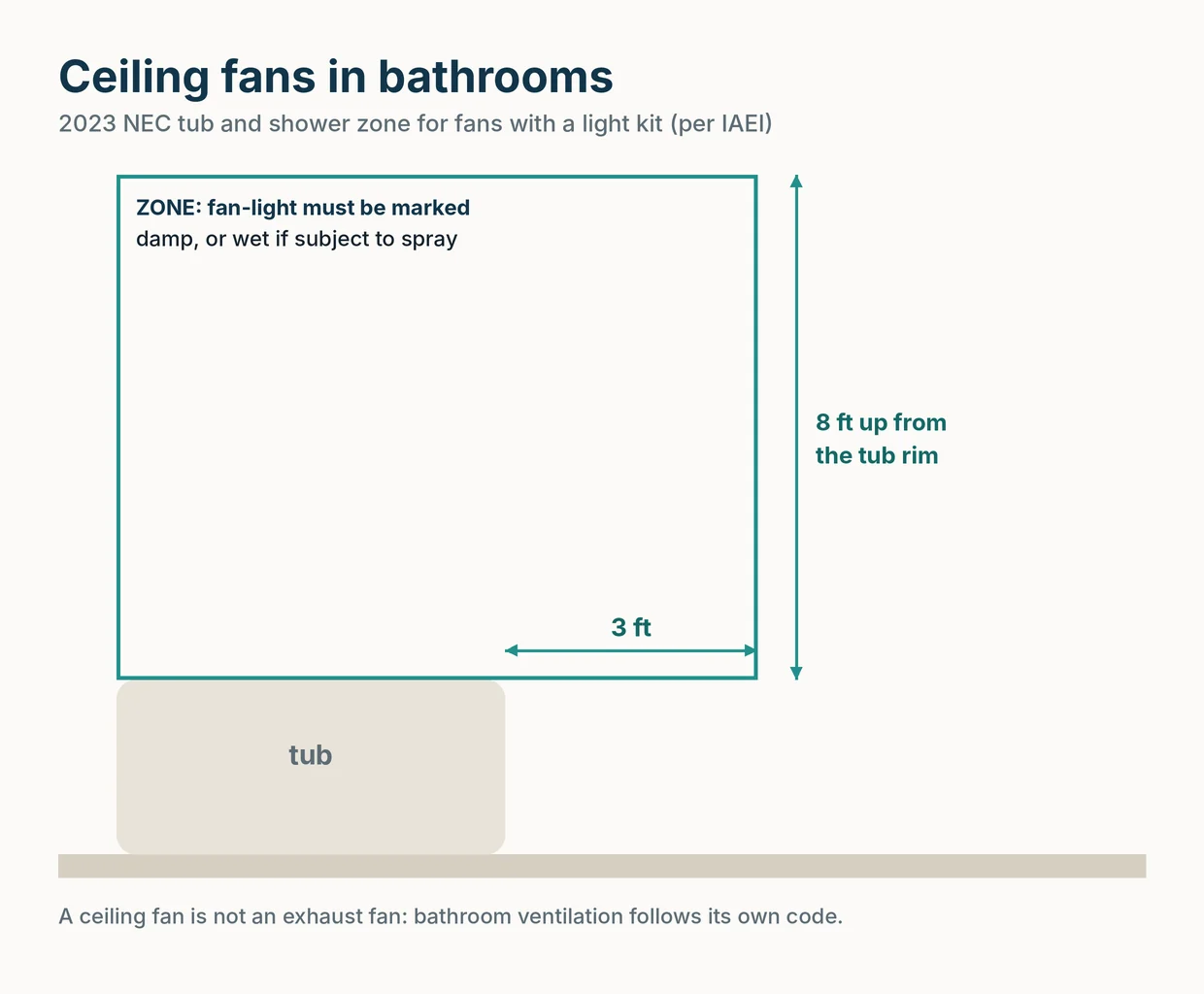
Bathroom Ceiling Fans: Ratings, Sizing and Safe Placement
A bathroom ceiling fan needs the right damp or wet rating, a small blade span and room to clear walls and heads. What the 2023 NEC zone means, plus four picks.
8 min read
Room Ideas
Quietest Ceiling Fans in 2026: Picks for Bedrooms
What independent lab testing says about quiet ceiling fans, six bedroom picks with honest notes on missing noise data, and how to quiet a fan you own.
8 min read

Room Ideas
Best Nursery Ceiling Fans in 2026: Quiet, Safe Picks
Quiet DC and low-profile fans with dimmable lights and remotes for a baby's room, plus safe mounting, crib placement and what the AAP says about overheating.
9 min read
Room Ideas
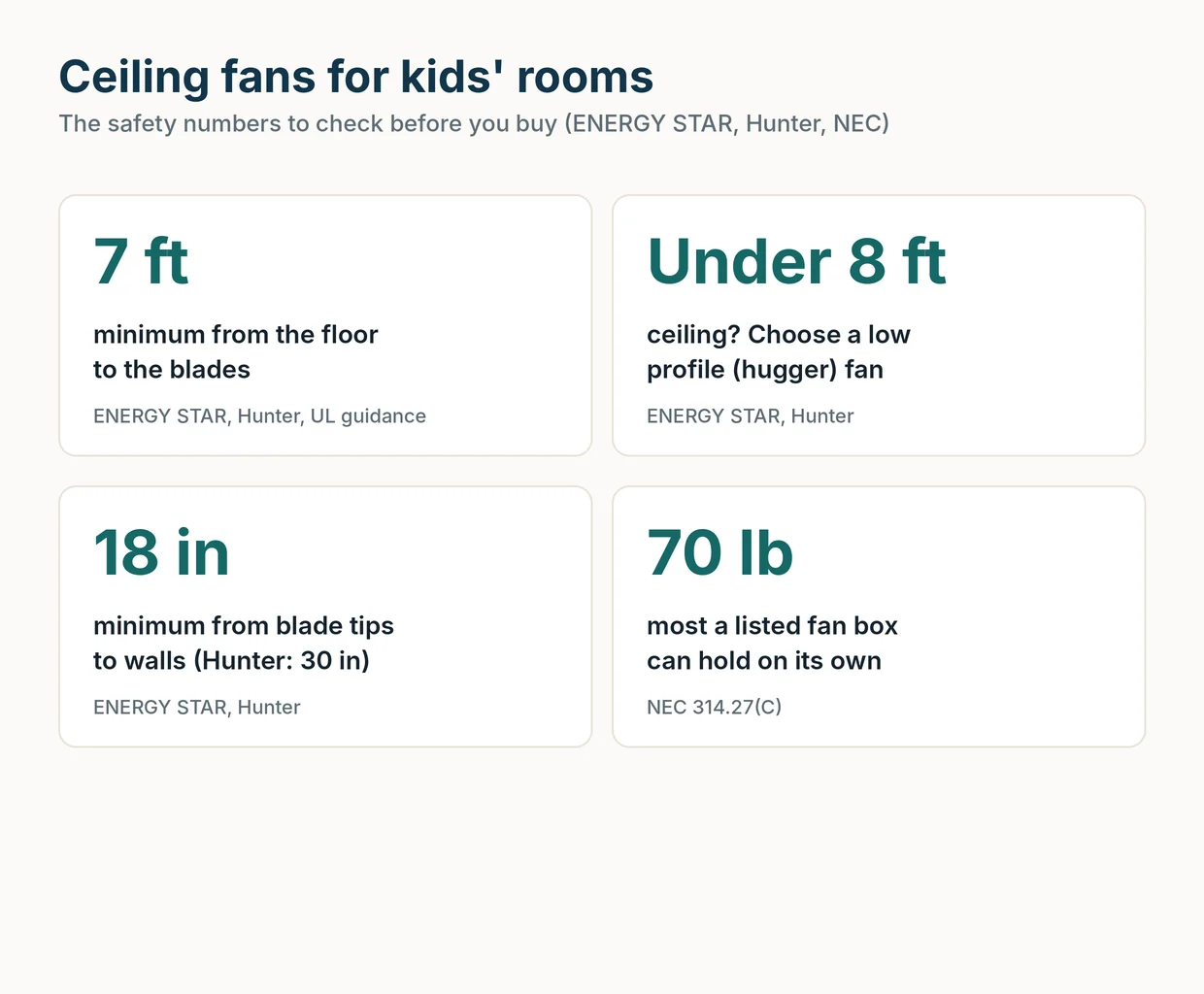
Best Ceiling Fans for Kids' Rooms in 2026: Safe, Simple Picks
Low-profile, remote-controlled and enclosed-blade fans for kids' and teens' bedrooms, plus the height, clearance and mounting rules that keep them safe.
9 min read