Ceiling Fan Size Guide: What Size Fan Does Your Room Need?
The right blade span for your room, how high to hang the fan, which downrod to buy, and how to read the airflow numbers on the box.
By Cool Ceiling Ideas editorial teamUpdated 8 min read
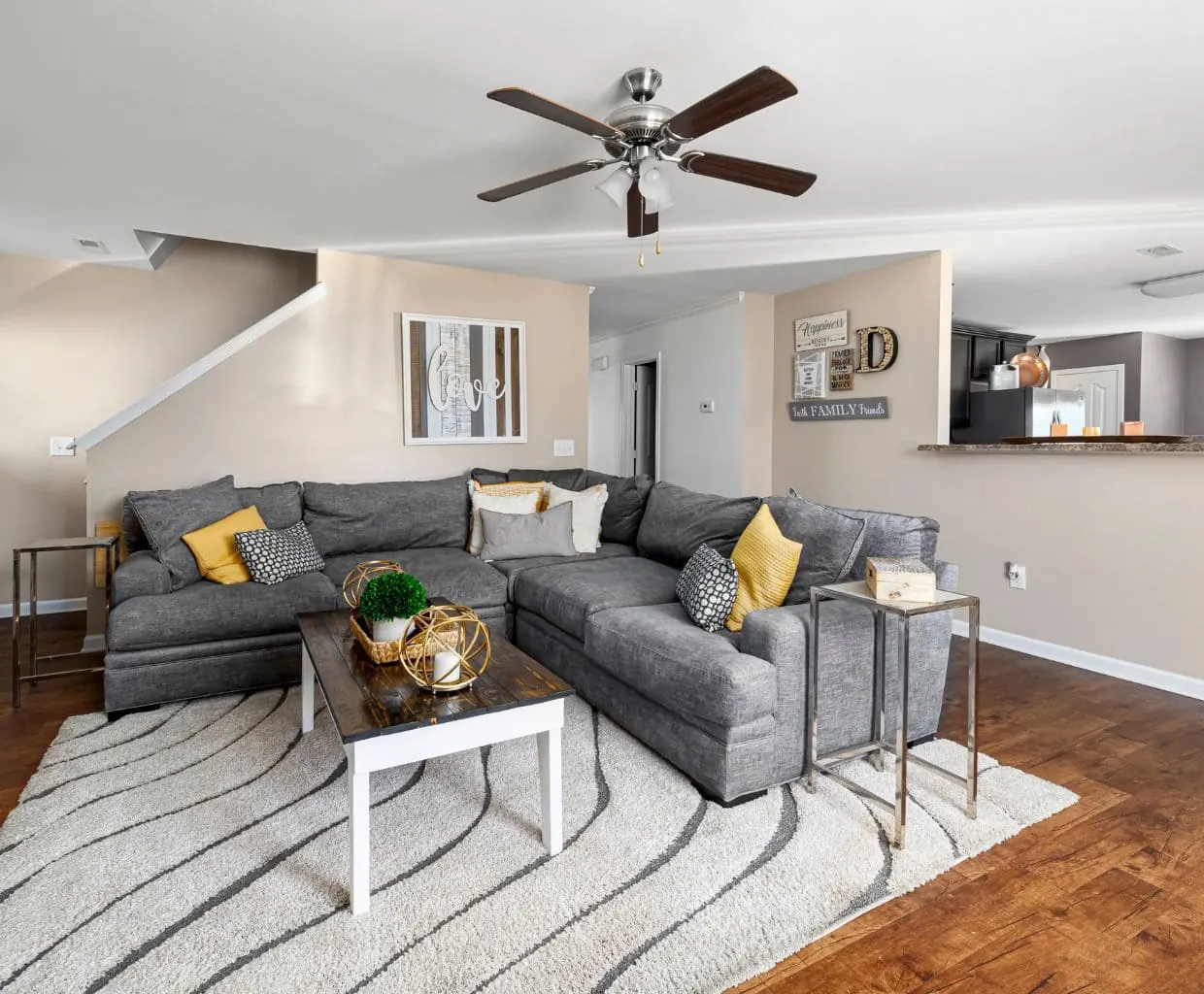
The short answer: match the blade span to the room’s floor area. Up to 75 sq ft takes a 29–36 in fan, 76–144 sq ft a 36–42 in fan, 144–225 sq ft a 44 in fan and 225–400 sq ft a 50–54 in fan. Hang it so the blades sit 8 to 9 ft above the floor (never lower than 7 ft), with at least 18 in between the blade tips and the walls.
Want the numbers worked out for you? Enter your room size and ceiling height in our ceiling fan size calculator. It uses the same rules as this guide and also gives you the downrod length.
Step 1: Measure the room and the fan
Multiply the room’s length by its width to get the floor area. For an open-plan space, measure only the zone the fan will serve.
Fan size is the blade span: the diameter of the circle the blades sweep, which is how the US Department of Energy (DOE) defines it. With an odd number of blades, measure from the center of the motor to one blade tip and double it.
Ceiling fan size chart by room size
| Room size | Blade span |
|---|---|
| Up to 75 sq ft (about 9 x 8 ft) | 29–36 in |
| 76–144 sq ft (up to 12 x 12 ft) | 36–42 in |
| 144–225 sq ft (up to 15 x 15 ft) | 44 in |
| 225–400 sq ft (up to 20 x 20 ft) | 50–54 in |
| Over 400 sq ft | 56 in or larger, or two fans |
The first four rows come from ENERGY STAR’s sizing chart, which the agency attributes to the American Lighting Association. That chart stops at 400 sq ft, so the last row uses Hunter’s recommendation of 56 in or more.
How Hunter, Home Depot and Big Ass Fans differ
| Room size | ENERGY STAR | Home Depot | Big Ass Fans | Hunter |
|---|---|---|---|---|
| Up to 75 sq ft | 29–36 in | No row | 44 in (smallest row) | 30–48 in (up to 100 sq ft) |
| 76–144 sq ft | 36–42 in | 42 in | 44 in | 30–48 in, then 50–54 in |
| 144–225 sq ft | 44 in | 44 in | 52 in | 50–54 in |
| 225–400 sq ft | 50–54 in | 52 in | 60 in | 50–54 in |
| Over 400 sq ft | No row | More than one fan | 84 in (up to 900 sq ft) | 56 in or more |
Big Ass Fans runs about one size larger than everyone else (its own Haiku L page even contradicts its blog on the 44 in fan). Home Depot gives single sizes rather than ranges, and Hunter uses wide bands. In our view, the ENERGY STAR chart is the sensible middle ground. When a room sits on a boundary, the larger size is usually fine as long as the blade tips stay 18 in from the walls.
For a cross-check, UC Berkeley’s Center for the Built Environment (CBE) suggests a fan diameter of 0.2 to 0.4 times the square root of the floor area: about 29–58 in for a 12 x 12 ft room. CBE also advises picking the largest fan that still fits the height and clearance rules, because bigger fans give more even air speeds.
One fan or two? Long and large rooms
CBE’s design guide says one centered fan can serve a room up to a length-to-width ratio of about 1.5 to 1. Beyond that, divide the room into roughly square zones and center a fan in each. A 14 x 30 ft open-plan room, for example, splits into two zones of about 210 sq ft, each with a 44 in fan. Home Depot also notes that larger rooms may need more than one fan. We’d choose two right-sized fans over one oversized fan in any long room.
For big spaces with ceilings of 11 ft or more, CBE suggests considering a large-diameter fan (over 7 ft). These need the blades at least 10 ft above the floor.
How high to hang a ceiling fan
- Minimum: 7 ft from the floor to the blades. ENERGY STAR, CBE, Hunter, Home Depot, Casablanca, Minka-Aire and Big Ass Fans all agree.
- Best: 8 to 9 ft. ENERGY STAR and Big Ass Fans call this optimal for airflow; Hunter says ideally 8 ft.
- Ceilings under 8 ft: choose a hugger or low-profile fan. These move less air because the blades sit close to the ceiling.
On very low ceilings, check the distance from ceiling to blades on the spec sheet. DOE’s definition lets a “hugger” put its blades up to 10 in below the ceiling. On a 7.5 ft ceiling that would leave them under 7 ft, so you’d need a model whose blades sit no more than 6 in down. Our guide to low-profile ceiling fans covers the options.
On a standard 8 ft ceiling, a typical fan that’s 12 in tall leaves the blades at exactly 7 ft: allowed, but below the ideal height. We’d pick a flush-mount model there.
Downrod length by ceiling height
| Ceiling height | Downrod length |
|---|---|
| Under 8 ft | None: use a low-profile (hugger) fan |
| 8 ft | Flush mount or the short rod in the box |
| 9 ft | The rod in the box (usually 3–6 in) |
| 10 ft | 12 in |
| 11 ft | 18–24 in |
| 12 ft | 36 in |
| 13 ft | 48 in |
| 14 ft | 60 in |
| 15 ft | 72 in |
| Over 15 ft | Longer rods, often two joined with a coupler |
These follow Hunter’s downrod chart, which gives a 12–18 in range at 10 ft; 12 in puts a typical fan’s blades at about 8 ft. To work it out yourself, use Hunter’s formula: ceiling height minus fan height minus target blade height. For a 12 ft ceiling and a 12 in fan: 144 − 12 − 96 = 36 in.
Downrods aren’t universal, so buy the rod made for your fan. On sloped ceilings, Hunter’s standard mount handles up to 32°, but some Minka-Aire models allow only 18–20°.
Clearances from walls and ceiling
| Clearance | Minimum | Better |
|---|---|---|
| Blade tips to walls | 18 in (ENERGY STAR, CBE, Home Depot, Minka-Aire) | 30 in (Hunter, Casablanca); 2–3 ft (CBE) |
| Blades to ceiling | 8 in (CBE, Home Depot, Hunter) | 12 in or more (CBE) |
| Blades to floor | 7 ft | 8–9 ft |
CBE’s rule of thumb for the ceiling gap is at least 0.2 times the fan’s diameter, or about 10 in for a 52 in fan. Too close and the fan is “starved” of air. ENERGY STAR adds that the fan belongs in the middle of the room.
Does the number of blades matter?
Less than most people think. CBE says more blades can increase airflow, but the extra weight and drag can lower efficiency. Most standard fans have three to five. Airflow depends mainly on:
- Blade span: a bigger sweep moves more air.
- Blade pitch: steeper blades move more air at some cost in efficiency. Manufacturers recommend 12–15°, per CBE.
- The motor: how fast and how efficiently it turns the blades. See our guide to ceiling fan motor types.
CBE also notes that airfoil-shaped blades are usually more efficient and quieter, but they work worse in reverse, so keep that in mind if you change the ceiling fan direction for winter. We’d skip paying extra for more blades and compare the airflow on the box instead.
How to read the EnergyGuide label
Almost every ceiling fan sold in the US carries an FTC EnergyGuide label on the box. It shows:
- Estimated yearly energy cost, with a range for similar models ($3 to $34 a year for fans 19–84 in)
- Airflow in cubic feet per minute (CFM)
- Energy use in watts, not counting lights
- Airflow efficiency in CFM per watt
The cost assumes 6.4 hours a day at 12 cents per kWh, so if you pay more, your real cost will be higher. Fans that can be mounted two ways must show the less efficient setup.
One caveat from CBE: the efficiency figure is a time-weighted average across speeds plus standby power. It ignores how much air the fan moves on high, so a fan with a weak top speed can still rate well. Read CFM and CFM per watt together.
The ENERGY STAR airflow benchmark
We couldn’t find a reputable source that says how much airflow a room needs. ENERGY STAR does set a minimum airflow on high for certified fans of each size, which makes a useful yardstick: a fan well below it will feel weak for its size.
| Blade span | Minimum airflow on high (ENERGY STAR standard fan) |
|---|---|
| 36 in | 1,767 CFM |
| 42 in | 2,405 CFM |
| 44 in | 2,640 CFM |
| 52 in | 3,687 CFM |
| 54 in | 3,976 CFM |
| 56 in | 4,276 CFM |
| 60 in | 4,909 CFM |
Values above 36 in come from ENERGY STAR’s formula (250 × π × (span ÷ 24)²), rounded. Hugger fans have a lower bar: about 2,950 CFM at 52 in.
Efficiency has a floor too. Federal rules require a 52 in standard fan made since January 2020 to reach at least 71.83 CFM per watt; ENERGY STAR asks for about 110. DC motors make the higher figures easier to reach (see AC vs DC ceiling fans).
Important: A ceiling fan must hang from an electrical box rated for fan support. Turn off the power at the breaker before any work, follow the fan’s manual and local code, and hire a licensed electrician if you’re unsure your box is fan-rated or you need new wiring.
Frequently asked questions
What size ceiling fan do I need for a 10x12 bedroom?
A 10 x 12 ft bedroom is 120 sq ft, which falls in the 36 to 42 in range on ENERGY STAR's sizing chart. A 42 in fan is the usual choice.
Is a 52-inch ceiling fan too big for a 12x12 room?
It's bigger than the charts suggest. ENERGY STAR's chart puts a 144 sq ft room at 36 to 42 in, and even Big Ass Fans, which sizes up, says 44 in. A 52 in fan still leaves more than 18 in between the blade tips and the walls in a 12 ft room, so it fits, but it may feel drafty on high.
What size ceiling fan for a 20x20 room?
A 20 x 20 ft room is 400 sq ft, so ENERGY STAR's chart suggests a 50 to 54 in fan. Big Ass Fans suggests 60 in for the same room. Above 400 sq ft, Hunter recommends 56 in or larger, or two fans if the room is long.
How high should a ceiling fan be from the floor?
The blades should be at least 7 ft above the floor. ENERGY STAR says 8 to 9 ft gives the best airflow if your ceiling is high enough.
How many CFM do I need for my room?
No reputable source publishes a CFM-by-room-size chart. Size the fan by blade span first, then use ENERGY STAR's minimum airflow for that size as a yardstick: a certified 52 in standard fan moves at least about 3,687 CFM on high.
Is it better to have one big fan or two smaller ones?
In a roughly square room, one fan is fine. UC Berkeley's Center for the Built Environment says one centered fan works up to a length-to-width ratio of about 1.5 to 1. In longer rooms, split the space into two near-square zones and center a fan in each.
Related guides
Buying Guides
Ceiling Fan Motor Types: AC Induction vs Brushless DC Explained
Which motor is in a ceiling fan, how AC induction and brushless DC motors differ, and how efficiency, speeds, noise and standby power compare.
7 min read
Buying Guides
AC vs DC Ceiling Fans: Which Should You Buy?
DC fans use far less power, have more speeds and run quieter; AC fans cost less and keep things simple. Here's how to choose.
6 min read

Free tool
Ceiling Fan Size Calculator
Enter your room size and ceiling height to get the blade span, mount type and downrod length to look for.
Free calculator

Buying Guides
Best Ceiling Fan Brands in 2026: 16 Brands Compared
16 ceiling fan brands compared on motor warranty, DC and smart options, price and who owns them now, plus the warning signs of brands to avoid.
14 min read