How to Install a Ceiling Fan Without Existing Wiring: Your Real Options
No ceiling box or wiring? Here are the realistic ways to get a ceiling fan up: new wiring by an electrician, a plug-in mount, and why battery fans are a gamble.
By Cool Ceiling Ideas editorial teamUpdated 6 min read

In this article
The short answer: if there’s no wiring in the ceiling, you have two dependable routes. Have a licensed electrician run a new switched line to a fan-rated box, or use a plug-in mounting system that hangs the fan from a joist and runs a cord to a wall outlet. Battery and solar ceiling fans exist too, but there’s no solid data on how well they work. Whatever you choose, the fan has to hang from the framing, not from drywall.
| Option | Who does it | Wall switch control | Main limit |
|---|---|---|---|
| New wiring and fan-rated box | Licensed electrician | Yes, including separate fan and light if you ask | Cost, opening the ceiling, possible permit |
| Plug-in mount with cord | No hard-wiring; bracket still goes into a joist | No, use the fan’s remote or controls | Visible cord, limited to compatible fans |
| Battery or solar fan | DIY | No | No verified airflow or runtime data |
Option 1: New wiring by a licensed electrician
This is the permanent, best-looking result: a fan that works like any other, from a wall switch, with nothing showing. In our view, it’s the option to choose if you own the home and plan to stay. Hunter says that where there’s no ceiling wiring, the hard-wired route is to have an electrician run a new switched circuit or box, and recommends a certified electrician whenever you need a fan-rated box.
What we’d ask the electrician for:
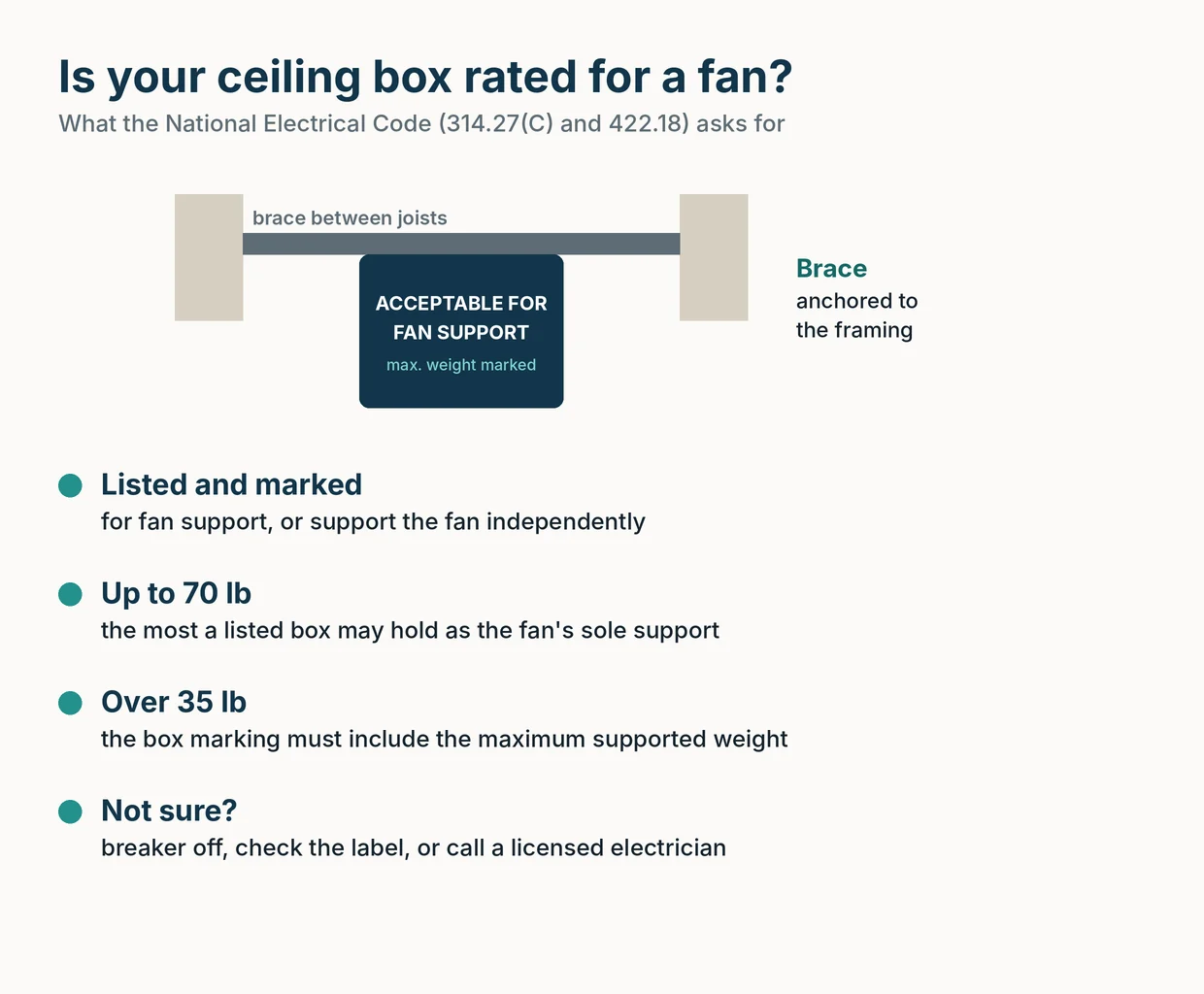
- A box listed for fan support, fastened to the framing. Under the National Electrical Code (2017 edition, as summarized by code expert Mike Holt), a box that is the only support for a fan must be listed and marked for fan support and can’t carry more than 70 lb. Boxes for fans over 35 lb must be marked with the maximum weight.
- Wiring for separate fan and light control, if you want it. Two-switch setups use a second switched hot wire (usually red) for the light, as Hunter’s wiring guide shows. It’s far easier to run the extra conductor now than later. The same code summary notes that when spare, separately switched wires run to a ceiling box in a spot suitable for a fan, that box must be listed for fan support.
- An on/off switch, not a dimmer. Hunter says a wall dimmer can’t operate a ceiling fan. Use a plain switch or the fan’s own compatible control.
- The right spot. ENERGY STAR says to mount the fan in the middle of the room, at least 18 in from the walls, with the blades at least 7 ft above the floor.
Whether the job needs a permit depends on your city or county. Ask your local building department, or ask the electrician to pull any permit that’s required.
Important: Running a new circuit or extending one means working in the panel and inside walls and ceilings. We’d leave this to a licensed electrician. If you do any part yourself, such as hanging the fan once the box is in, turn off the breaker first, confirm the power is off with a voltage tester and follow the fan’s manual and local code.
Once the box is in, our ceiling fan wiring guide explains what each wire color does, so you’ll know what the electrician left you.
Option 2: A plug-in mount (no hard-wiring)
If opening the ceiling isn’t practical, for example in a rental, a plug-in system avoids hard-wiring. The manufacturer-made option in our research is Hunter’s Plug-In Ceiling Fan Universal Mounting System:
- The bracket attaches to a ceiling joist or other solid structure.
- A cord of roughly 16 ft runs to a standard 120 V wall outlet.
- Hunter says it works with most Hunter and Casablanca fans, but not its Original or low-profile models.
- Hunter’s page doesn’t give a weight limit or price, so check the product listing for those before you buy.
Available on AmazonSearch the Hunter plug-in ceiling fan mountSee today's price, ratings and delivery options
Check priceYou’ll also see generic “plug-in” or “swag” fans sold with a cord to hang from a hook and drape to an outlet. We haven’t found manufacturer data on these that we could verify, so we’d judge each one on the basics: it should be listed by a recognized testing lab, it should mount to a joist (not a drywall anchor), and its cord should reach the outlet without an extension cord. If a listing can’t answer those questions, skip it.
Plug-in setups have no wall switch, so you’ll run the fan from its pull chains, remote or app.
Option 3: Battery and solar ceiling fans
Battery-powered and solar ceiling fans exist, but they’re niche. We couldn’t find any manufacturer or government data on how much air they move or how long they run on a charge, so we can’t recommend one with confidence.
If you’re considering one, ask for numbers. Ceiling fans covered by the FTC’s labeling rule must show airflow (CFM) and power use (watts) on an EnergyGuide label. A battery or solar fan that publishes no comparable figures gives you no way to compare it with a wired fan. For rooms where a ceiling fan just isn’t possible, our guide to ceiling fan alternatives covers other ways to move air.
Whatever the power source: the fan needs real support
A ceiling fan is heavy and it moves, so how it hangs matters as much as how it’s powered.
- Anchor to the framing. ENERGY STAR says to anchor the fan to a ceiling joist, or, if no joist is centered where you want the fan, to install a ceiling-fan mounting bracket with spiked ends that spans between the joists.
- Use a fan-rated box for wired fans. Hunter describes one as round or octagonal, fastened to a joist, wood block or adjustable brace, and marked “Approved for Ceiling Fans” or with a weight rating. Most ordinary light fixture boxes don’t qualify.
- Or support the fan independently. The code (per Mike Holt’s summary) allows a fan to be supported independently of the box, by a listed fan-support box system, or by a listed locking support and receptacle system.
- Check from the attic if you have one. An accessible attic above lets you (or your electrician) see where the joists run and fasten the brace or box to them.
A box or bracket that isn’t solid is a fall hazard, and it also causes ceiling fan wobble.
Important: Never hang a fan from a drywall anchor or a box that isn’t marked for fan support. If you’re not sure what’s above your ceiling, have a licensed electrician or contractor check before you buy anything.
Size and height before you buy
Plan the fan itself while you’re planning the power. Measure the room and use our ceiling fan size calculator to pick a blade span. On a ceiling over 9 ft, check the ceiling fan downrod length you’ll need to bring the blades to about 8 ft. And if your ceiling is under 8 ft, a low-profile ceiling fan is the usual choice, though Hunter’s plug-in mount doesn’t work with its low-profile models, so a hard-wired box may be the only way there.
Frequently asked questions
Can you install a ceiling fan without a junction box?
Not hard-wired. A wired fan needs a box marked for fan support or its own support from the framing. The main no-box option is a plug-in mounting system, where the bracket still attaches to a joist and a cord runs to a wall outlet.
Can a ceiling fan plug into a wall outlet?
Some can, with the right mount. Hunter sells a plug-in ceiling fan mounting system that attaches to a ceiling joist and uses a cord of about 16 ft that plugs into a standard 120 V outlet. It works with most Hunter and Casablanca fans, but not Original or low-profile models.
Do I need a permit to add a ceiling fan where there's no wiring?
It depends on where you live. Permit rules vary by city and county, so ask your local building department, or let your electrician handle it.
Are battery-powered or solar ceiling fans any good?
They exist, but we couldn't find any manufacturer or government data on how much air they move or how long they run. Treat performance claims with caution and look for a published airflow (CFM) figure before you buy.
How do I know if a spot on my ceiling can hold a fan?
The fan has to be anchored to a ceiling joist or to a fan-rated brace that spans between joists. A hole in drywall with nothing behind it can't hold a fan, whatever the power source.
Can I run power to a ceiling fan from a nearby outlet or switch?
Extending an existing circuit is one way an electrician can bring power to a new ceiling box, but it means working inside walls, ceilings and possibly the panel. Leave it to a licensed electrician and check whether your city needs a permit. A plug-in mount is the option that needs no new wiring.
Related guides
How-To
Fan Rated Box: How to Tell If Your Ceiling Box Can Hold a Fan
A ceiling fan needs a box listed and marked for fan support, or its own support from the framing. Here's what the code says and how to check your box.
8 min read
How-To
Ceiling Fan Wiring: What Each Wire Does, With One or Two Switches
What the black, white, blue, red and green wires do, how one-switch and two-switch setups differ, and when to stop and call an electrician.
8 min read
How-To
How to Install a Ceiling Fan Light Kit, Step by Step
Check that your fan can take a kit, cut the power at the breaker, open the switch housing, connect the light lead, mount the kit and fit bulbs within the limit.
7 min read
How-To
How to Turn Off a Ceiling Fan Without a Chain
Pull chain broken or missing? Use the wall switch, the remote or the breaker to stop the fan, then replace the switch or add a remote kit.
5 min read