Ceiling Fan Alternatives: What to Use When a Ceiling Fan Won't Work
Low ceiling, rental or no wiring? Tower, pedestal, wall, window and bladeless fans, portable AC and mini-splits compared, with real running costs.
By Cool Ceiling Ideas editorial teamUpdated 8 min read
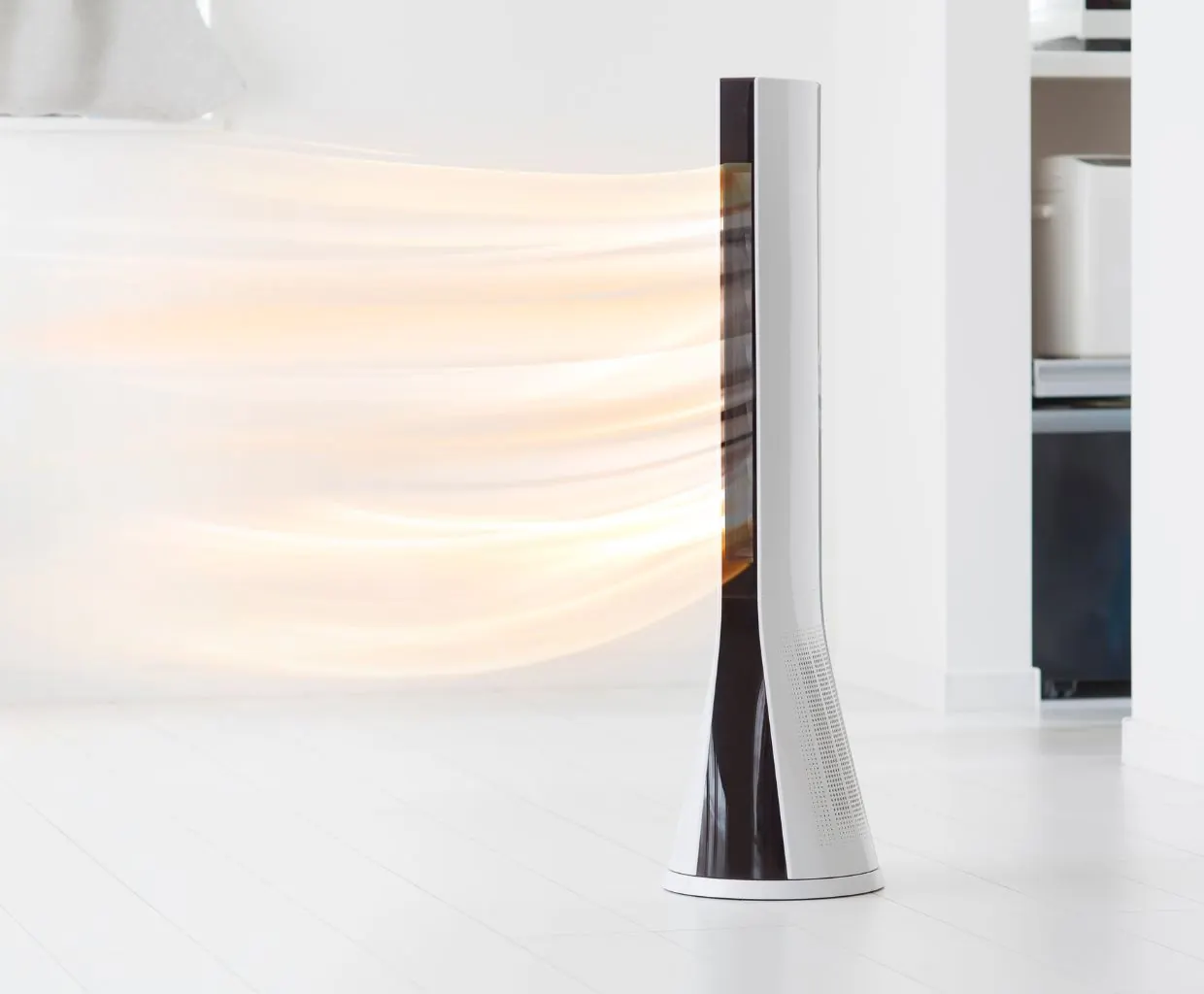
A ceiling fan is one of the cheapest ways to feel cooler, but it isn’t always possible or sensible. If your ceiling is too low for the blades to clear 7 ft, you rent, or there’s no wiring or fan-rated box overhead, a tower, pedestal, wall or window fan gives you the same cooling breeze with nothing to install. If you need the room itself to get colder, only an air conditioner does that: a window unit, a portable unit or a ductless mini-split.
When a ceiling fan isn’t the right choice
ENERGY STAR and every fan manual in our research (Hunter, Minka-Aire, Casablanca, Fanimation) require at least 7 ft between the floor and the bottom of the blades. That rule, plus wiring, rules out a ceiling fan in more rooms than you’d think:
- The ceiling is too low. The flattest hugger in our research, the Hunter Low Profile IV, puts its blades 7.53 in below the ceiling. Under about 7 ft 8 in, even that fan leaves the blades below the 7 ft line. ENERGY STAR also notes that huggers move less air, because the blades sit close to the ceiling. If your ceiling is a little taller, our low profile ceiling fans guide has the flattest options.
- You rent. Swapping a light fixture for a fan means wiring and, often, a new box. Most leases need the landlord’s OK for that. A plug-in fan leaves the walls alone.
- There’s no wiring or no fan-rated box. A Harbor Breeze manual warns that most boxes installed for light fixtures aren’t acceptable for fan support. Adding a box or a circuit is a job for a licensed electrician.
- You want the room colder, not just breezier. In ENERGY STAR’s words, “ceiling fans cool people, not rooms.”
- Bunk or loft beds. A child on a top bunk is far closer to the blades than the 7 ft rule assumes. See ceiling fans for bunk beds before you hang anything over one.
The honest downsides of ceiling fans
Ceiling fans are great value, but they have real drawbacks:
- Dust. The top edge of every blade collects it. Hunter suggests dusting every 1 to 3 months and a deeper clean every 3 to 6 months, and the Sleep Foundation notes that fans can spread dust and allergens around a bedroom.
- Wobble. A Hampton Bay manual says some wobble is normal and not a defect, and Harbor Breeze tells owners to check and tighten every screw at least twice a year. Fixes are in our ceiling fan wobble guide.
- Installation. The fan has to hang from the building structure or from a box marked for fan support (Hunter’s manuals call for one rated for 70 lb). Turn off power at the breaker, follow the manual and local code, and hire a licensed electrician if you’re unsure.
- Ladder work. Cleaning and maintenance happen overhead. The CPSC says people 65 and older are 80% more likely than other adults to end up in an emergency room after a ladder or stool injury.
- It can’t lower the temperature. A fan only makes you feel cooler while you’re in its breeze. In a heat wave, that may not be enough.
The alternatives, one by one
The fans plug in, with no ladder or electrician. The air conditioners are a bigger commitment.
Tower fans
A tall, narrow column that pushes air out of a vertical grille, usually with oscillation, a timer and a remote. They fit in corners and next to beds, and they move easily between rooms.
- Good for: bedrooms, home offices, renters, small floor plans.
- Watch out for: a narrower stream of air than a ceiling or pedestal fan, and a grille that is awkward to clean inside.
Pedestal fans
A bladed fan on an adjustable stand. You can raise, lower and tilt the head, and the larger blades throw air further than most tower fans.
- Good for: living rooms, rooms with low ceilings, cheap whole-seat coverage.
- Watch out for: floor space, a stand that can tip, and a grille that small fingers or paws can reach.
For a living room with a ceiling too low for any fan overhead, we’d pick a pedestal fan first.
Wall-mounted fans
An oscillating fan screwed to the wall and plugged into a nearby outlet. It keeps the floor clear and stays out of reach.
- Good for: garages, workshops, kitchens, kids’ rooms where you want the fan off the floor.
- Watch out for: screw holes (check your lease) and a cord running down the wall.
Window and box fans
These sit in or near a window to pull outside air in or push warm indoor air out. They help most on evenings when it’s cooler outside than inside.
- Good for: cheap cooling in mild climates, airing out a stuffy room.
- Watch out for: they do little when the outside air is hotter, they block the window, and they bring in outdoor noise.
Bladeless floor fans
These hide the impeller in the base and blow air out through a ring or slot. There are no exposed blades, and the smooth surfaces are easy to wipe. Expect to pay more than for a basic tower or pedestal fan.
Window and portable air conditioners
These are the only plug-in options that actually lower the air temperature and pull moisture out of the air. A window unit sits in the window frame. A portable unit stands on the floor and vents hot air through a hose to a window kit. They cost far more to run than any fan (see the table below).
See window air conditioners on Amazon
Ductless mini-splits
An indoor wall unit linked to an outdoor compressor by refrigerant lines. Many models heat as well as cool. They’re permanent and need a professional installer, so they’re a homeowner’s project, not a renter’s. In our view, a mini-split is the right answer when you’d otherwise be running window units all summer.
Running costs compared
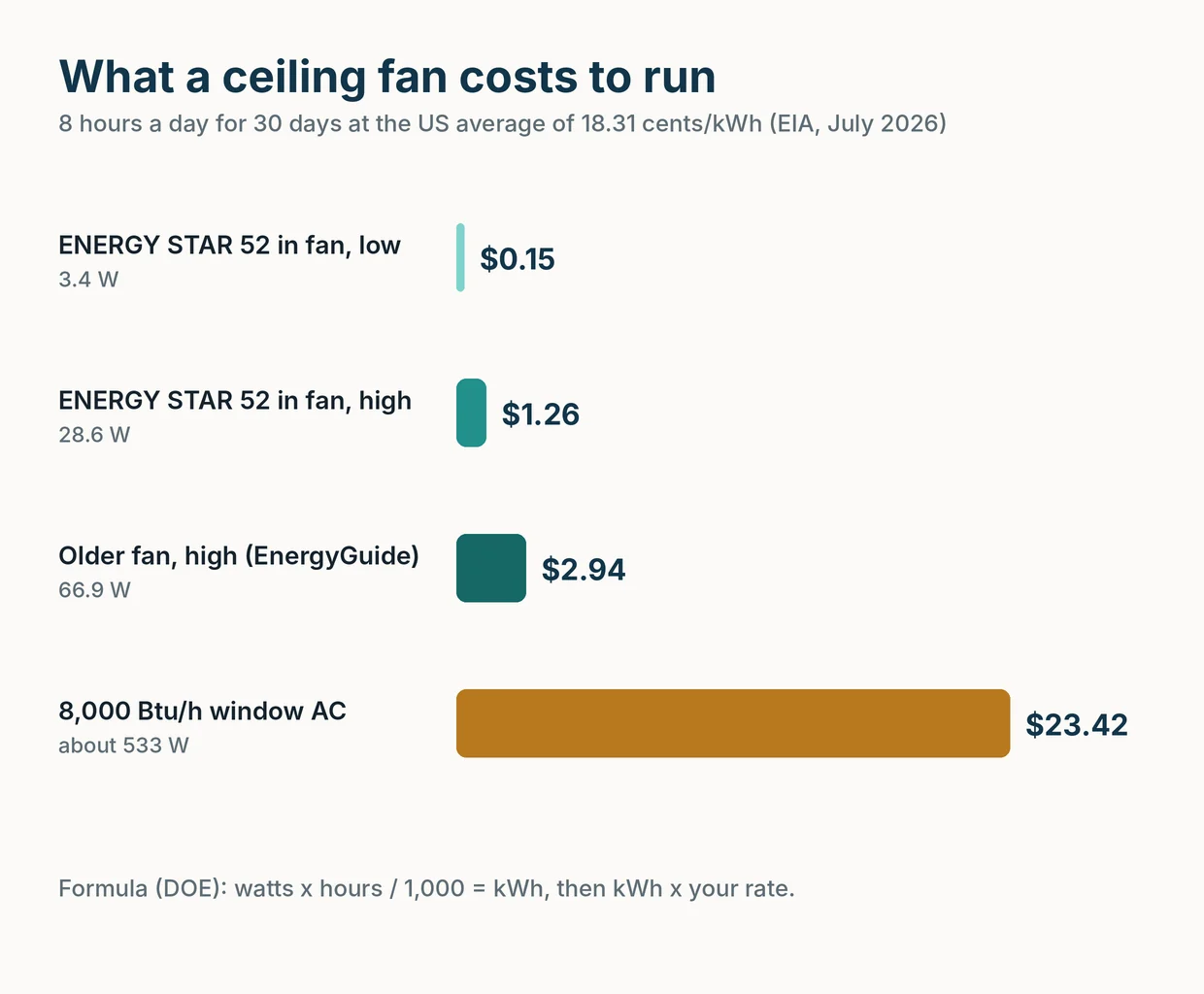
The math follows the Department of Energy formula (watts × hours ÷ 1,000 = kWh), at 8 hours a day for 30 days and the EIA’s latest US average residential price: 18.31 cents per kWh (July 2026).
| Appliance | Power while running | kWh per month | Cost per month |
|---|---|---|---|
| ENERGY STAR 52 in ceiling fan, low (median) | 3.4 W | 0.82 | about $0.15 |
| ENERGY STAR 52 in ceiling fan, high (median) | 28.6 W | 6.86 | about $1.26 |
| Small plug-in fan (Vornado Pivot3 Clip, high) | 34 W | 8.16 | about $1.49 |
| Older-style ceiling fan, high (one EnergyGuide label) | 66.9 W | 16.06 | about $2.94 |
| 8,000 Btu/h ENERGY STAR window AC | about 533 W | 127.92 | about $23.42 |
| 12,000 Btu/h ENERGY STAR window AC | about 800 W | 192.00 | about $35.16 |
The fan figures are medians from the ENERGY STAR ceiling fan dataset; the AC figures are derived from ENERGY STAR’s room air conditioner data. The AC rows assume the compressor runs the whole time; real units cycle on and off, so actual costs are lower. We didn’t have verified wattage figures for typical tower, pedestal or portable AC models, so check the label on yours and plug it into the same formula. Our guide to how much electricity a ceiling fan uses walks through that formula step by step.
Note: Every fan, ceiling or plug-in, cools you only while you’re in its breeze. Turn it off when you leave the room, as ENERGY STAR advises.
The takeaway: any fan costs pennies to a dollar or two a month, and an air conditioner costs many times more. The DOE says a ceiling fan lets you raise the thermostat about 4°F without losing comfort, and the same breeze from any fan does the same job. We’d pair whichever fan you choose with your AC rather than treat them as either/or.
Which alternative fits your situation
| Situation | Our pick | Why |
|---|---|---|
| Ceiling under about 7 ft 8 in | Pedestal or tower fan | No blade-height rule to meet |
| Renting | Tower, pedestal or window fan | Nothing to wire or drill |
| No ceiling wiring, but you own the home | Plug-in ceiling mount or a new circuit | Keeps the ceiling fan option open |
| Kids’ room with bunk beds | Wall-mounted fan out of reach | Keeps blades away from the top bunk |
| Hot, humid summers | Window AC or mini-split, plus a fan | Only AC lowers temperature and humidity |
If you own the home and simply lack wiring, don’t give up on the ceiling yet. Hunter sells a plug-in universal mounting system: the bracket fastens to a joist and a cord of roughly 16 ft plugs into a standard 120 V outlet. Hunter says it works with most Hunter and Casablanca fans, but not the Original or low-profile models. We’d still have an electrician check the joist and the outlet circuit.
Important: Any ceiling fan, plug-in or hard-wired, must hang from the building structure or a box marked for fan support, with the blades at least 7 ft above the floor. Turn off power at the breaker before any wiring work, follow the manual and local code, and hire a licensed electrician if you’re unsure.
If you do go the ceiling fan route, our ceiling fan size calculator works out the blade span for your room.
Frequently asked questions
What can I use instead of a ceiling fan?
For a breeze, a tower, pedestal, wall-mounted, window or bladeless floor fan does the same job with no wiring. If you need the room itself to get cooler, you need an air conditioner: a window unit, a portable unit or a ductless mini-split.
Is a tower fan better than a ceiling fan?
Not for a whole room. A ceiling fan spreads a gentle breeze over a wide area, while a tower fan aims a narrower stream at one or two people. A tower fan wins when you can't install a ceiling fan, need to move the fan between rooms, or rent.
What is the cheapest way to cool a room without a ceiling fan?
A plug-in fan costs about as little to run as a ceiling fan, but no fan lowers the air temperature. A window fan can pull in cooler evening air, and only an air conditioner actually cools the room. An 8,000 Btu/h window unit draws about 18 times the power of a typical ENERGY STAR ceiling fan on high.
How low is too low for a ceiling fan?
Manufacturers and ENERGY STAR require at least 7 ft between the floor and the blades. Even the flattest hugger in our research sits about 7.5 in below the ceiling, so ceilings under roughly 7 ft 8 in are a job for a floor, tower or wall fan.
Can I put up a ceiling fan if there's no wiring in the ceiling?
Yes, but it takes work. An electrician can run a new switched circuit and a fan-rated box, or you can use a plug-in mounting kit that attaches to a joist and plugs into a wall outlet. Either way, the fan must hang from the building structure or a box rated for fans.
Does a ceiling fan use less electricity than a floor fan?
Often a little less, but both are cheap to run. The median ENERGY STAR 52 in ceiling fan draws 28.6 W on high, and the small plug-in fan in our table draws 34 W on high. Either costs around a dollar or two a month at 8 hours a day.
Related guides
Ceiling Fans
How Much Electricity Does a Ceiling Fan Use? Watts and Running Cost
A typical ENERGY STAR ceiling fan uses about 3 W on low and 29 W on high, roughly half a cent an hour. Here's the math, a cost table and how to cut it.
8 min read

Ceiling Fans
Best Low Profile Ceiling Fans in 2026 for Low Ceilings
Hugger fans for ceilings under 8 ft: how low each one sits, how much air it moves, and which to pick for small, standard and large rooms.
11 min read
Ceiling Fans
Best Ceiling Fans With Light and Remote in 2026
Seven ceiling fans that ship with both a light and a handheld remote, plus what to do if you lose the remote or want to add one to a fan you own.
9 min read
Ceiling Fans
Best Outdoor Ceiling Fans in 2026: Damp vs Wet Rated Picks
Damp-rated fans belong under a solid roof; wet-rated fans can take rain. Six picks for porches, pergolas and the coast, plus the warranty fine print.
11 min read