Ceiling Fan Safety for Kids: A Parent's Checklist by Age
How kids actually get hurt by ceiling fans, the height and mounting rules that prevent it, and a quick safety checklist for babies, toddlers and older kids.
By Cool Ceiling Ideas editorial teamUpdated 7 min read

In this article
- Is a ceiling fan safe in a child’s bedroom?
- How kids actually get hurt by ceiling fans
- Height and clearance rules for a kid’s room
- Bunk beds, loft beds and climbable furniture
- Make sure the fan is mounted securely
- Pull chains, remotes and coin batteries
- Check for recalls and worn parts
- Safety by age: babies, toddlers and older kids
- Quick ceiling fan safety checklist
The short answer: a ceiling fan is safe for kids when the blades sit at least 7 ft above the floor and the fan hangs from a fan-rated box. Nothing a child can climb should sit under or near the blades. Two habits matter most: never lift a child toward a spinning fan, and keep bunk and loft beds away from it.
This checklist works for a fan that’s already up or one you’re about to buy.
Is a ceiling fan safe in a child’s bedroom?
Yes, for most families, as long as it’s installed by the manual and placed away from beds and furniture. Injuries do happen, but researchers describe them as uncommon and preventable, and most were cuts rather than serious harm.
If you’re still choosing a fan, our roundup of kid-friendly ceiling fans with remotes and low-profile mounts covers models that sit tight to the ceiling and skip pull chains.
How kids actually get hurt by ceiling fans
The best data comes from a 2023 Pediatrics study, “Traumatic Head Injuries Caused by Ceiling Fans,” from Dell Children’s Trauma and Injury Research Center. It used the CPSC’s National Electronic Injury Surveillance System, which collects emergency room data. As reported by Healio, they estimated 20,523 pediatric head injuries from ceiling fans from 2013 to 2021, about 2,300 a year.
The case narratives showed two clear patterns:
- Babies and toddlers were usually hurt when an adult lifted them into the air and their head struck the fan.
- Older children were usually hurt jumping off furniture, most often a bunk bed or a loft bed.
Lacerations were the most common injury. Skull fractures and concussions were rare. The study couldn’t say whether blade size, type or speed changes how bad an injury is. So we wouldn’t count on a slow speed or a blade shape to make a fan safe. Placement and habits are what the evidence points to.
Height and clearance rules for a kid’s room
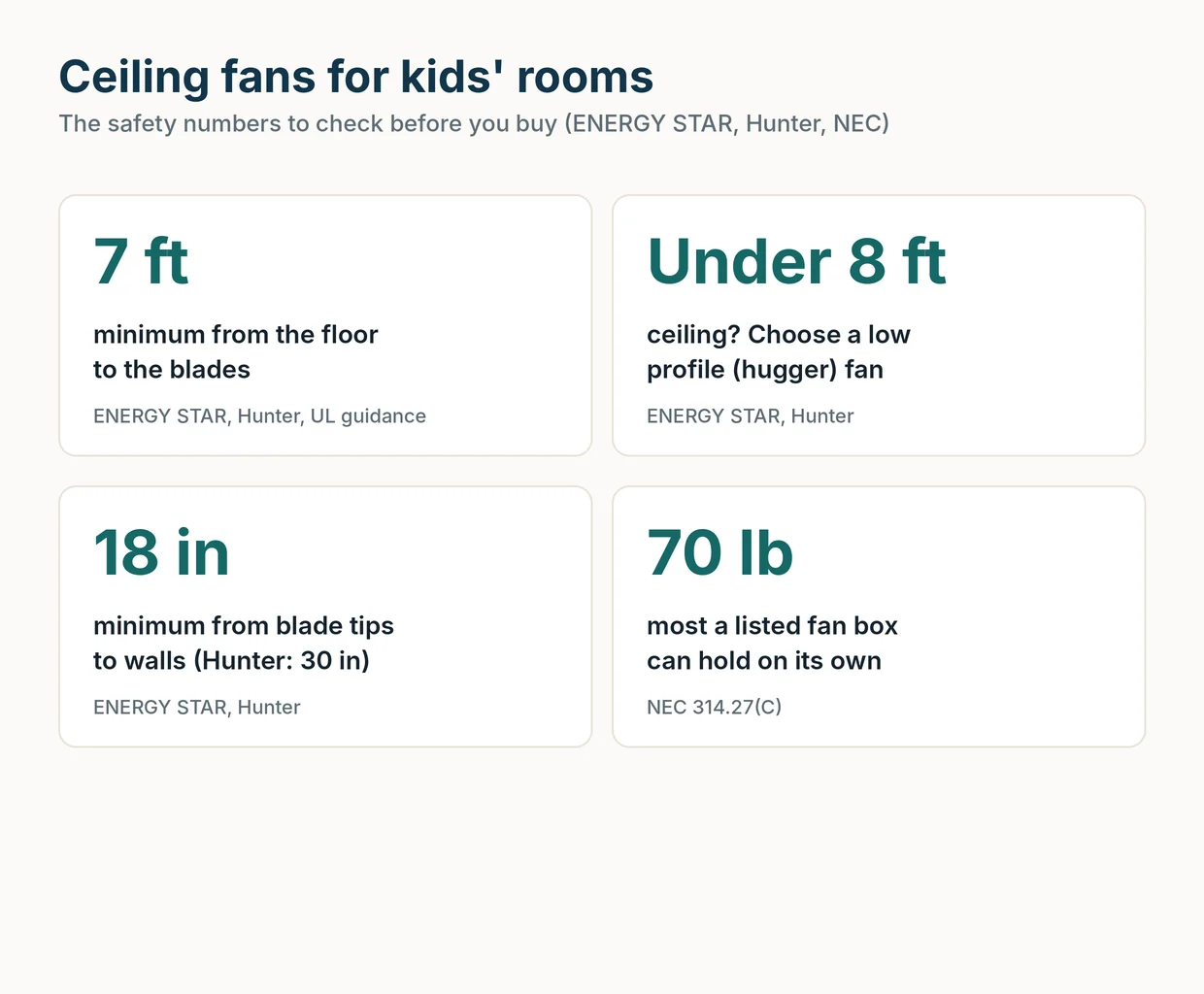
Every fan manual in our research sets the same minimum: at least 7 ft from the floor to the bottom of the blades. ENERGY STAR repeats it and adds that the fan should sit in the middle of the room, at least 18 in from walls. It says 8 to 9 ft gives the best airflow if the ceiling allows. Hunter asks for more room to the sides: 30 in from the blade tips to the nearest wall or obstruction.
In a kid’s room, we’d read “obstruction” broadly: a dresser or toy chest is a step stool to a curious child. To check your room:
- Measure from the floor to the lowest point of the blades, not to the ceiling.
- Measure from the blade tips to the nearest wall and to any furniture a child could stand on.
- If the blades sit below 7 ft, the fan needs to come down. On a ceiling under 8 ft, Hunter and ENERGY STAR both point you to a low-profile (hugger) fan.
Bunk beds, loft beds and climbable furniture
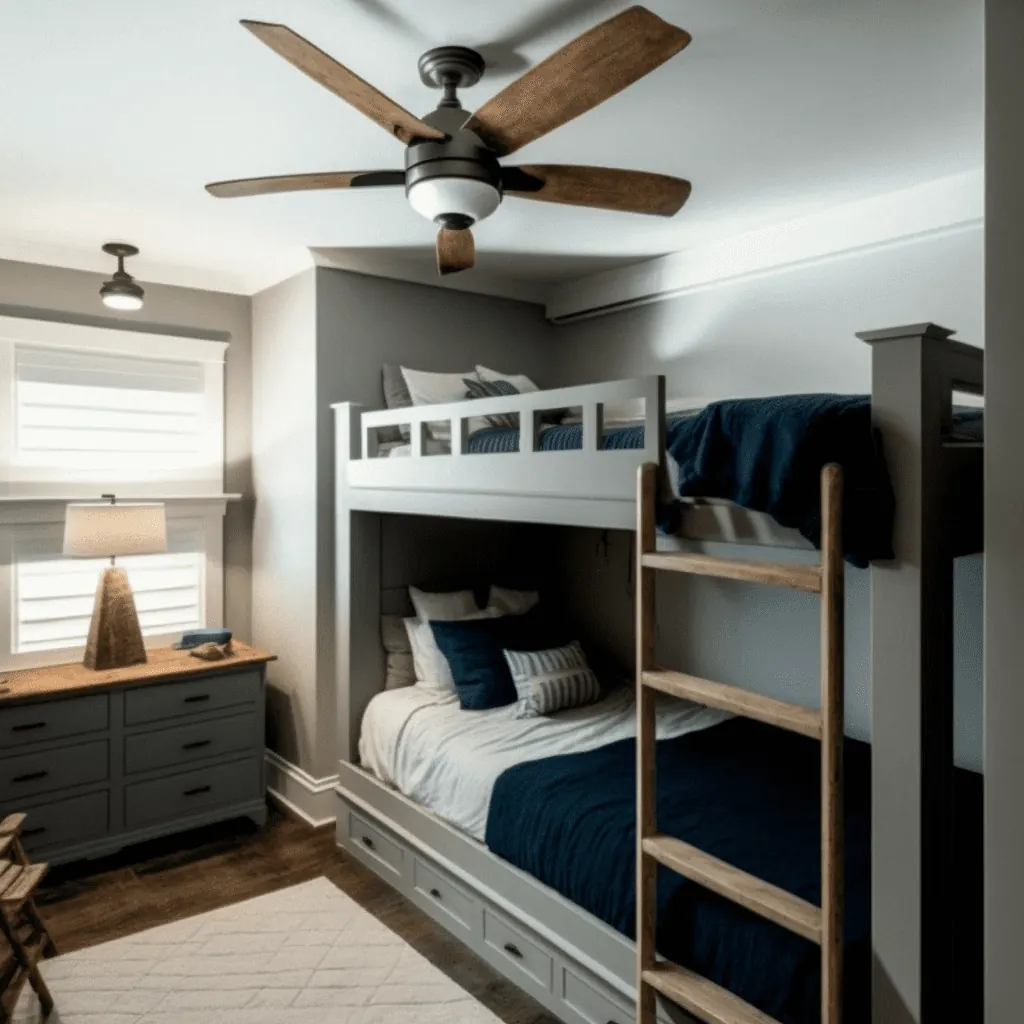
The 7 ft rule assumes a child standing on the floor. A top bunk or loft bed lifts them several feet closer to the blades. That’s why older kids in the Pediatrics study were so often hurt jumping from them. The researchers’ advice was direct: keep bunk and loft beds away from ceiling fans.
Our view: never place a raised bed under or beside the blade sweep, and set a house rule of no standing, jumping or reaching up on the top bunk. Our guide to measuring clearance between a top bunk and a ceiling fan walks through the math and covers clip-on fans for the top bunk.
Make sure the fan is mounted securely
Hunter’s manual calls for an outlet box marked as acceptable for fan support of 70 lb (31.8 kg), or mounting to the building structure. Electrician Mike Holt’s code Q&A explains the National Electrical Code (2017 edition) rule. A box that is the fan’s only support must be listed and marked for fan support, and it can’t carry a fan over 70 lb. Most boxes installed for light fixtures don’t qualify.
Signs the mount needs attention: the canopy or bracket moves against the ceiling, or a wobble that’s new or getting worse. If the wobble seems to come from the mount rather than the blades, turn the power off and inspect it before anyone uses the fan again. Our ceiling fan wobble guide explains how to tell the difference.
Important: Checking or replacing a ceiling box is electrical work. Turn off power at the breaker, follow the fan’s manual and local code, and hire a licensed electrician if you’re unsure. Our guide to how to tell if you have a fan-rated box shows what the markings look like.
Pull chains, remotes and coin batteries
A pull chain is the one part of a fan made to be grabbed, and a dangling chain invites tugging and swinging. We’d skip pull chains in a kid’s room and use a remote or wall control instead. You don’t need a new fan for that. Hunter says an add-on remote kit can run a pull-chain fan if the chains stay set to high and light on. Our ceiling fan remote kits guide covers which kits fit which fans.
Remotes bring their own risk. Many use lithium coin batteries, and Hunter’s remote manual warns that a swallowed coin battery can cause severe internal burns and death in as little as 2 hours. The AAP’s HealthyChildren.org lists remote controls among the common household items that use these batteries. Its prevention advice:
- Keep remotes in a secure drawer or cabinet, or another spot out of reach and out of sight, when not in use.
- Make sure the battery cover is secure, and consider taping it shut.
- Wrap old batteries in tape and put them in an outside trash can, even if they seem dead.
If you think a child swallowed a battery, the AAP says to go to the emergency room or call 911 and say it may be a lithium coin battery. Don’t make the child vomit. The National Battery Ingestion Hotline is 800-498-8666.
Check for recalls and worn parts
The CPSC announced 8 ceiling fan recalls between January 2020 and October 2026, and most involved blades or blade holders that could break or come off. If the fan came with the house, it’s worth a five-minute check. Find the model number on the motor label, the manual or your order history, then compare it with the CPSC’s ceiling fan recall listing. If your fan is recalled, stop using it and follow the remedy in the notice.
Kids’ rooms are also hard on fans. If a ball or toy hits the blades, turn the fan off and check each blade for cracks or bending before you run it again. Hunter says to replace warped blades, since they can’t be balanced.
Safety by age: babies, toddlers and older kids
Babies. The injury data says don’t lift a baby toward a spinning fan, even to show it to them. Keep the crib out of the blade sweep. The AAP says overheating can raise the risk of SIDS, but neither the AAP nor the NIH’s Safe to Sleep campaign mentions ceiling fans in its safe-sleep advice. Our nursery ceiling fans guide covers placement, and we look at the evidence on drafts, dust and SIDS in can ceiling fans make babies sick. If you have questions about your baby’s sleep environment or room temperature, talk to your pediatrician.
Toddlers. This is the climbing and swallowing age. Keep lifting games away from the fan, remotes out of reach, and furniture from giving a toddler a path toward the blades.
Older kids and teens. Bunk and loft beds are the main hazard. Hunter’s Avel fan manual says children 8 and older may use the appliance only with supervision or instruction, shouldn’t play with it, and need supervision to clean it. In our view, an adult should do the dusting, with the fan off, the blades stopped and a proper step ladder, never a bed or chair.
Quick ceiling fan safety checklist
Run through this for any fan in a child’s room:
- Blades at least 7 ft above the floor
- Blade tips at least 18 in from walls (Hunter says 30 in to walls or obstructions)
- No bunk bed, loft bed or climbable furniture under or near the blades
- Fan hung from a box marked for fan support, or from the building structure
- No moving canopy, new wobble or cracked or bent blades
- Model checked against the CPSC recall listing
- Remote or wall control instead of pull chains
- Remote stored out of reach, battery cover secure
- House rule: nobody lifts a child toward the fan
- House rule: no jumping or standing on the top bunk
Tip: Snap a photo of the fan’s model label and keep the manual when a new fan goes up. It makes the next recall check or blade replacement much faster.
Frequently asked questions
How do most kids get hurt by ceiling fans?
A 2023 Pediatrics study of US emergency room data found that babies and toddlers were usually hurt when an adult lifted them up into a spinning fan. Older kids were usually hurt jumping off furniture, most often a bunk or loft bed. Most injuries were cuts.
How high does a ceiling fan need to be in a kid's room?
At least 7 ft from the floor to the bottom of the blades, the minimum in Hunter, Minka-Aire and Casablanca manuals and on ENERGY STAR's fan basics page. ENERGY STAR says 8 to 9 ft is better if the ceiling allows.
Is a ceiling fan safe above a bunk bed?
We wouldn't hang one there. A child on a top bunk is far closer to the blades than the 7 ft rule assumes, and the Pediatrics study found older kids were often hurt jumping off bunk or loft beds. Hang the fan over open floor instead.
Are ceiling fan remotes dangerous for small children?
The remote itself isn't, but many use lithium coin batteries. Hunter warns a swallowed coin battery can cause severe internal burns and death in as little as 2 hours, so keep remotes out of reach and consider taping the battery cover shut.
Can a toddler stop a ceiling fan with a toy?
Kids do throw things at fans, and a hit can bend or crack a blade. If something strikes the blades, turn the fan off and check each blade before you run it again. Hunter says to replace warped blades, since they can't be balanced.
Related guides
Room Ideas
Ceiling Fans for Bunk Beds: Clearance, Placement and Safer Options
No ceiling fan is rated for use over a top bunk. How to measure, where to put the fan instead, and the caged, low-profile and clip-on fans worth a look.
10 min read
Room Ideas
Best Ceiling Fans for Kids' Rooms in 2026: Safe, Simple Picks
Low-profile, remote-controlled and enclosed-blade fans for kids' and teens' bedrooms, plus the height, clearance and mounting rules that keep them safe.
10 min read

Room Ideas
Best Nursery Ceiling Fans in 2026: Quiet, Safe Picks
Quiet DC and low-profile fans with dimmable lights and remotes for a baby's room, plus safe mounting, crib placement and what the AAP says about overheating.
10 min read

Room Ideas
Can Ceiling Fans Make Babies Sick? Myths, Evidence and Nursery Tips
No, a ceiling fan won't make your baby sick. What it can do (dry air, dust, drafts), what the AAP says about overheating, and how to run a nursery fan safely.
7 min read